
As electric vehicle (EV) charging infrastructure becomes more widespread in commercial and public environments, electrical safety has become a critical design and operational priority. Among all safety measures, proper grounding and surge protection are fundamental to ensuring system reliability, user safety, and long-term equipment durability.
This article explains why grounding and surge protection are essential for EV charging systems, how they work, and what best practices businesses should follow.
Why Grounding Is Critical for EV Chargers
Grounding (earthing) provides a low-resistance path for fault current to safely dissipate into the ground. In EV charging systems, improper grounding can result in:
- Electric shock risks for users
- Malfunction of charging equipment
- Damage to vehicles and power electronics
- Failure to comply with electrical safety regulations
Because EV chargers handle high currents and long charging durations, grounding quality directly impacts operational safety.
Common Grounding Methods in EV Charging Installations
Protective Earth (PE) Connection
Most commercial EV chargers rely on a dedicated protective earth conductor connected to the site grounding system. This ensures exposed metal parts do not become energized under fault conditions.
TN, TT, and IT Systems
Different regions adopt different grounding schemes:
| Grounding System | Common Regions | Key Characteristics |
| TN | Europe, parts of Asia | Neutral grounded at transformer, PE provided |
| TT | Europe, rural areas | Separate earth electrode for installation |
| IT | Industrial sites | Isolated or impedance-grounded neutral |
Selecting the correct grounding method depends on local electrical codes and site conditions.
What Is Surge Protection in EV Charging Systems?
Surge protection prevents damage caused by transient overvoltages, which may originate from:
- Lightning strikes
- Grid switching operations
- Nearby heavy industrial equipment
- Faults in upstream power infrastructure
Even short-duration voltage spikes can damage sensitive components inside EV chargers, including main control boards, communication modules, and power conversion units.
Key Components of Surge Protection for EV Chargers
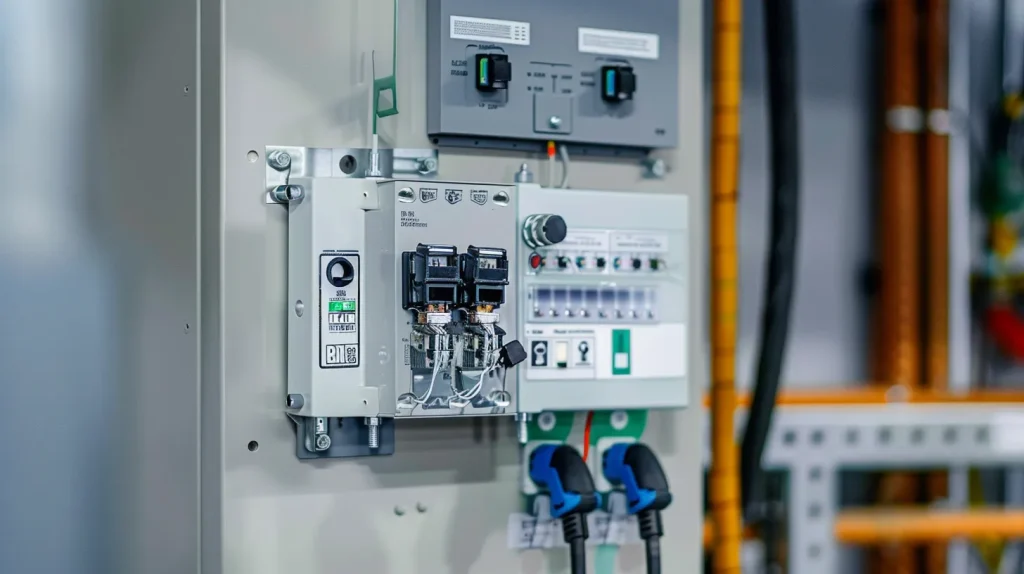
Surge Protection Devices (SPDs)
SPDs are designed to divert excessive voltage away from sensitive equipment.
| SPD Type | Application |
| Type 1 | Lightning protection at service entrance |
| Type 2 | Distribution boards and EV chargers |
| Type 3 | Sensitive electronics and communication lines |
Commercial EV chargers typically require Type 2 SPDs at minimum.
Protection for Communication Interfaces
Modern chargers rely on Ethernet, RS485, 4G/LTE, or CAN communication. These interfaces must also be protected against surges to prevent:
- Network failure
- Backend disconnection
- Data corruption
Dedicated signal-line SPDs are strongly recommended.
Relationship Between Grounding and Surge Protection
Grounding and surge protection must be designed together, not independently.
- Surge protectors rely on low-impedance grounding to discharge energy effectively
- Poor grounding reduces SPD effectiveness
- Inadequate earthing can cause surge energy to flow through unintended paths
A high-quality grounding system is the foundation of effective surge protection.
Standards and Compliance Requirements
Proper grounding and surge protection must comply with international and regional standards, including:
- IEC 60364 – Low-voltage electrical installations
- IEC 61851 – EV conductive charging systems
- IEC 62305 – Lightning protection
- UL 2231 / UL 2594 – North American EV charger safety
- IEEE 80 – Grounding in electrical substations
Compliance ensures both legal acceptance and insurance eligibility for commercial charging installations.
Common Grounding and Surge Protection Mistakes
Some frequent issues seen in commercial EV charging projects include:
- Shared grounding with insufficient conductor size
- Missing SPDs on communication lines
- Improper SPD coordination (Type mismatch)
- High grounding resistance exceeding local limits
- No regular inspection or testing
These issues often lead to intermittent faults, unexpected downtime, and premature equipment failure.
Best Practices for Commercial EV Charging Projects
To ensure long-term safety and reliability:
- Design grounding systems based on local soil resistivity
- Keep grounding resistance within regulatory thresholds
- Install coordinated SPDs at power and communication entry points
- Conduct regular grounding resistance and SPD condition tests
- Document grounding and surge protection during commissioning
These practices significantly reduce operational risk and maintenance costs.
Conclusion
Grounding and surge protection are not optional add-ons—they are core safety systems for any commercial EV charging installation. As charging networks expand into public, fleet, and high-traffic environments, robust electrical protection becomes essential for protecting people, vehicles, and infrastructure.For businesses deploying EV charging solutions at scale, investing in proper grounding design and surge protection ensures compliance, reliability, and long-term operational stability.