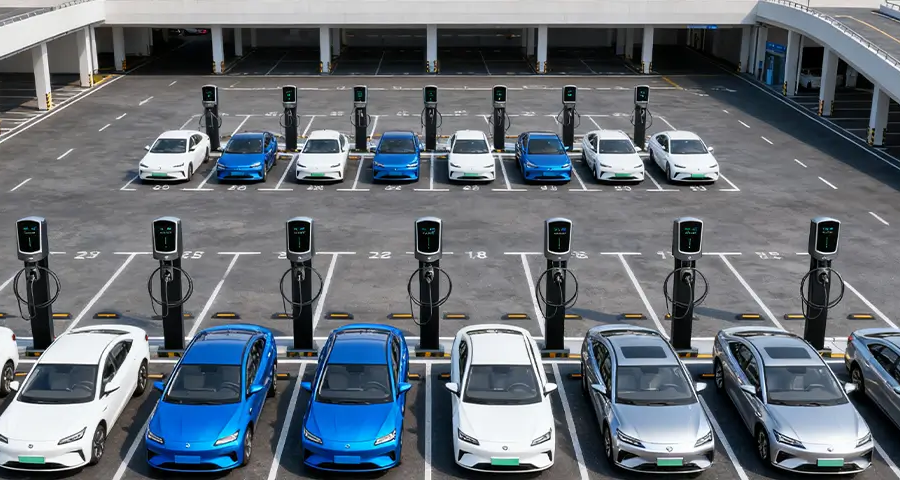

As EV charging becomes a permanent part of commercial and fleet operations, electricity cost management has emerged as a critical concern. For B2B users, uncontrolled charging during peak hours can significantly increase demand charges and strain on-site electrical infrastructure.
This is where peak shaving and off-peak EV charging play a central role in building efficient, grid-friendly charging systems.
What Is Peak Shaving in EV Charging?
Peak shaving refers to strategies that limit or reduce the maximum power demand drawn from the grid during high-load periods.
In EV charging environments, peak shaving typically involves:
- Limiting total charging power during peak grid hours
- Dynamically distributing available capacity among chargers
- Coordinating charging sessions to avoid simultaneous peak loads
For commercial sites, peak shaving is primarily about cost control and grid compliance, rather than charging speed.
Understanding Off-Peak Charging Windows
Off-peak charging takes advantage of periods when electricity demand and tariffs are lower—often late at night or during early morning hours.
Typical off-peak windows include:
- Overnight hours for fleet depots
- Early morning periods for residential and mixed-use properties
- Utility-defined low-tariff time blocks
By shifting charging to these periods, operators can:
- Reduce energy costs
- Improve grid stability
- Maximize existing electrical capacity
Why Peak Shaving Matters for B2B Charging Sites
Unlike residential users, commercial sites are often billed based on maximum demand, not just total energy consumption.
Key benefits of peak shaving:
| Benefit | Impact |
| Lower demand charges | Significant OPEX reduction |
| Grid compliance | Avoids transformer overload |
| Infrastructure efficiency | Delays costly electrical upgrades |
| Operational stability | Predictable power usage |
In regions with demand-based pricing, even a single uncontrolled peak can affect the entire monthly bill.
Technologies That Enable Peak Shaving and Off-Peak Charging
Modern EV charging systems rely on a combination of hardware intelligence and software control.
Common enabling technologies include:
- Dynamic Load Management (DLM)
- Smart scheduling and time-based charging rules
- OCPP-based backend platforms
- Integration with building energy management systems (BEMS)
These tools allow operators to prioritize charging sessions based on time, vehicle needs, or operational importance.
Peak Shaving vs. Charging Speed: Finding the Right Balance
A common misconception is that peak shaving always slows charging.
In reality, effective systems focus on:
- Optimized power allocation, not power elimination
- Charging vehicles over longer dwell times
- Matching charging power to actual operational requirements
For fleet vehicles parked overnight, slower off-peak charging often has no operational downside.
Typical Use Cases by Scenario
Fleet Depots
- Centralized scheduling
- Overnight off-peak charging
- Predictable load profiles
Commercial Parking
- Power caps during business hours
- Higher allocation during low-traffic periods
Mixed-Use Properties
- Coordination between tenant load and EV charging
- Adaptive limits based on building consumption
Each scenario requires different peak shaving rules, even when using the same hardware.
Implementation Best Practices
To implement peak shaving effectively, B2B operators should:
- Analyze historical load profiles
- Define acceptable peak thresholds
- Align charging schedules with operational needs
- Ensure chargers support remote configuration and updates
- Continuously monitor and adjust based on real usage data
Peak shaving is not a one-time setup—it is an ongoing optimization process.
Future Outlook: From Cost Control to Grid Participation
As energy markets evolve, peak shaving strategies are increasingly linked to:
- Demand response programs
- Renewable energy integration
- Vehicle-to-grid (V2G) readiness
Charging systems deployed today should be capable of adapting to these future requirements through software, not hardware replacement.
Conclusion: Smarter Charging, Lower Costs
For commercial and fleet operators, peak shaving and off-peak EV charging are no longer optional features—they are essential tools for sustainable and cost-effective operations.
AC-focused, intelligent charging solutions that support load management, scheduling, and remote control enable businesses to scale EV charging without overloading their electrical infrastructure.Solution-oriented providers such as QIAO, with a focus on smart AC charging for global B2B deployments, help operators implement these strategies efficiently while remaining future-ready.