Table of Contents
Enterprise Office Building EV Charger Deployment Guide
As electric vehicle adoption accelerates globally, enterprise office buildings are increasingly expected to provide workplace charging. For companies, EV charging is no longer just an amenity—it is part of ESG strategy, employee benefits, and long-term asset planning.
This guide explains how to deploy EV chargers in office buildings from technical planning to operational management.
Understand the Role of Workplace Charging
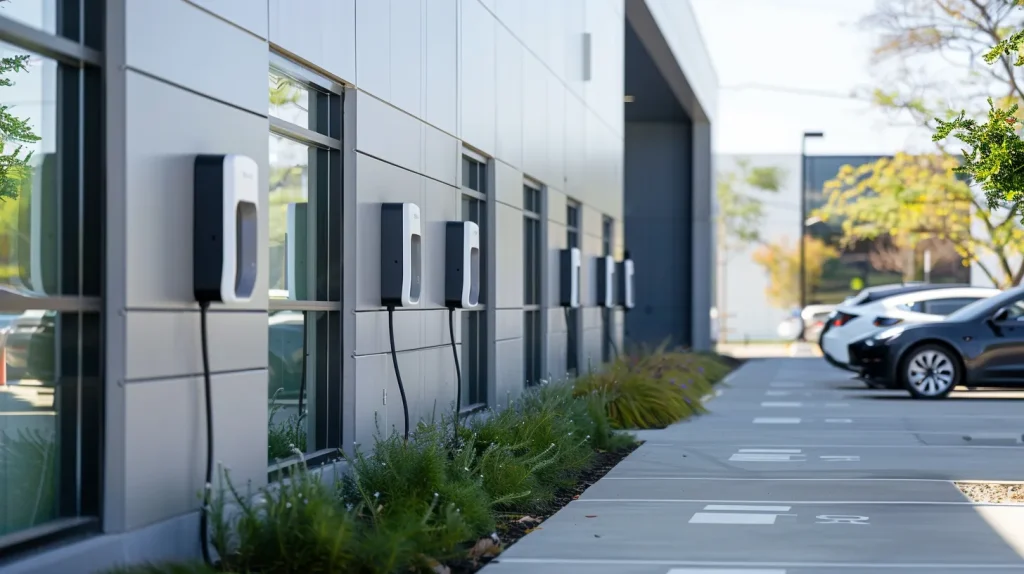
Workplace charging typically falls into Level 2 AC charging, which uses alternating current supplied by the building’s electrical system.
Alternating Current – Wikipedia
https://en.wikipedia.org/wiki/Alternating_current
Unlike DC fast charging, AC charging converts power inside the vehicle via the onboard charger, making it more cost-effective and suitable for 4–9 hour parking durations typical in office environments.
Step One: Electrical Capacity Assessment
Before installation, conduct a detailed electrical study:
- Main distribution board capacity
- Spare load margin (kW / kVA)
- Existing peak demand
- Future expansion potential
Most medium-to-large office buildings operate on a three-phase power system, which allows more stable and higher-capacity charging deployment.
Three-phase electric power – Wikipedia
https://en.wikipedia.org/wiki/Three-phase_electric_power
Load planning must consider HVAC systems, elevators, lighting, and EV charging simultaneously.
Step Two: Choose the Right Charger Configuration
AC Power Rating
Typical enterprise configurations:
- 7kW (single-phase) – small installations
- 11kW / 22kW (three-phase) – recommended for scalable deployments
Connector Standards
Connector type depends on region:
- Type 2 (IEC 62196-2) – Europe & many global markets
IEC 62196 – Wikipedia
https://en.wikipedia.org/wiki/IEC_62196 - SAE J1772 – North America
SAE J1772 – Wikipedia
https://en.wikipedia.org/wiki/SAE_J1772
Selecting regionally compliant hardware ensures compatibility and regulatory approval.
Step Three: Implement Smart Load Management
Installing multiple chargers without coordination can overload building infrastructure. The solution is Dynamic Load Management (DLM), which distributes available electrical capacity in real time.
Smart grid – Wikipedia
https://en.wikipedia.org/wiki/Smart_grid
Benefits include:
- Preventing breaker trips
- Avoiding costly grid upgrades
- Reducing peak demand charges
- Enabling future expansion
For enterprise environments, smart charging is not optional—it is infrastructure control.
Step Four: Safety and Compliance
Enterprise installations must comply with electrical protection standards.
Key components include:
- Residual Current Device (RCD) protection
Residual-current device – Wikipedia
https://en.wikipedia.org/wiki/Residual-current_device - Proper grounding (earthing)
Earthing system – Wikipedia
https://en.wikipedia.org/wiki/Earthing_system - Surge protection devices
- Certified components compliant with IEC or local codes
International Electrotechnical Commission (IEC)
https://en.wikipedia.org/wiki/International_Electrotechnical_Commission
Compliance protects both infrastructure and corporate liability.
Step Five: Network & Backend Management
Enterprise EV charging systems should support OCPP (Open Charge Point Protocol) to enable centralized control.
Open Charge Point Protocol – Wikipedia
https://en.wikipedia.org/wiki/Open_Charge_Point_Protocol
OCPP enables:
- User authentication (RFID / app)
- Usage tracking
- Remote diagnostics
- Firmware updates
- Multi-building management
For corporations with multiple office locations, backend connectivity is critical for scalability.
Deployment Best Practices for Office Buildings
✔ Install chargers near designated employee parking
✔ Separate EV circuits from critical building systems
✔ Plan cable routing for safety and aesthetics
✔ Prepare conduit pathways for future expansion
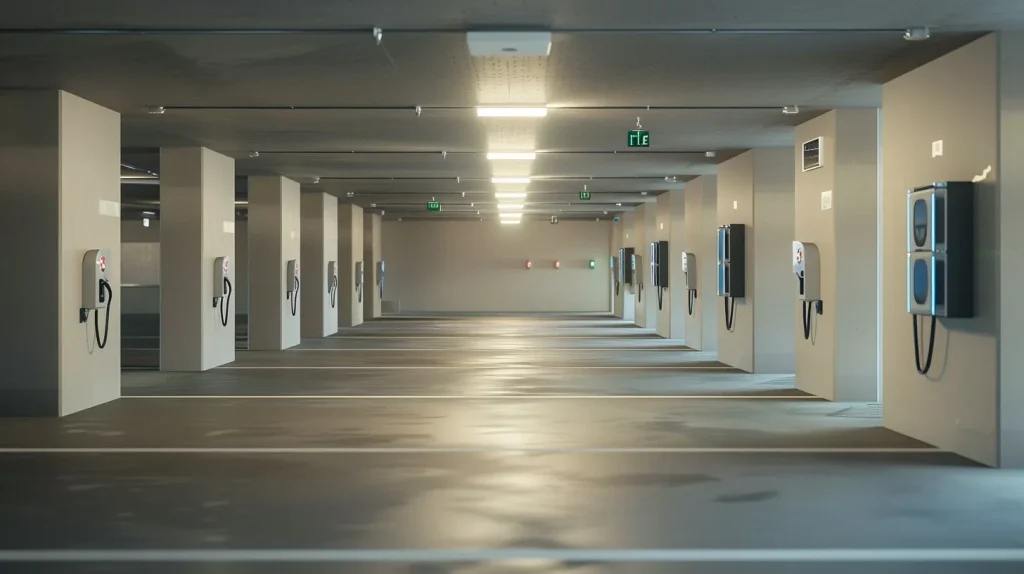
✔ Use wall-mounted commercial-grade hardware
Scalability should be part of the initial design—not an afterthought.
Conclusion
Deploying EV chargers in enterprise office buildings requires structured planning across:
- Electrical capacity
- Safety compliance
- Load management
- Network integration
- Future scalability
When properly implemented, workplace EV charging supports corporate sustainability goals, enhances employee satisfaction, and increases property value.
About QIAO
QIAO specializes in commercial and enterprise-grade AC EV charging solutions, designed specifically for:
- Office buildings
- Hotels
- Shopping malls
- Structured parking facilities
Our wall-mounted AC chargers integrate load management, OCPP compatibility, and scalable deployment architecture—making them suitable for multi-site enterprise environments.
If your organization is planning EV infrastructure deployment, QIAO provides technical consultation and commercial-grade solutions tailored to business environments.
FAQ
1. Is AC charging sufficient for office buildings?
Yes. Because employees typically park for 6–9 hours, Level 2 AC charging provides sufficient daily range without requiring DC infrastructure.
2. How many chargers should an office building install?
It depends on employee EV adoption rate, available electrical capacity, and parking layout. Many enterprises start with 5–10% of total parking spaces and scale gradually.
3. Can EV chargers overload office electrical systems?
Without load management, yes. Implementing dynamic load management prevents overload and protects building infrastructure.
4. Do enterprise chargers require backend connectivity?
Yes. OCPP-enabled chargers allow centralized monitoring, billing control, and remote diagnostics—essential for enterprise-level operations.