Table of Contents
EV Charging in Public Parking Facilities
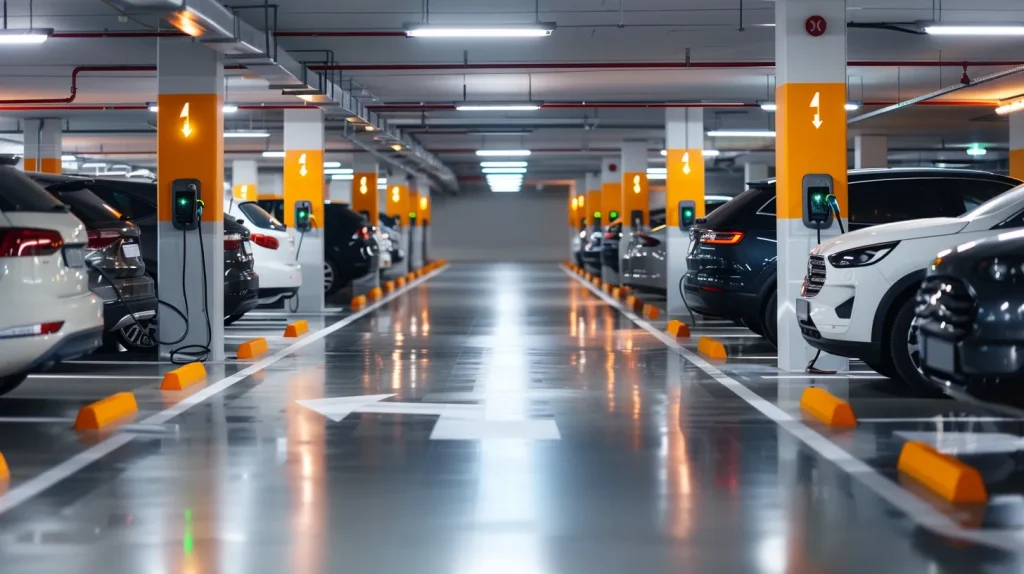
Public parking facilities are rapidly becoming one of the most important locations for EV charging deployment. Unlike residential or fleet-only environments, public parking combines high user diversity, variable dwell time, and strict operational constraints, making charging design more complex—but also more valuable.
This article explains how EV charging can be effectively planned and operated in public parking environments.
Why Public Parking Is a Strategic Charging Location
Public parking lots—such as shopping centers, office buildings, airports, and municipal garages—offer unique advantages:
- Vehicles remain parked for predictable periods
- Existing electrical infrastructure is often available
- High visibility encourages EV adoption
- Charging increases dwell time and site attractiveness
For operators, EV charging is not only an energy service but also a value-added amenity.
Typical Charging Use Cases in Public Parking
Public parking facilities serve multiple user profiles, often simultaneously.
Short-Stay Parking
Examples include retail centers and street-level parking.
Best suited for:
- AC chargers with moderate power
- Simple user access and payment
Medium-Stay Parking
Office buildings and commercial complexes fall into this category.
Key priorities include:
- Load management
- User authentication
- Predictable daily usage patterns
Long-Stay Parking
Airports and municipal garages support overnight or extended parking.
Here, efficiency and grid protection become more important than charging speed.
Charger Type Selection for Public Parking
Most public parking deployments favor AC chargers due to cost and grid constraints.
Key considerations include:
- Single-phase vs. three-phase availability
- Power level matching average parking duration
- Cable management and vandal resistance
DC fast chargers are typically limited to high-turnover or transit-oriented locations rather than standard parking lots.
Power Capacity and Load Management
Public parking facilities often face limited electrical capacity.
Effective strategies include:
- Dynamic load management (DLM)
- Time-based charging schedules
- Power sharing across multiple chargers
Smart load balancing ensures:
- Maximum charger utilization
- No overload of the building’s main supply
- Lower infrastructure upgrade costs
User Access, Payment, and Control
Public charging requires flexible access models.
Common options:
- RFID cards
- Mobile apps
- QR-code activation
- Parking system integration
Clear pricing transparency and simple activation reduce user frustration and improve adoption rates.
Safety, Compliance, and Reliability
Public environments demand higher safety standards due to user diversity and exposure.
Critical factors include:
- Grounding and surge protection
- Residual current protection (RCD)
- Weather resistance and vandal-proof design
- Compliance with local electrical and fire codes
Reliability is particularly important, as charger downtime directly impacts public perception.
Operational Considerations for Parking Operators
Beyond installation, long-term operation defines success.
Operators should plan for:
- Remote monitoring and fault alerts
- Software updates and diagnostics
- Clear maintenance procedures
- Usage analytics for future expansion
Well-managed public charging infrastructure improves both operational efficiency and customer satisfaction.
Business Impact of EV Charging in Public Parking
EV charging can deliver measurable commercial benefits:
- Increased parking utilization
- Longer visitor dwell time
- Enhanced property value
- Alignment with sustainability goals
In many regions, charging infrastructure also qualifies for government incentives or green building certifications.
Conclusion
Public parking facilities are a natural and scalable foundation for EV charging networks. Success depends on aligning charging power, user behavior, grid capacity, and operational management.By adopting smart charging strategies and selecting reliable, compliant equipment, parking operators can transform EV charging into a long-term asset rather than a technical burden.