Table of Contents
From Hardware to Platform: 3 Major Shifts in the EV Charging Ecosystem
The EV charging industry is undergoing a fundamental transformation.
What started as a hardware-driven market (selling chargers) is rapidly evolving into a platform-driven ecosystem (managing energy, users, and data).
In 2026 and beyond, the real competition is no longer about devices—it is about platform capability.

The Old Model: Hardware-Centric Charging
In the early stage, EV charging was simple:
- sell chargers
- install equipment
- provide basic charging
Revenue model:
0one-time hardware sales
Limitations:
- low margins
- no recurring revenue
- limited differentiation
�� Hardware quickly became commoditized
The New Model: Platform-Centric Charging
Today, EV charging is becoming a digital infrastructure layer.
A modern charging system includes:
- hardware (AC/DC chargers)
- software platform
- cloud connectivity
- energy management
- user management
The value is shifting from device → system → platform
The 3 Major Changes Driving Platformization
1. From “Selling Chargers” to “Operating Networks”
Traditional Model
- hardware sold to customers
- limited post-sale interaction
Platform Model
Charging providers now:
- operate networks of chargers
- manage users and sessions
- control pricing and access
Charging becomes a service (CaaS: Charging as a Service)
Key Capabilities
- remote monitoring
- OTA updates
- real-time diagnostics
- centralized control
Business Impact
| Model | Revenue Type |
| Hardware | one-time |
| Platform | recurring |
Platforms unlock:
- subscription fees
- usage-based revenue
- service contracts
2. From “Electricity Delivery” to “Energy Management”
Charging is no longer just about delivering power.
It is about optimizing energy usage.
Traditional Approach
- fixed charging power
- no energy optimization
Platform Approach
Platforms integrate:
- load management
- smart charging
- peak shaving
- renewable energy
Example
A site with 10 chargers:
- without platform → grid overload risk
- with platform → dynamic power distribution
Energy Optimization Functions
- dynamic load balancing
- time-of-use pricing
- solar integration
- battery storage coordination
Charging becomes part of a smart energy system
3. From “Single Device” to “Multi-Stakeholder Ecosystem”
In the past:
charging involved only device + user
Today:
it involves multiple stakeholders:
| Stakeholder | Role |
| Operator | manages network |
| Property owner | provides space |
| Energy provider | supplies electricity |
| User | consumes service |
| Platform | connects all |
Platform as the Core Layer
The platform acts as:
- data hub
- control center
- integration layer
Key Integrations
- payment systems
- mobile apps
- fleet management
- energy providers
Result
Charging becomes a connected ecosystem, not a standalone product.
Platform Architecture: What It Looks Like
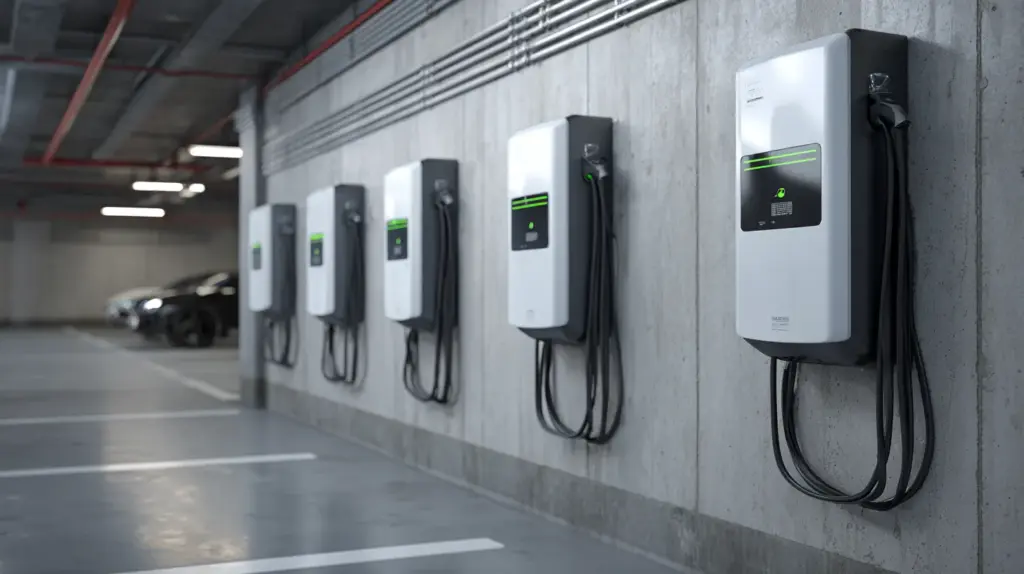
A modern EV charging platform typically includes:
1. Device Layer
- AC/DC chargers
- sensors and meters
2. Communication Layer
- protocols (e.g., OCPP)
- connectivity (4G / Wi-Fi / Ethernet)
3. Cloud Platform
- device management
- user management
- billing system
4. Application Layer
- mobile apps
- dashboards
- APIs
This layered architecture enables scalability and flexibility
Why Platformization Is Inevitable
1. Scale Requires Centralized Control
As networks grow:
- manual management becomes impossible
Platforms enable automation
2. Revenue Requires Data
Charging businesses need:
- usage data
- pricing control
- customer insights
Data = monetization
3. Energy Complexity Is Increasing
With:
- renewables
- grid constraints
- dynamic pricing
Platforms are required to manage complexity
Key Technologies Enabling Platformization
Cloud Computing
Cloud computing overview:
https://en.wikipedia.org/wiki/Cloud_computing
Enables:
- remote control
- scalability
Internet of Things (IoT)
Internet of Things overview:
https://en.wikipedia.org/wiki/Internet_of_things
Enables:
- device connectivity
- real-time data
Artificial Intelligence (AI)
Artificial intelligence overview:
https://en.wikipedia.org/wiki/Artificial_intelligence
Enables:
- predictive optimization
- dynamic pricing
Business Model Evolution
| Stage | Model |
| Phase 1 | hardware sales |
| Phase 2 | hardware + software |
| Phase 3 | platform ecosystem |
Challenges of Platform Transformation
- higher development cost
- need for software capability
- system integration complexity
- cybersecurity risks
Not all hardware companies can successfully transition.
Strategic Implications for Businesses
For Charger Manufacturers
Must evolve into:
- hardware + software providers
For Operators
Must adopt:
- platform-based management
For Investors
Focus shifts to:
- scalable platforms
- recurring revenue models
Future Outlook
By 2030:
- most charging networks will be platform-driven
- hardware margins will shrink
- software and services will dominate
The winners will be those who control the platform layer
About QIAO
QIAO provides smart AC EV charging solutions with integrated platform capabilities.
Our solutions include:
- cloud-based management platform
- smart charging and load management
- user and billing systems
- scalable deployment architecture
QIAO helps customers transition from device-based charging to platform-driven ecosystems.
FAQ
What is a charging platform?
A system that manages chargers, users, and energy.
Is hardware still important?
Yes, but it is no longer the main differentiator.
Can small operators use platforms?
Yes, platforms enable scaling even for small deployments.
What is the biggest benefit of platformization?
Recurring revenue and operational efficiency.