Table of Contents
EVSE Safety and Compliance Standards Explained
As the global deployment of electric vehicle charging infrastructure accelerates, EVSE sa have becomAC EV char used in
Unlike conventional electrical equipment, EVSE operates under c,sys.
This article provides a structured, technical explanation of the most critical EVSE safety mechanisms—IP protection, IK impact resistance, thermal protection, and electrical safeguards—with a focus on B2B-grade AC electric vehicle chargers.
Why EVSE Safety Standards Matter More Than Ever
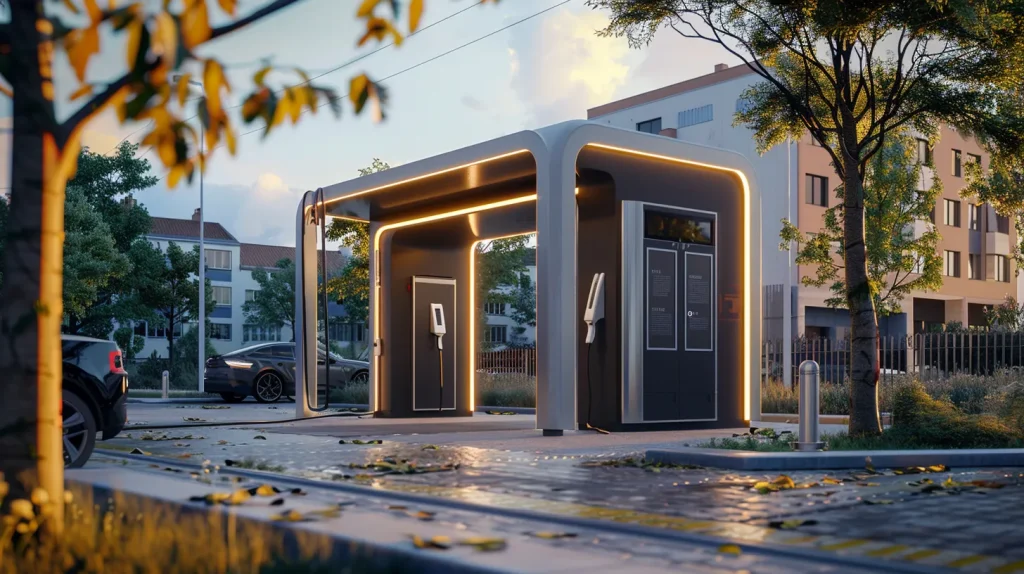
EVSE differs fundamentally from standard electrical devices due to several inherent characteristics:
- Sustained high-current operation (typically 7 kW–22 kW for AC charging)
- Long charging sessions with limited supervision
- Outdoor or semi-outdoor installation environments
- Direct interaction between users, vehicles, and the power grid
Any weakness in safety design can escalate into equipment failure, vehicle damage, or personal injury.
For this reason, EV charging stations are subject to stricter environmental, mechanical, thermal, and electrical safety requirements.
IP Rating for EV Chargers: Environmental Protection Explained
What Is an IP Rating?
The IP (Ingress Protection) rating defines how well an EV charger enclosure protects against:
- Solid particles such as dust (first digit: 0–6)
- Liquids such as rain or water spray (second digit: 0–9)
For outdoor EVSE, IP rating directly impacts installation flexibility and long-term reliability.
Why IP65 Is the Standard for Commercial AC EV Chargers
An IP65-rated EV charger provides:
- IP6X: Complete dust protection
- IPX5: Resistance to low-pressure water jets from all directions
This makes IP65 AC EV chargers suitable for:
- Outdoor parking lots
- Residential exterior walls
- Commercial and workplace charging
- Regions with high humidity or dust levels
From an engineering perspective, achieving IP65 requires:
- Precision enclosure design and sealing tolerances
- Long-term gasket aging and deformation testing
- Waterproof cable entry and charging connector interfaces
- Maintaining ingress protection after servicing or maintenance
A nominal IP rating without field-oriented design validation often fails under real deployment conditions.
IK Rating: Mechanical Impact Resistance in Public Spaces
Understanding IK Impact Protection
The IK rating measures an enclosure’s resistance to mechanical impact—an essential requirement for EV chargers installed in publicly accessible locations.
IK10: The Highest Practical Protection Level for EVSE
IK10-rated EV chargers can withstand:
- 20 joules of impact energy
- Equivalent to a 5 kg object dropped from 40 cm
For AC EV charging stations, IK10 protection mitigates risks from:
- Vehicle contact and parking incidents
- Vandalism or misuse
- Accidental impact during maintenance
- Environmental debris during extreme weather
True IK10 compliance requires more than a thick enclosure. It depends on:
- Structural reinforcement at mounting points
- Shock-resistant internal component fixation
- Functional safety verification after impact testing
Over-Temperature Protection in AC EV Chargers
Sources of Thermal Risk in EVSE
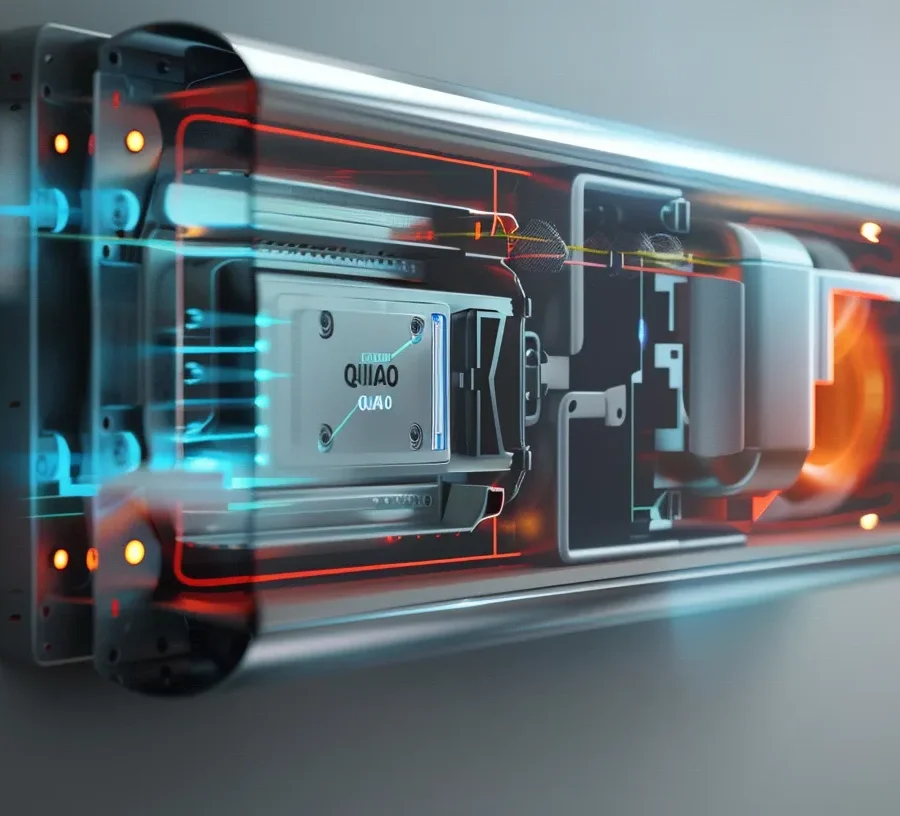
Thermal stress is one of the most common failure mechanisms in AC EV chargers. Heat accumulation typically occurs around:
- Power relays and contactors
- Internal wiring terminals
- Charging cables and connectors
- Control boards and power electronics
- Enclosed spaces with limited airflow
Without proper thermal management, prolonged charging sessions can degrade components or trigger unsafe operating conditions.
Multi-Level Thermal Protection Architecture
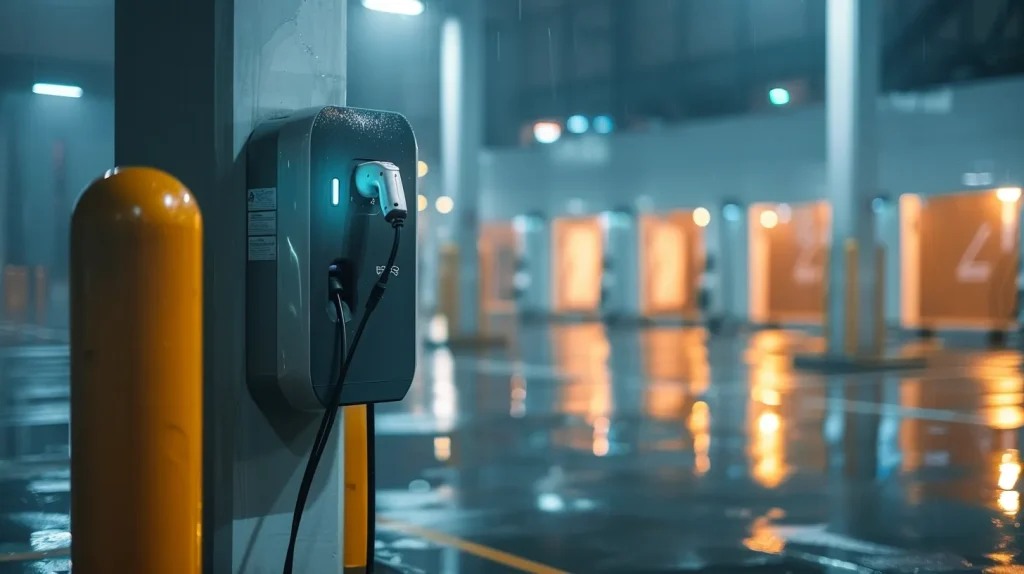
Commercial-grade EVSE implements layered over-temperature protection, including:
- Multiple temperature sensors at critical components
- Continuous thermal monitoring by the main controller
- Dynamic current derating under elevated temperatures
- Automatic shutdown under critical thermal thresholds
Advanced AC EV chargers further integrate:
- Ambient temperature compensation algorithms
- Optimized passive heat dissipation design
- Firmware-based coordination between power and control modules
This ensures both user safety and long-term charger durability, especially in high-usage B2B scenarios.
Electrical Safety Protections Required for EVSE Compliance
Beyond environmental and thermal protection, a complete EVSE safety framework includes:
- Residual current detection (Type A + RDC-DD)
- Over-voltage and under-voltage protection
- Short-circuit and over-current protection
- Grounding and insulation monitoring
- EMC / EMI compliance for grid stability
- Fail-safe logic against misconnection or abnormal charging states
These systems operate as a cohesive safety architecture, combining hardware protection with software intelligence.
Certification Compliance vs. Real-World Reliability
It is important to distinguish between certification compliance and engineering robustness.
While certification confirms conformity under defined test conditions, real-world EV charger reliability depends on:
- Environmental adaptation to target deployment regions
- Thermal aging and material fatigue performance
- Software stability under edge-case scenarios
- Experience with large-scale commercial deployments
For B2B buyers, these factors often determine total cost of ownership and operational uptime.
Conclusion: Safety as the Foundation of AC EV Charging Infrastructure
Features such as IP65 protection, IK10 impact resistance, and advanced over-temperature control are not optional add-ons—they are core indicators of a mature, commercial-grade EVSE design.
As AC EV charging continues to scale globally, safety and compliance will remain the foundation upon which reliability, scalability, and intelligent operation are built.
About QIAO EV Charger
QIAO EV Charger specializes in B2B AC electric vehicle charging solutions, delivering commercial-grade EVSE engineered with a strong focus on safety architecture, regulatory compliance, and long-term operational stability.
By integrating enclosure protection, electrical safety, and intelligent control systems, QIAO supports partners deploying reliable AC EV charging infrastructure across diverse markets and use cases.