Table of Contents
How to Perform Daily Maintenance for EV Charging Stations
As EV charging infrastructure becomes a core asset for commercial properties, fleets, retail locations, and public facilities, daily maintenance of charging stations is no longer optional. Proper maintenance ensures uptime, safety, user satisfaction, and long-term ROI.
This guide explains what daily EV charger maintenance involves, who should be responsible, and how businesses can standardize the process.
Why Daily Maintenance Matters for EV Charging Stations
Daily maintenance is not about complex repairs—it focuses on early detection and operational stability.
Well-maintained charging stations help operators:
- Reduce unexpected downtime
- Prevent safety hazards
- Extend equipment lifespan
- Maintain regulatory compliance
- Protect brand reputation
For commercial operators, even short outages can result in lost revenue and negative user reviews.
Core Areas of Daily EV Charger Maintenance
Daily checks should cover four key dimensions: physical condition, electrical safety, connectivity, and user experience.
Visual and Physical Inspection
Start with a quick but systematic visual check.
What to inspect daily:
- Charger enclosure integrity (cracks, corrosion, deformation)
- Wall-mounted stability or pedestal alignment
- Cable insulation condition
- Connector cleanliness and locking mechanism
- Screen visibility and readability
Tip: Wall-mounted chargers in outdoor or semi-outdoor environments should receive extra attention due to weather exposure.
Cable and Connector Health Check
Cables and connectors are the most frequently handled components and the most common failure points.
Daily best practices:
- Ensure cables are not twisted, overstretched, or pinched
- Check connectors for debris, moisture, or bent pins
- Confirm connector locks engage and release properly
- Wipe connectors with dry, non-abrasive cloths
Ignoring early cable damage often leads to full charger shutdowns.
Power and Charging Status Verification
A daily operational check ensures chargers are not silently failing.
Recommended actions:
- Verify standby and charging indicator lights
- Perform a short test charge if possible
- Confirm charging starts and stops correctly
- Monitor abnormal noise or heat during operation
For multi-port stations, test at least one port per unit daily.
Network & Software Monitoring (Critical for Smart Chargers)
Modern commercial chargers rely heavily on software and connectivity.
Daily Software Checks Include:
- Online/offline status via management platform
- Error codes or fault alerts
- Successful data uploads (charging records, energy usage)
- Clock and tariff accuracy
If your chargers support remote monitoring and OTA updates, many of these checks can be automated.
Environmental & Site Condition Checks
Charging station performance is strongly affected by its surroundings.
Inspect daily:
- Water pooling near charger base
- Dust, sand, or snow accumulation
- Ventilation clearance (especially for enclosed parking)
- Nearby construction or vehicle impact risks
Preventive cleaning can significantly reduce thermal and insulation issues.
Daily Maintenance Checklist (Quick Reference)
| Area | Check Item | Frequency |
| Physical | Enclosure & mounting | Daily |
| Cable | Insulation & connectors | Daily |
| Operation | Charging start/stop | Daily |
| Safety | Overheating, abnormal noise | Daily |
| Network | Online status & errors | Daily |
| Environment | Water, debris, ventilation | Daily |
Who Should Perform Daily Maintenance?
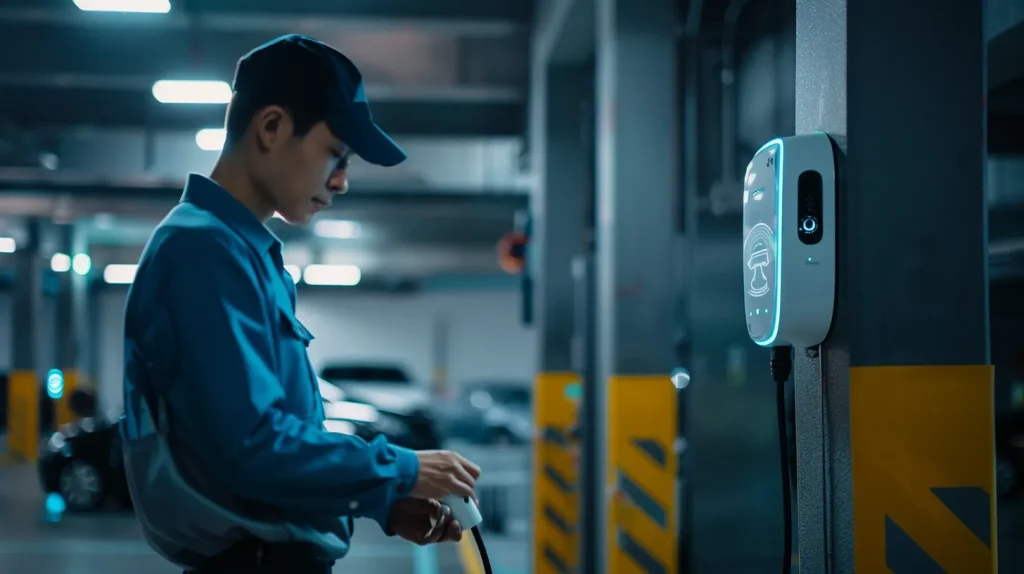
Daily maintenance does not require certified electricians.
Typical responsible roles include:
- Property management staff
- Fleet operations teams
- Facility maintenance personnel
- On-site technicians for public charging hubs
However, any electrical faults or internal repairs should always be escalated to qualified professionals.
Common Daily Maintenance Mistakes to Avoid
- Skipping checks because chargers “look fine”
- Ignoring intermittent fault alerts
- Delaying cable replacement
- Using improper cleaning agents
- Relying only on annual inspections
Daily routines are about consistency, not complexity.
How Smart Chargers Simplify Daily Maintenance
Commercial-grade smart chargers significantly reduce manual workload by enabling:
- Real-time fault alerts
- Remote diagnostics
- Usage and health analytics
- Predictive maintenance insights
This is especially valuable for multi-site deployments or unmanned locations.
Final Thoughts
Daily maintenance is the foundation of safe, reliable, and profitable EV charging operations. A standardized routine protects equipment, users, and business continuity—while minimizing long-term costs.
For businesses deploying scalable charging networks, choosing commercial EV chargers designed for durability, remote monitoring, and easy maintenance is just as important as the maintenance process itself.
Brands like QIAO focus on commercial-grade EV charging solutions that support stable operation, remote management, and long-term reliability, making daily maintenance simpler and more efficient for B-end operators.