Table of Contents
How NEVI Policy Is Driving AC Public Charging Demand in North America
The National Electric Vehicle Infrastructure Program is reshaping the EV charging landscape in North America.
While NEVI is primarily known for DC fast charging along highways, its real impact is broader:
It is indirectly accelerating demand for AC public charging in urban, commercial, and destination scenarios.
What Is NEVI?
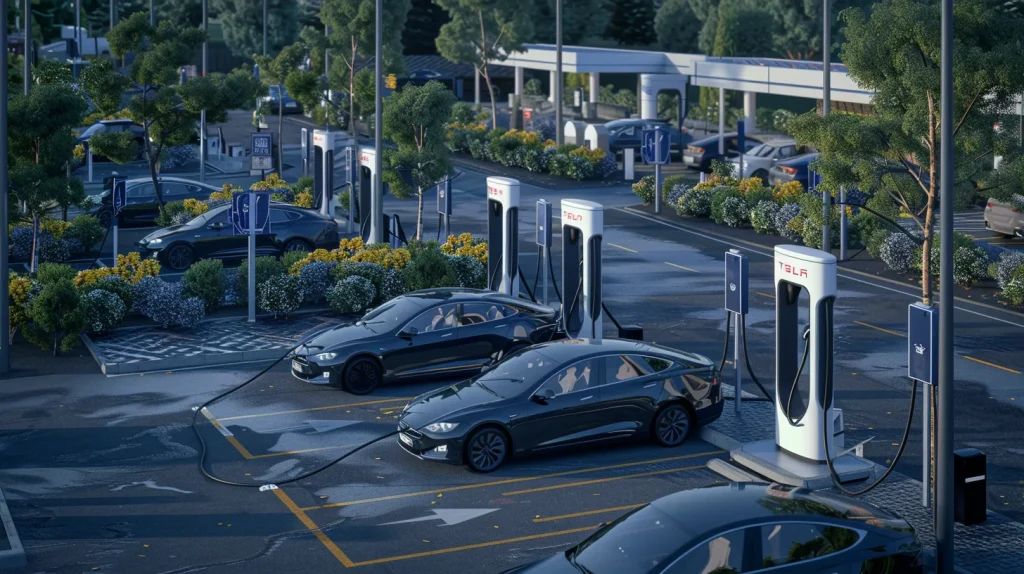
NEVI is a $5 billion federal program created under the Infrastructure Investment and Jobs Act (IIJA) to build a nationwide EV charging network.
Key facts:
- $5 billion funding (2022–2026)
- Focus on highway corridors (DC fast charging)
- Goal: 500,000 public chargers by 2030
2025–2026: Policy Updates That Change the Game
Recent updates have significantly increased NEVI’s impact:
1. Faster Deployment & Funding Resumption
- Funding resumed and accelerated in 2026
- ~$885M allocated for FY2026
This is triggering large-scale infrastructure expansion
2. More Flexible Location Rules
- Removal of strict 50-mile spacing requirement
- States now have flexibility in planning locations
This opens the door for:
- urban charging
- commercial areas
- public parking facilities
3. Expansion Beyond Highways
Once highway corridors are complete:
NEVI funds can be used for public charging in cities and communities
Why NEVI Is Boosting AC Public Charging Demand
1. DC Charging Creates Ecosystem Spillover
NEVI focuses on DC fast charging, but it creates:
- increased EV adoption
- higher charging frequency
- more localized demand
Result:
AC charging becomes necessary for daily and destination charging
2. Urban & Destination Charging Gap
Highway charging solves long-distance travel, but:
| Scenario | Needs |
| Shopping malls | 1–3 hour charging |
| Hotels | overnight charging |
| Offices | workday charging |
These scenarios are dominated by AC charging (Level 2)
Policy-Driven EV Growth = Charging Demand Surge
As NEVI reduces range anxiety:
- EV ownership increases
- daily charging demand rises
This drives demand for:
- workplace charging
- public AC chargers
- residential shared charging
Grid Constraints Favor AC Deployment
DC fast charging:
- high power (150kW+)
- expensive infrastructure
AC charging:
- lower power (7–22kW)
- easier deployment
- scalable
In many urban areas, AC is the only practical solution
AC Charging’s Role in the NEVI Ecosystem
| Charging Type | Role |
| DC Fast Charging | Long-distance travel |
| AC Public Charging | Daily & destination charging |
| Residential Charging | Overnight charging |
NEVI builds the “backbone”
AC charging fills the “last mile”
New Market Opportunities (2026–2028)
Commercial Real Estate
- malls
- retail centers
- office buildings
Increasing demand for destination AC charging
2. Hospitality Industry
Hotels are becoming:
EV charging hubs
- longer dwell time
- lower power requirement
3. Public Parking Operators
City parking:
- ideal for shared AC charging
- lower installation cost
4. Fleet & Workplace Charging
Corporate electrification is accelerating:
- employee charging
- fleet depots
Challenges in NEVI Implementation (Latest Insights)
1. Slow Initial Deployment
As of 2025:
Indicates huge growth potential ahead
Supply Chain & Localization Pressure
New proposals require:
- up to 100% domestic manufacturing
This may:
- delay DC deployment
- shift short-term demand toward AC solutions
3. Standardization Improvements
NEVI introduces:
- nationwide standards
- interoperability requirements
This improves:
- user experience
- system compatibility
Strategic Insight: Why AC Charging Will Surge
NEVI indirectly creates a three-layer charging structure:
- Highway DC network (NEVI-funded)
- Urban AC public charging (market-driven)
- Private/residential charging
The fastest growth segment?
AC public charging in commercial and semi-public spaces
What This Means for Businesses
If you are:
- real estate developer
- parking operator
- hotel chain
- EV infrastructure provider
You should focus on:
- AC charger deployment
- smart load management
- scalable infrastructure
About QIAO
QIAO provides smart AC EV charging solutions designed for the evolving North American market.
Our solutions support:
- commercial and public charging deployment
- load balancing and energy optimization
- OCPP-compatible systems
- scalable expansion aligned with NEVI-driven demand
QIAO helps businesses capture the next wave of AC charging growth.
FAQ
Does NEVI fund AC chargers directly?
Primarily no, it focuses on DC fast charging.
Why does NEVI increase AC charging demand?
Because it accelerates EV adoption and daily charging needs.
Where is AC charging most needed?
Urban areas, parking lots, hotels, and workplaces.
Is AC charging more cost-effective than DC?
Yes, especially for long-duration parking scenarios.