
A 7kW charger is enough for most drivers who charge at home overnight. Choose an 11kW charger when your EV accepts 11kW AC charging and your home has a suitable three-phase supply. A 22kW charger only gives you its full speed when the car, household supply, installation, and cable all support 22kW.
The lowest limit in that chain sets the real charging speed. This guide uses common UK and European configurations: 230V single-phase and 400V three-phase power. Rules differ by country. We will compare vehicle limits, charging times, supply requirements, and installation costs.
7kW vs. 11kW vs. 22kW Home Charging: Quick Comparison
The main differences between 7kW, 11kW, and 22kW home charging are speed, electrical phase, current, vehicle support, and installation needs.
| Comparison | 7kW Charger | 11kW Charger | 22kW Charger |
| Typical Supply | 230V single-phase | 400V three-phase | 400V three-phase |
| Common Current | 32A on one phase | 16A per phase | 32A per phase |
| AC Energy Supplied in 1 Hour | Up to about 7kWh before losses | Up to about 11kWh before losses | Up to about 22kWh before losses |
| Time to Add 60kWh to the Battery | About 9.5 hours | About 6.1 hours | About 3.0 hours |
| Vehicle Requirement | EV accepts about 7kW AC | EV accepts 11kW AC | EV accepts 22kW AC |
| Home Use | Common choice | Fits homes with suitable three-phase power | Fits a limited group of homes and EVs |
| Best Fit | Routine overnight charging | Shorter charging windows | Fast home turnaround for a compatible EV |
These estimates assume 90% charging efficiency and full use of the stated AC power. Current settings, load management, temperature, and vehicle controls can extend a session.
What Limits Your Home Charging Speed?
To find the real charging rate, check the vehicle first, then the wallbox, cable, household supply, and any active power controls.
Your EV’s Onboard Charger Sets the AC Limit
Your EV’s onboard charger sets the maximum AC power that the battery can receive. The wallbox supplies alternating current (AC), while the onboard charger converts it into direct current for the battery.
For example, a car with a 7kW onboard charger will take no more than about 7kW from an 11kW or 22kW wallbox.
Manuals may shorten onboard charger to OBC. Look for “maximum AC charging rate”, “AC input”, or “onboard charger”.
Do Not Confuse AC and DC Charging Rates
The DC rapid-charging number in an EV advertisement is not its home AC limit. A car advertised with 150kW DC charging may accept only 7kW or 11kW from a home wallbox.
DC stations send direct current to the battery. Home AC charging uses the onboard charger and has a separate limit.
Can an 11kW EV Charge From a 22kW Charger?
Yes, an 11kW EV can normally use a compatible 22kW AC charger, but it will take no more than 11kW. The wallbox does not force the car to accept its full rating.
This table shows the simplified result when the supply and cable support the selected wallbox:
| Vehicle’s Maximum AC Rate | 7kW Wallbox | 11kW Wallbox | 22kW Wallbox |
| 7kW | Up to about 7kW | Up to about 7kW | Up to about 7kW |
| 11kw | Up to about 7kW | Up to about 11kW | Up to about 11kW |
| 22kw | Up to about 7kW | Up to about 11kW | Up to about 22kW |
The connector, cable, phase support, and current settings must also match.
Where Can You Find Your EV’s AC Charging Limit?
Find your EV’s maximum AC charging rate in the following places:
- Owner’s Manual: Search the charging section for AC input power, voltage, and supported phases.
- Manufacturer Specification Page: Check the exact model year, battery version, and market configuration.
- Vehicle Charging Menu: Some EVs display an AC current or power setting in the car.
- Dealer Documentation: Ask for the AC charging specification, not the DC rapid-charging figure.
Does Your Home Have Single-Phase or Three-Phase Power?
A 7kW charger normally uses single-phase power, while 11kW and 22kW models need three-phase power to deliver their common UK and European ratings.
The electrical calculations explain the difference:
- 7kW Single-Phase Charging: A 230V supply at 32A provides about 7.36kW, often sold as 7kW or 7.4kW.
- 11kW Three-Phase Charging: A 400V three-phase supply at 16A per phase provides about 11kW.
- 22kW Three-Phase Charging: A 400V three-phase supply at 32A per phase provides about 22kW.
Three-phase service does not guarantee spare capacity. The main fuse, consumer unit, circuit, cable, and protective devices must also support the installation.
How Can You Tell Which Electrical Supply Your Home Has?
Confirm your electrical phase and available capacity with a qualified electrician or electricity network operator. You can review your meter and consumer unit labels, but do not remove covers or touch incoming supply equipment.
Your electricity account or property records may identify the supply. An installer should still assess the main fuse, demand, cable route, earthing, and protection. Do not judge the supply from a socket label.
What Should UK Homeowners Check?
UK homeowners should confirm the supply phase, main fuse rating, and spare household capacity before ordering an 11kW or 22kW charger. The UK Office for Zero Emission Vehicles uses 230V single-phase and 400V three-phase values in itsResidential Chargepoints: Minimum Technical Specification.
An installer should contact the local distribution network operator when notification or an upgrade is required. On its “What Do You Need to Upgrade?” page, UK Power Networks lists EV charger installation as one reason a property may need more power.
Can Dynamic Load Balancing Avoid an Electrical Upgrade?
Dynamic load balancing may keep EV charging within the home’s available capacity, but it cannot add new phases or raise the property’s service limit.
A compatible system measures household demand while the EV charges. It lowers charging current when an oven, electric shower, heat pump, or air conditioner raises the total load. It can increase the current again after those loads fall.
This control may reduce some electrical work. It cannot fix undersized wiring, missing protection, or an inadequate service.
How Long Do 7kW, 11kW, and 22kW Chargers Take?
Charging time depends on how much energy you need to add and the actual AC power accepted throughout the session.
Use this formula for a quick estimate:
Estimated charging time = Energy added to the battery ÷ (Actual AC charging power × Estimated charging efficiency)
For example, at an estimated charging efficiency of 90%, a 7kW charger delivers about 6.3kW of effective power to the battery. Adding 60kWh would take approximately 60 ÷ (7 × 0.9) = 9.5 hours. Charging efficiency varies by vehicle, power level, temperature, and charging conditions.
| Energy Added to the Battery | 7kW | 11kW | 22kW |
| 20kWh | About 3.2 hours | About 2.0 hours | About 1.0 hour |
| 40kWh | About 6.3 hours | About 4.0 hours | About 2.0 hours |
| 60kWh | About 9.5 hours | About 6.1 hours | About 3.0 hours |
| 80kWh | About 12.7 hours | About 8.1 hours | About 4.0 hours |
These estimates assume 90% charging efficiency and full use of the stated AC power. They measure energy added to the battery and do not assume a 0% starting charge or use the full advertised battery capacity.
Why Is a 0-100% Charging Time Often Misleading?
A full-charge time rarely reflects a normal day because most drivers only replace the energy used since their last session. Daily distance, vehicle efficiency, parking time, and off-peak hours give you a better comparison.
Start with four questions:
- Daily Distance: How many kilometres do you normally drive?
- Daily Energy Use: How many kilowatt-hours does that distance consume?
- Home Parking Time: How long does the car remain connected?
- Charging Window: How many hours are available at your preferred electricity rate?
You need more power when 7kW cannot replace your normal energy use within that window. A larger battery alone does not create that need.
Example: Replacing an 80km Daily Drive
A car using 18kWh per 100km consumes about 14.4kWh over an 80km drive. At an estimated charging efficiency of 90%, the charger would draw about 16.0kWh from the electrical supply to replace that energy.
Replacing the drive would take about 2.3 hours at 7kW, 1.5 hours at 11kW, or 45 minutes at 22kW. These figures assume that the vehicle, charger, and home supply support each charging rate. An 80km commute does not justify 22kW when the vehicle remains parked for eight hours overnight.
How Do Installation Costs Compare?
Installation cost can rise with power because higher ratings may need three-phase service, larger cables, added protection, or a supply upgrade.
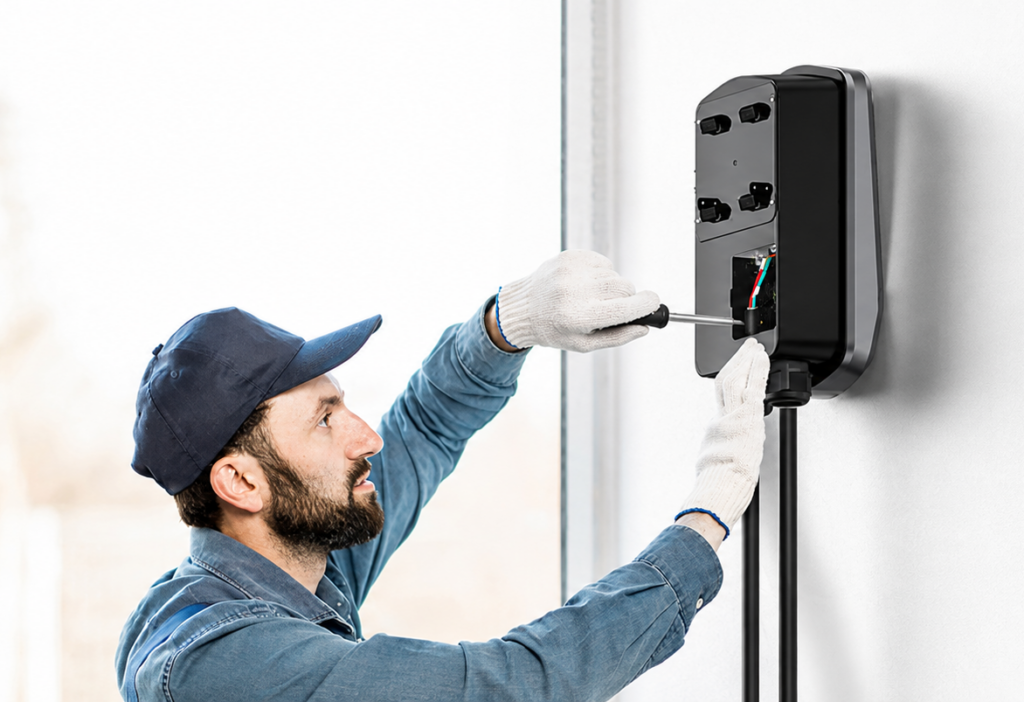
Your quotation may include the following cost areas:
- Charging Equipment: Price varies by power, cable, controls, and product configuration.
- Cable Route: Long runs, wall penetrations, and buried cable increase materials and labour.
- Circuit and Protection: The installation may require a dedicated circuit and the residual-current and overcurrent protection specified by the charger manufacturer and local electrical rules.
- Service Capacity: A main fuse change or three-phase upgrade may involve the electricity network operator.
- Site Work: Trenching, ground repair, parking layout, and mounting hardware can add labour.
- Inspection and Approval: Notification, permits, testing, and certification vary by country.
An existing three-phase home may support higher power with less work. Ask for an itemised quotation covering the charger, circuit, protection, cable route, testing, and network work.
Which EV Charger Power Should You Choose?
Choose 7kW for routine overnight charging on a single-phase supply. Consider 11kW or 22kW only when your vehicle, household supply, and charging schedule can use the extra power.
Choose a 7kW Charger for Routine Overnight Charging
A 7kW home charger fits most drivers who park overnight. At an estimated charging efficiency of 90%, it can add about 60kWh to the battery in approximately 9.5 hours.
Choose 7kW when your setup has these conditions:
- Single-Phase Supply: Your home has a suitable 230V circuit and enough available capacity.
- Overnight Parking: Your EV stays connected long enough to replace the day’s energy.
- Normal Commuting: Your daily use falls well below a full battery charge.
- Vehicle Limit: Your car accepts about 7kW AC or less.
- Lower Installation Work: You do not want a three-phase upgrade only for faster charging.
7 kilowatts may also suit an 11kW-capable EV when it can finish by morning.
Choose an 11kW Charger for a Shorter Charging Window
At full rated power, an 11kW charger provides about 57% more power than a 7kW charger and reduces the estimated charging time for the same amount of energy by about 36%.
Choose 11kW when the following conditions apply:
- Three-Phase Use: Your supply, circuit, and installer assessment support 16A on each phase.
- Vehicle Compatibility: Your EV can take 11kW through its onboard charger.
- Short Off-Peak Period: You want to place more charging inside a limited tariff window.
- Fast Turnaround: You often return with a low battery and need the car again within a few hours.
- Large Daily Energy Use: 7 kilowatts cannot replace your normal driving energy in time.
Choose a 22kW Charger Only When You Can Use 22kW
At an estimated charging efficiency of 90%, a 22kW charger can add about 60kWh to a compatible battery in approximately three hours. However, relatively few home charging setups can use the full 22kW rate.
Check these conditions before you choose 22kW:
- Full Vehicle Support: The EV accepts 22kW AC, not only 22kW or more on DC.
- Full Supply Support: The home can provide 32A per phase after other loads are considered.
- Short Dwell Time: The car often needs a large energy refill in three or four hours.
- Acceptable Installation Cost: The time saved justifies the equipment and electrical work.
- Correct Cable and Model: The cable, connector, phase, and current rating support 22kW.
Charging at 22kW does not cut the electricity price by itself. You still pay for the kilowatt-hours used plus losses. A 7kW unit offers the same tariff benefit if it finishes off-peak.
Future vehicle plans can support the decision, but they should not be the only reason. Confirm the next car’s AC limit.
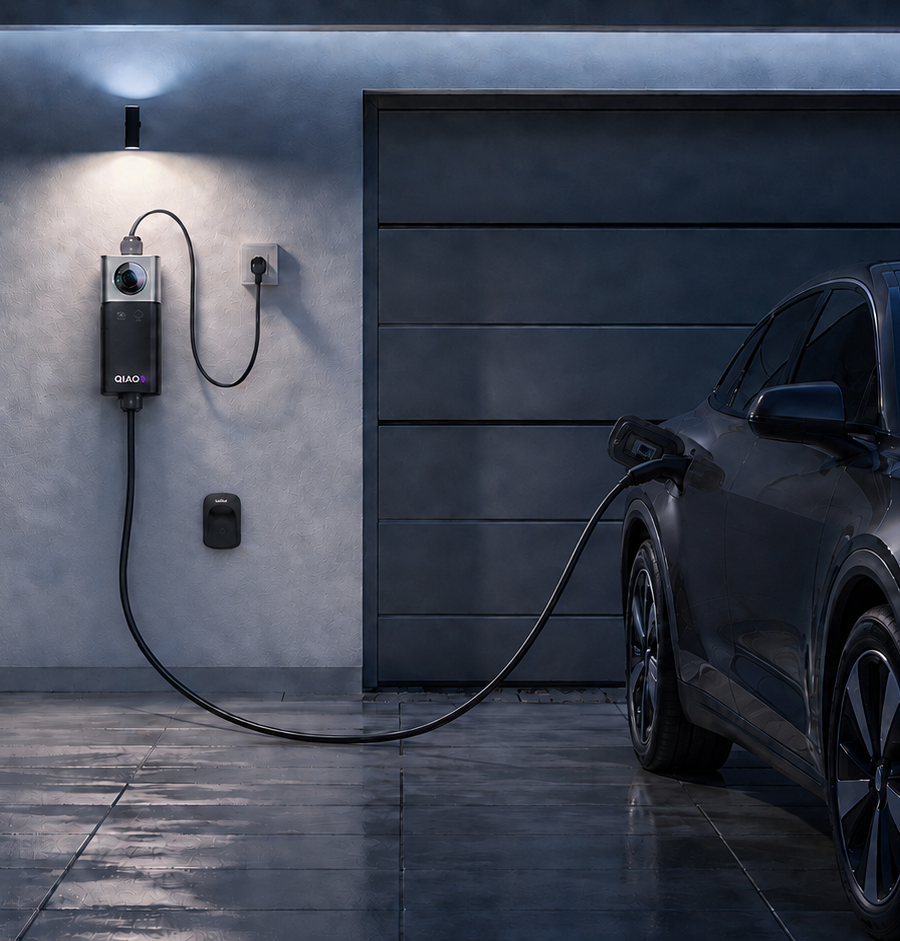
The QIAO Q6 home EV charger comes in 7kW, 11kW, and 22kW configurations. Supply, wiring, controls, and features vary by version, so check the selected configuration.
What If Your Household Has Two EVs?
Two EVs do not automatically require a 22kW charger. The right setup depends on daily energy use, parking schedules, number of connectors, and total household capacity.
A single connector serves one vehicle at a time. A dual-output unit may share power between two cars. Two wallboxes can also share a site limit through compatible controls. Household load balancing and charger-to-charger sharing are different functions.
Alternating nights may cover two low-mileage cars. Longer journeys or short parking windows may favor 11kW or a managed multi-charger setup.
Five Checks to Complete Before Buying
Complete these five checks before choosing a 7kW, 11kW, or 22kW home charging setup:
- Check the Vehicle’s AC Limit: Find the onboard charger rating instead of the DC rapid-charging number.
- Check the Household Supply: Confirm the voltage, phase, main fuse, and available capacity.
- Calculate Daily Energy: Use your normal distance and vehicle efficiency to estimate the kilowatt-hours you replace.
- Measure the Charging Window: Compare your home parking time and off-peak period with the estimated session length.
- Request an Electrical Assessment: Ask a qualified electrician to check the circuit, cable, protection, earthing, and installation rules.
Avoid buying the highest rating before you complete these checks. Do not assume that adjustable current means a wallbox supports both single-phase and three-phase wiring. Also, compare daily top-ups instead of relying only on a 0-100% time.
Once you know your vehicle limit, household supply, and charging window, compare QIAO home EV chargers by power, connector, wiring method, and control options.
Conclusion
Choose the lowest charger rating that can replace your normal driving energy within your available charging window. A higher rating only saves time when the vehicle, household supply, cable, and installation can support it.
Confirm your vehicle’s maximum AC charging rate first, then ask a qualified electrician to verify the available supply capacity, circuit, and protection requirements. Once those details are clear, compare QIAO Charger residential AC charging options across 7kW, 11kW, and 22kW configurations.
FAQs
Yes. A compatible single-phase 32A Type 2 cable can normally be used with a socketed 22kW charger, but it cannot carry the full 22kW output. Full 22kW AC charging normally requires a three-phase cable rated at 32A per phase, plus a charger, vehicle, and electrical supply that support three-phase charging.
The actual charging rate will be limited by the cable, the vehicle’s onboard charger, the charge point, and the available electrical supply. A tethered charger already has a fixed cable, so you do not connect a separate charging cable. For a socketed charger, compare the connector type, phase support, current rating, and cable length when browsing QIAO EV charging accessories.
No, a Type 2 port identifies the connector format, not the vehicle’s AC power limit. Type 2 can support different current and phase configurations. TheIEC 62196-2 standard covers AC vehicle connectors and inlets, but the car’s onboard charger still decides how much AC power it accepts. Check the exact EV specification before buying a wallbox.
Some 22kW chargers can operate below their maximum rating, but product designs differ. Adjustable current lets a charger reduce amperage. Single-phase and three-phase support describes the allowed supply connection. Phase switching describes a separate ability to change the phases used. Read the rated voltage, phase, current range, wiring diagram, and manual. Do not assume every 22kW unit can connect to a single-phase home and run at 7kW.
Not always. A plug-in hybrid electric vehicle, or PHEV, combines a rechargeable battery with a petrol or diesel engine. Many PHEVs have a lower maximum AC charging rate than fully electric vehicles, so a higher-power wallbox may not shorten the charging time.
For example, a PHEV with a 3.6kW onboard charger will draw only about 3.6kW from a 7kW, 11kW, or 22kW wallbox. Some PHEVs support higher AC rates, so check the exact model’s maximum AC charging specification before choosing a charger. The connector type and battery size alone do not confirm the vehicle’s AC charging limit.
A 22kW wallbox does not bypass the vehicle’s charging controls. The onboard charger and battery management system set the accepted power and manage the session. The car will reduce or reject power that it cannot use. Follow the vehicle manufacturer’s charging guidance, software limits, and temperature advice. Choose 22kW for charging time and compatibility, not because it is automatically better or worse for every battery.