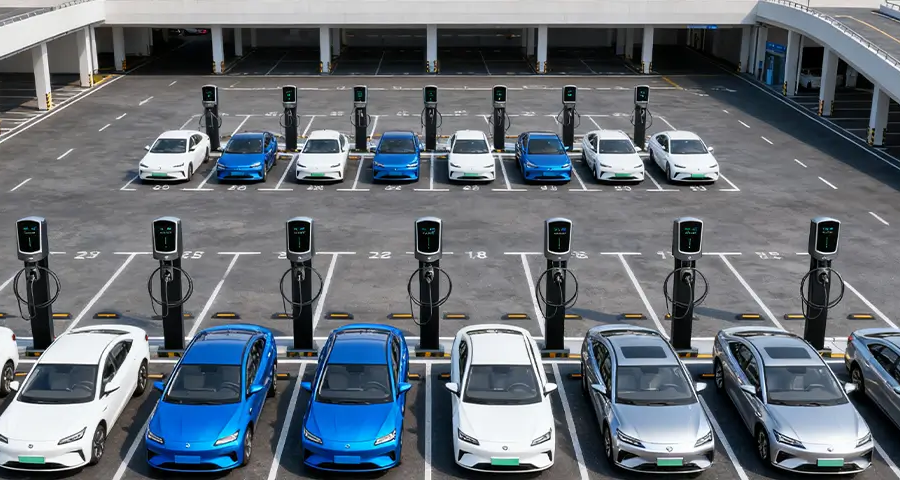

As electric vehicle deployment scales, power demand planning becomes a critical engineering and financial discipline.
Poor demand planning leads to:
- Transformer overload
- Excessive demand charges
- Costly grid upgrades
- Deployment delays
Proper planning ensures EV charging systems are scalable, compliant, and economically viable.
This guide explains how to assess, model, and optimize electrical demand before installing commercial EV charging infrastructure.

1. What Is Power Demand Planning?
Power demand planning is the process of forecasting electrical load requirements and ensuring sufficient supply capacity without compromising system stability.
In EV charging contexts, this includes:
- Connected load calculation
- Coincidence factor analysis
- Peak demand estimation
- Utility coordination
- Load growth forecasting
Authoritative framework reference:
U.S. Department of Energy – Grid Modernization & Load Planning
https://www.energy.gov/oe/activities/technology-development/grid-modernization-and-smart-grid
2. Why EV Charging Complicates Load Planning
Unlike traditional building loads, EV charging is:
- High power density
- Potentially simultaneous
- User behavior–dependent
- Time-sensitive
A single 7–22 kW AC charger is manageable.
Twenty chargers operating concurrently may exceed building transformer limits.
This introduces the need for load diversity modeling rather than simple nameplate summation.
3. Step-by-Step Demand Planning Framework
3.1 Assess Existing Electrical Capacity
Key parameters to evaluate:
- Transformer rating (kVA)
- Main switchboard capacity
- Available spare capacity
- Existing peak demand (utility data)
Utility billing data should be analyzed for at least 12 months to identify:
- Seasonal peaks
- Demand charge thresholds
- Load factor trends
3.2 Calculate Connected Load vs. Expected Load
Connected Load =
Number of chargers × Rated power
Example:
10 chargers × 11 kW = 110 kW
But actual peak demand depends on:
- User charging behavior
- Session duration
- Arrival clustering
- Smart charging control
This is where diversity factor and coincidence factor modeling become essential.
Industry interconnection standard reference:
IEEE – Standard 1547
https://standards.ieee.org/standard/1547-2018.html
3.3 Demand Charge Impact Analysis
Many commercial tariffs include demand charges based on:
- Highest 15-minute peak
- Monthly maximum demand
- Time-of-use peak windows
Poorly managed EV charging can significantly increase these costs.
Demand planning must include:
- Peak shaving modeling
- Time-of-use shifting
- Storage integration scenarios
3.4 Smart Load Management Integration
Dynamic Load Management (DLM) systems allow chargers to share available capacity.
Instead of upgrading transformers, DLM:
- Caps total site load
- Allocates power dynamically
- Prevents breaker trips
- Improves infrastructure scalability
This is often more cost-effective than hardware upgrades.
4. Grid Upgrade vs. Load Optimization
When additional capacity is required, businesses face two options:
Option A: Utility Grid Upgrade
- Transformer replacement
- Service capacity increase
- Long approval timelines
- High CAPEX
Option B: Intelligent Demand Optimization
- Smart charging
- Battery storage buffering
- Load scheduling
- Microgrid integration
Planning must compare total lifecycle cost (CAPEX + OPEX), not just installation cost.

5. Role of Energy Storage in Demand Planning
Battery Energy Storage Systems (BESS) can:
- Discharge during peak charging
- Limit grid draw
- Reduce demand charges
- Defer grid upgrades
Technology reference:
International Renewable Energy Agency – Electricity Storage
https://www.irena.org/Energy-Transition/Technology/Energy-Storage
Storage becomes economically attractive when:
- Demand charges are high
- Charger utilization is clustered
- Grid upgrades are expensive
6. Modeling Future Growth
Power demand planning must account for:
- Fleet electrification expansion
- Increased EV adoption
- Policy-driven mandates
- Tenant demand
Planning only for current usage leads to infrastructure bottlenecks within 2–3 years.
Best practice:
Design electrical backbone capacity for at least 3–5 years of growth.
7. Compliance & Utility Coordination
Before deployment, coordination with local utilities is mandatory for:
- Load impact studies
- Interconnection approval
- Protection coordination
- Metering configuration
Technical compliance reduces commissioning delays.
Conclusion
Power demand planning is not a spreadsheet exercise — it is a strategic infrastructure decision.
Proper planning ensures:
- Electrical safety
- Cost predictability
- Scalability
- Regulatory compliance
- Long-term ROI
As EV adoption accelerates, infrastructure operators must treat charging as an integrated energy system, not an isolated appliance load.
About QIAO
QIAO commercial AC charging solutions support:
- Dynamic load management
- Scalable deployment architecture
- Renewable-ready integration
- OCPP backend compatibility
For projects requiring transformer assessment, load balancing, or future expansion planning, QIAO provides infrastructure-ready solutions aligned with modern power demand strategies.
FAQ
1. Do I need a grid upgrade for EV chargers?
Not always. Smart load management may eliminate the need.
2. How many chargers can one transformer support?
It depends on transformer rating, building load, and diversity factor.
3. Do demand charges significantly impact EV projects?
Yes. Poorly managed peaks can increase electricity costs substantially.
4. Should I plan for future EV growth?
Yes. Electrical infrastructure should account for multi-year expansion.