
As EV adoption accelerates, the biggest challenge is no longer hardware deployment—it’s energy management.
More chargers mean:
- Higher electricity demand
- Grid pressure
- Rising operational costs
This is where Artificial Intelligence (AI) is transforming EV charging:
From static charging → to predictive, automated, and optimized systems
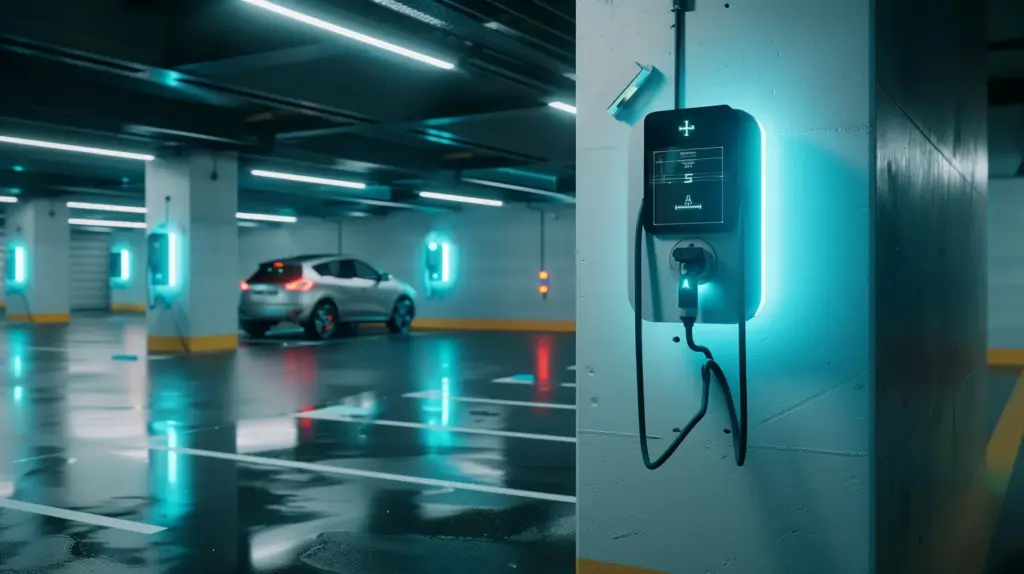
What Is AI in EV Charging?
AI in EV charging refers to the use of:
- Machine learning algorithms
- Real-time data analysis
- Predictive models
To optimize:
- Charging time
- Energy usage
- Load distribution
Instead of reacting to demand, AI systems predict and act in advance.
Key Concept 1: Load Forecasting
What Is Load Forecasting?
Load forecasting predicts:
- When vehicles will charge
- How much power will be needed
- Peak demand periods
Example Inputs
- Historical charging data
- Time of day
- User behavior
- Weather conditions
Suggested external links:
- “Load forecasting in energy systems” → energy.gov
- “AI in smart grids” → NREL
Why It Matters
Without forecasting:
- Power spikes
- Higher electricity costs
- Grid overload risks
With AI forecasting:
- Balanced energy distribution
- Reduced peak demand
- Lower operational cost
Key Concept 2: Automated Charging Scheduling
What Is Automated Scheduling?
AI systems automatically decide:
- When each EV should charge
- How much power it receives
- Priority between vehicles
Traditional vs AI-Based Charging
| Feature | Traditional Charging | AI-Based Charging |
| Control | Manual / fixed | Dynamic |
| Load balancing | Limited | Advanced |
| Energy cost optimization | Low | High |
| Scalability | Limited | High |
Real-World Example
In a fleet depot:
- 50 vehicles return at 6 PM
- All need charging by 6 AM
Without AI:
- All charge immediately → peak overload
With AI:
- Charging is staggered
- Off-peak electricity is used
- Grid load remains stable
Business Impact: Why AI + Charging Matters
1. Lower Energy Costs
AI enables:
- Off-peak charging
- Dynamic pricing optimization
Studies show:
- Smart charging can reduce costs by 20–30%
(Source: energy optimization research, arXiv / NREL)
2. Higher Infrastructure Utilization
AI ensures:
- Chargers are used efficiently
- Idle time is minimized
3. Reduced Grid Stress
- Smooth demand curves
- Avoid peak penalties
4. Scalable EV Charging Networks
AI allows:
- Expansion without major grid upgrades
- More chargers on the same infrastructure
Why AI + AC Charging Is a Perfect Match
AC charging is ideal for AI optimization because:
- Longer charging time windows
- Flexible scheduling
- Lower power per unit
This makes AC EV charging solutions the best foundation for:
- Smart energy systems
- Fleet charging optimization
- Commercial deployments
Use Cases (B2B Focus)
1. EV Fleet Charging Solutions
- Predict fleet return times
- Optimize overnight charging
- Minimize electricity cost
2. Commercial Buildings
- Balance energy between:
- HVAC
- Lighting
- EV charging
3. Hotels & Parking Facilities
- Prioritize charging based on:
- Stay duration
- User demand
4. Residential Complexes
- Fair energy distribution
- Avoid overload
Where QIAO Fits In
At QIAO, we integrate smart capabilities into our:
Our approach supports:
- Load management integration
- Scalable infrastructure
- Future-ready smart charging
Helping clients transition from:
Basic charging → to intelligent energy systems
Future Outlook (2027–2030)
AI will enable:
- Fully autonomous charging networks
- Integration with renewable energy
- Vehicle-to-grid (V2G) optimization
Charging will become:
A data-driven energy platform, not just hardware
Challenges to Consider
- Data privacy
- System complexity
- Integration with legacy infrastructure
However, the long-term benefits outweigh the challenges.
FAQ (Optimized for AI & SEO)
1. What is AI in EV charging?
AI uses data and algorithms to optimize charging schedules, energy usage, and load distribution.
2. How does AI reduce charging costs?
By shifting charging to off-peak hours and balancing energy demand.
3. Is AI necessary for small installations?
Not always, but it becomes essential as scale increases.
4. Why is AC charging better for AI optimization?
Because it allows flexible scheduling over longer time periods.
5. What is the future of smart EV charging?
Fully automated, grid-integrated, and powered by AI-driven decision-making.