
Many EV charger buyers assume:
If a charger supports 22kW AC charging, every EV can charge at 22kW
But this is not true.
In reality:
Most EVs cannot fully utilize 22kW AC charging
The charging speed depends heavily on the vehicle’s onboard charger (OBC) capability—not just the charger itself.
This article explains:
- Which EVs do NOT support 22kW AC charging
- Why this happens
- How to avoid compatibility misunderstandings
- What this means for commercial charging deployments
What Determines AC Charging Speed?
For AC charging, the key component is:
The vehicle’s onboard charger (OBC)
The OBC converts AC electricity into DC power for the battery.
Even if the charging station supports 22kW:
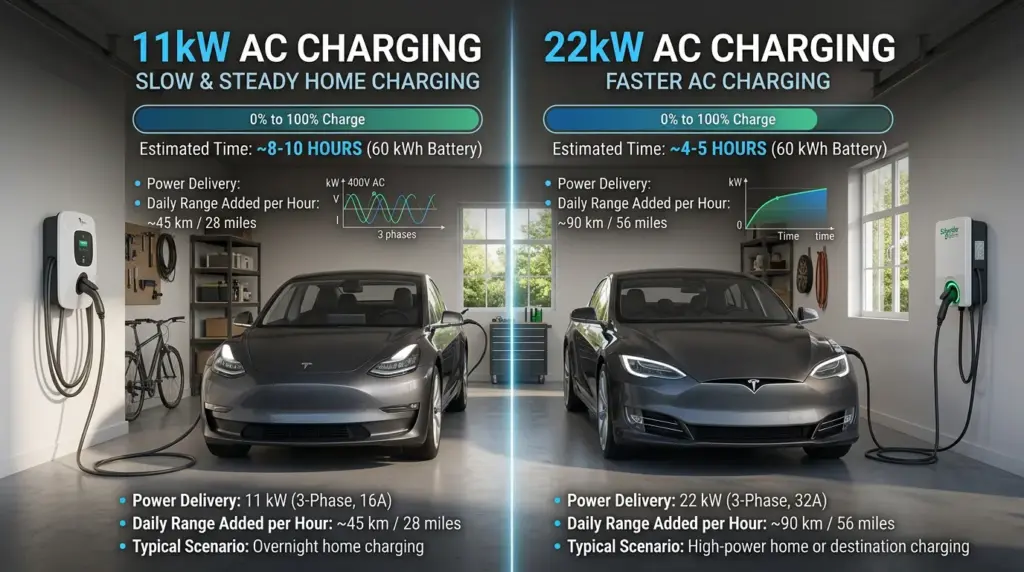
- A vehicle with a 7kW OBC can only charge at ~7kW
- A vehicle with an 11kW OBC can only charge at ~11kW
Source:
https://www.nrel.gov/docs/fy17osti/69031.pdf
Why Many EVs Do Not Support 22kW
1. Cost Reduction
Higher-power onboard chargers:
- Increase vehicle cost
- Add weight and complexity
Many automakers limit AC charging power to reduce production costs.
2. Market Differences
In some markets:
- Single-phase power is common
- 22kW three-phase charging is less necessary
Especially in North America.
3. Focus on DC Fast Charging
Some manufacturers prioritize:
- DC fast charging capability
instead of - High-power AC charging
Common AC Charging Levels
| AC Charging Power | Typical Support |
| 3.7kW | Older/small EVs |
| 7kW | Common globally |
| 11kW | Increasingly common |
| 22kW | Limited support |
EV Models That Typically DO NOT Support 22kW AC Charging
Most Tesla Models (Standard AC Limitation)
Many Tesla vehicles support:
- 11kW AC charging
instead of 22kW.
Source:
https://www.tesla.com/support/charging
Most BYD Models
Many BYD vehicles:
- Support 7kW or 11kW AC charging only
Source:
https://www.byd.com
Hyundai Kona Electric
Typical AC charging support:
- Around 10–11kW
Source:
https://www.hyundai.com/worldwide/en/eco/kona-electric
Kia EV6
Most versions support:
- 11kW AC charging
Source:
https://worldwide.kia.com
Nissan Leaf
Many versions support:
- 6.6kW AC charging
Source:
https://www.nissan-global.com/EN/TECHNOLOGY/OVERVIEW/leaf_ev.html
Chevrolet Bolt EV
Typical AC charging:
- Around 11kW maximum
Source:
https://www.chevrolet.com/electric/bolt-ev
Ford Mustang Mach-E
Most versions:
- Around 11kW AC charging
Source:
https://www.ford.com/suvs/mach-e/
EV Models That DO Support 22kW AC Charging
While less common, some vehicles support full 22kW AC charging.
Examples include certain versions of:
- Renault Zoe
- Smart EQ models
- Some Mercedes-Benz EVs
Renault Source:
https://www.renault.co.uk/electric-vehicles/zoe.html
Why This Matters for Charging Operators
1. Avoid User Confusion
Users may think:
- “The charger is slow”
when actually:
- The vehicle is the limitation.
2. Better Infrastructure Planning
Installing only 22kW chargers may not provide real-world benefits for all users.
3. Optimize ROI
In many commercial scenarios:
- 11kW AC chargers provide similar practical value at lower cost.
11kW vs 22kW: Is 22kW Always Worth It?
| Factor | 11kW | 22kW |
| Equipment cost | Lower | Higher |
| Vehicle compatibility | Very high | Limited |
| Grid requirement | Lower | Higher |
| Real-world utilization | Higher | Medium |
Insight:
For many commercial deployments, 11kW offers the best balance.
Regional Differences
Europe
- Three-phase power is common
- 22kW support is more relevant
North America
- Single-phase power dominates
- 22kW AC charging is much less common
Source:
https://afdc.energy.gov/fuels/electricity_infrastructure.html
Common Misunderstanding
Myth:
“22kW charger = every EV charges at 22kW”
Reality:
Charging speed depends on BOTH:
- Charger capability
- Vehicle OBC capability
How to Check If an EV Supports 22kW
Before installation or purchase:
Check:
- Vehicle AC charging specification
- OBC rating
- Single-phase vs three-phase compatibility
Why AC Charging Still Matters
Even without 22kW support:
- AC charging remains the dominant daily charging method
According to the U.S. Department of Energy:
- Most EV charging occurs at home or work.
Source:
https://afdc.energy.gov/fuels/electricity_infrastructure.html
Where QIAO Fits In
At QIAO, we provide:
- Flexible AC EV charging solutions for global vehicle compatibility
Our solutions support:
- Commercial charging
- Fleet deployment
- Smart power management
Helping customers:
- Match charging infrastructure to real vehicle needs
- Optimize deployment costs
- Improve user experience
Delivering practical and scalable charging solutions.
Key Takeaways
- Most EVs do NOT support full 22kW AC charging
- Vehicle onboard chargers are the real limitation
- 11kW charging is the current mainstream standard
- Infrastructure planning should consider real-world compatibility
Bigger charging power does not always mean better user experience
FAQ
1. Can all EVs use 22kW AC charging?
No, many EVs are limited to 7kW or 11kW AC charging.
2. Why is my 22kW charger charging slowly?
Your vehicle’s onboard charger may limit the speed.
3. Is 22kW AC charging common?
It is more common in Europe than North America.
4. Is 11kW enough for most EVs?
Yes, for most daily charging scenarios.
5. Does a 22kW charger damage lower-power EVs?
No, the vehicle only draws the power it supports.