Table of Contents
Real Estate Developers: How to Plan AC EV Charging Ratios for New Projects
As EV adoption accelerates globally, real estate developers are under increasing pressure to integrate EV charging infrastructure into new buildings.
The key question is no longer “whether to install chargers” — but:
“How many AC EV chargers should we plan for?”
Getting this ratio right directly impacts:
- project cost
- long-term asset value
- regulatory compliance
- user satisfaction

Why Charging Ratio Planning Matters
Poor planning leads to two common problems:
| Scenario | Result |
| Too few chargers | Resident complaints, retrofit costs |
| Too many chargers | Overinvestment, low utilization |
A well-designed AC charging ratio ensures:
- scalable infrastructure
- optimized CAPEX
- future-ready buildings
Global EV Adoption Driving Demand
According to the International Energy Agency:
- Global EV sales exceeded 14 million units in 2023
- EVs are projected to reach 35%+ of new car sales by 2030
Source:
https://www.iea.org/reports/global-ev-outlook-2024
This rapid growth means:
Charging demand in residential and commercial buildings will increase exponentially
What Is a Charging Ratio?
Charging ratio refers to:
Number of parking spaces per EV charger
Example:
- 1:5 → 1 charger for every 5 parking spots
- 1:10 → 1 charger for every 10 parking spots
Recommended AC Charging Ratios (2026)
Below is a practical guideline based on global trends and regulations:
| Property Type | Recommended Ratio | Notes |
| High-end residential | 1:3 – 1:5 | EV adoption is higher |
| Standard apartments (MUD) | 1:5 – 1:10 | Allow future expansion |
| Office buildings | 1:10 – 1:20 | Daytime usage |
| Mixed-use developments | 1:6 – 1:12 | Variable demand |
| Hotels | 1:8 – 1:15 | Overnight charging |
Regulations Are Increasingly Mandatory
Many regions now require EV-ready infrastructure:
- European Union mandates EV-ready parking in new buildings
- California building codes require EV-capable spaces in new developments
Example regulation reference:
https://energycodeace.com/site/custom/public/reference-ace-2019/Documents/2019evchargingrequirements.htm
This means developers must plan beyond minimum compliance.
Key Factors That Affect Charging Ratio
1. EV Adoption Rate
Higher EV penetration = higher charging demand
Urban areas typically require:
- higher charger density
- faster scalability
2. Power Capacity Availability
Grid capacity directly limits deployment.
Learn more:
https://en.wikipedia.org/wiki/Electric_power_system
Developers should evaluate:
- transformer capacity
- load limits
- peak demand
3. Charging Behavior Patterns
Residential charging is typically:
- overnight
- low-power AC charging
This allows:
More users to share fewer chargers
4. Smart Charging Capability
Smart charging enables:
- load balancing
- peak shaving
- scheduled charging
This can reduce required charger quantity by 20–40%.
AC Charging vs DC Charging in Real Estate
| Factor | AC Charging | DC Charging |
| Cost | Low | High |
| Installation | Simple | Complex |
| Use case | Overnight / workplace | Fast charging |
| Scalability | High | Limited |
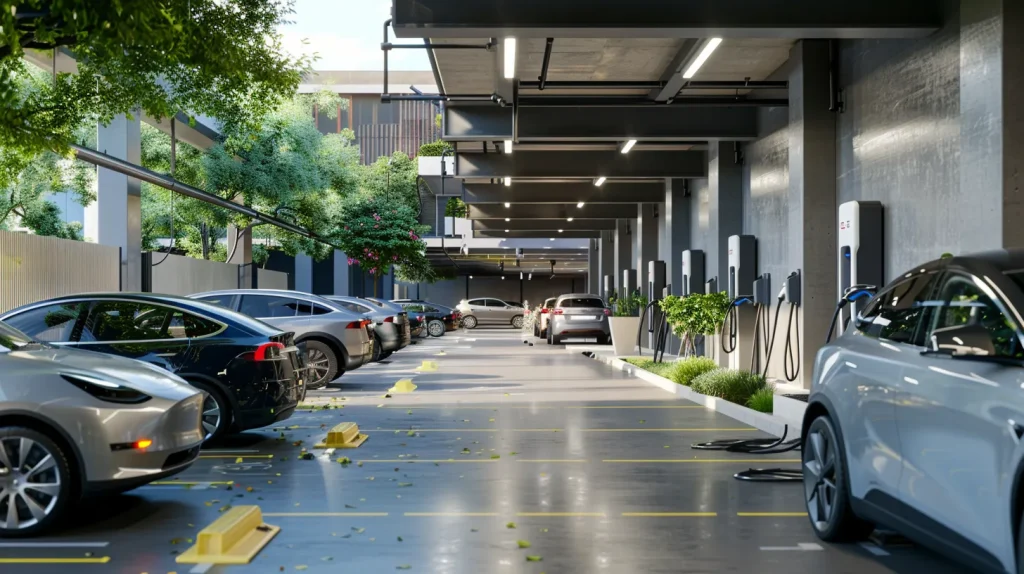
For real estate projects, AC charging is the dominant solution
Future-Proofing: EV-Ready vs EV-Installed
A common strategy is:
| Type | Description |
| EV-ready | Conduits + wiring prepared |
| EV-installed | Chargers installed immediately |
Best practice:
Install 20–40% chargers + 100% EV-ready infrastructure
Infrastructure Design Strategy
Step 1: Plan Electrical Capacity
- central load management
- scalable distribution
Step 2: Use Load Balancing Systems
Load management overview:
https://en.wikipedia.org/wiki/Load_management
This ensures:
- no grid overload
- efficient energy use
Step 3: Modular Deployment
Install chargers in phases:
- Phase 1: initial demand
- Phase 2: scale based on usage
Step 4: Integrate Smart Charging
This enables:
- energy cost optimization
- grid-friendly operation
- future integration with solar/storage
ROI Considerations for Developers
EV charging infrastructure adds value through:
- higher property attractiveness
- premium pricing potential
- ESG compliance
- long-term competitiveness
About QIAO
QIAO provides scalable AC EV charging solutions tailored for real estate developers.
Our solutions support:
- flexible charging ratios
- smart load balancing
- OCPP-based management
- easy expansion for future demand
QIAO helps developers build EV-ready, future-proof properties without overinvesting upfront.
FAQ
What is the ideal EV charger ratio for apartments?
Typically 1:5 to 1:10, depending on EV adoption.
Can smart charging reduce the number of chargers needed?
Yes, by optimizing usage and load distribution.
Is it better to install chargers or just prepare infrastructure?
A hybrid approach is best (partial install + full readiness).
Do regulations require EV chargers in new buildings?
Yes, in many regions including the EU and California.