Table of Contents
EV Charging Cable Solutions for Flexible and On-Demand Travel Charging
EV charging solutions are evolving rapidly as electric vehicle usage expands, and one of the most practical tools for on-the-go charging is the EV charging cable. Whether drivers are on a long-distance journey, staying at a temporary destination, or simply looking for greater charging flexibility, a reliable charging cable becomes an indispensable travel companion. This article explores the role of charging cables within broader EV charging solutions, their technical variations, use scenarios, safety considerations, and how drivers can select the right cable for different environments.

The Growing Demand for Portable EV Charging Flexibility
As EV adoption increases globally, more users require charging solutions beyond fixed public stations and home wall boxes. Portable cables fill this gap by enabling drivers to tap into available AC power sources when needed. Compared with station-based chargers, cables offer mobility, adaptability, and user autonomy—making them a key component of travel-ready EV charging solutions.
Common travel scenarios include:
- Long-distance road trips with limited charging infrastructure
- Overnight stays at hotels, Airbnb properties, or rural areas
- Workplace or temporary charging
- Emergency charging when the battery is low
In each scenario, the ability to connect an EV to a compatible AC outlet provides convenience and peace of mind.
Key Types of EV Charging Cables
Mode 2 Portable Charging Cables
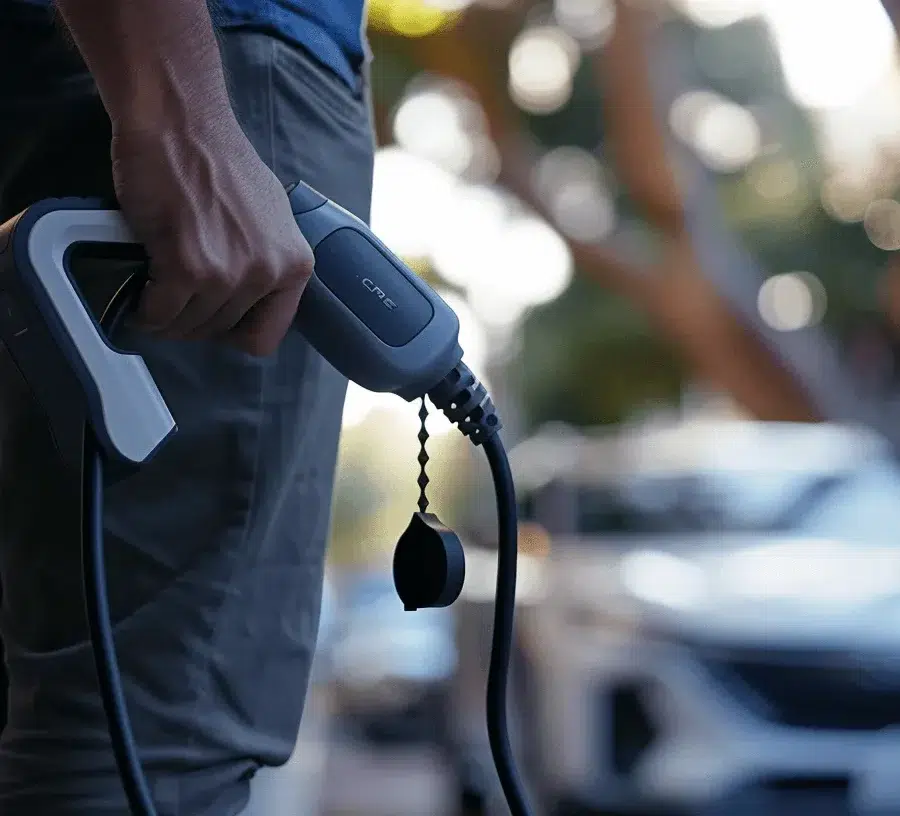
These cables connect directly to standard household or industrial AC sockets. They include a control box (ICCB) to manage safety and regulate current.
Best for: Road trips, emergency use, destinations without fixed chargers.
Type 1 and Type 2 EV Charging Cables
These vehicle-side connectors vary by market:
- Type 1: Common in North America
- Type 2: Standard across Europe and compatible with most modern EVs globally
Drivers should select the plug type that matches their vehicle and the available charging outlets.
High-Capacity Cables With Adjustable Current
Some advanced cables allow the user to adjust amp levels manually—helpful when plugging into outlets with varying capacity and ensuring safe operation.
Why EV Charging Cables Are Essential to Travel Charging
Convenience and Control
With a portable cable, drivers are not dependent on the availability or uptime of public charging networks. They can charge anywhere a compatible outlet exists.
Cost Efficiency
Charging via AC power—especially at accommodations or workplaces—is often more economical compared to public fast-charging stations.
Safety and Compatibility
Well-engineered EV charging cables include temperature monitoring, current protection, leakage detection, and automatic shutoff—ensuring safe charging even in unfamiliar environments.
Supports EV Charging Solutions Ecosystems
A portable cable complements wall-mounted chargers, public AC stations, DC fast chargers, and V2V tools. It is a foundational element of a broader, diversified charging strategy.

How to Choose the Right EV Charging Cable for Travel
When selecting a cable, drivers should evaluate the following:
1. Connector Type Compatibility
Confirm whether your EV uses Type 1 or Type 2. European users generally require Type 2, while North American drivers may need both options for flexibility.
2. Adjustable Current Levels
Adjustable current is valuable when charging at different types of outlets (hotel sockets, RV park outlets, residential garages).
3. Length and Durability
A 5-8 meter cable is ideal for travel, ensuring reach in less accessible parking spaces. Outdoor-rated insulation and waterproof design (IP65 or above) provide extra reliability.
4. Portability
Travel cables must be lightweight, easy to store in the trunk, and include a protective case. Compact design is essential for daily commuting and long-distance travel alike.
5. Intelligent Control Features
Look for cables with:
- Smart display
- Current control
- Auto-recovery
- Temperature protection
- Built-in safety diagnostics
These features elevate a cable from a simple accessory to a core component of intelligent EV charging solutions.
Best Practices for Safe and Efficient Cable Charging
- Avoid using damaged or low-quality extension cords
- Ensure the outlet’s rated current matches cable settings
- Keep connections dry, especially in outdoor environments
- Regularly check for overheating
- Store the cable properly after each use
Adhering to safety recommendations safeguards both the vehicle and the user.
Conclusion
EV charging cables play a crucial role in modern EV charging solutions, especially for drivers who value mobility and flexibility. They provide a reliable, economical, and safe method to charge during travel, bridging the gap between permanent charging infrastructure and real-world charging needs.