
The right EV charging cable connects your car to the charging point you plan to use. To choose one, check whether the charging point already has a cable, match the connectors at both ends, choose a suitable current and phase rating, and measure the distance to your car’s charge port.
In the UK and Europe, this often means a removable Type 2 cable for a socketed AC charger. This guide focuses on that setup and explains what changes when a charger has an attached cable or only an electrical outlet is available. It also briefly notes how North American charging connections differ.
Quick Answer: Which EV Charging Cable Do You Need?
Start with the charging point. Its connection tells you whether you need to bring a cable at all.
| Where you charge | What is at the charging location? | What should you use? |
| Home charger with an attached cable | A charging connector fixed to the unit | Use the attached cable if it fits your car. |
| Socketed home AC charger | A socket, often Type 2 in the UK and Europe | Bring a compatible cable between the charger and your car. |
| Socketed public AC charging point | A charging socket, often Type 2 | Bring your own compatible cable. |
| Household or industrial electrical outlet | An electrical power socket, not an EV charging point | Use a suitable portable EV charger with a matching input plug. |
| Public DC fast charger | A charger with its own DC cable | Use the station’s compatible attached connector. |
Check the station listing before setting off. For example, the City of Edinburgh Council says drivers need their own cable at its 7 kW and 22 kW Type 2 socketed points.
Do You Need a Separate Cable for Home and Travel?
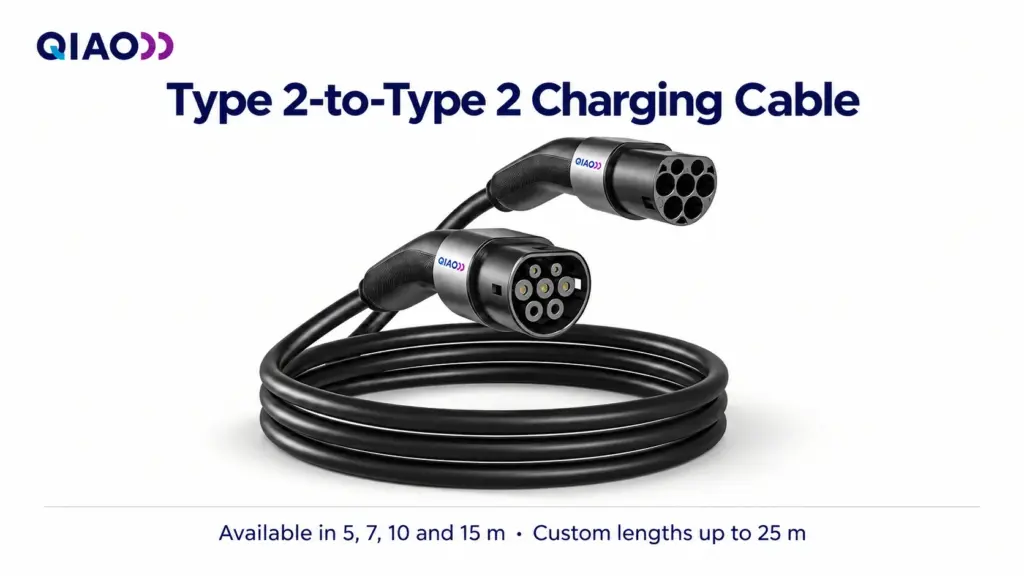
One removable AC cable can serve both home and travel if the charging points you use have compatible sockets. For example, a Type 2-to-Type 2 cable may work with a socketed Type 2 home charger and socketed public Type 2 points, provided it fits your car and has suitable current and phase ratings.
Before buying another cable, check whether one came with your car. Read its label and see whether it reaches your usual parking positions comfortably. If it already meets your needs, keeping a second cable in the car is mainly a matter of convenience.
Charging equipment can vary when you travel. A tethered AC charger or DC fast charger has its own cable, while an ordinary electrical outlet requires suitable portable charging equipment.
Match Both Ends of the Cable
A charging cable must fit the charging point and your car. Do not order from a product title that says only “Type 2” or “EV charging cable.” Check what connector is on each end.
Check the charging-point end
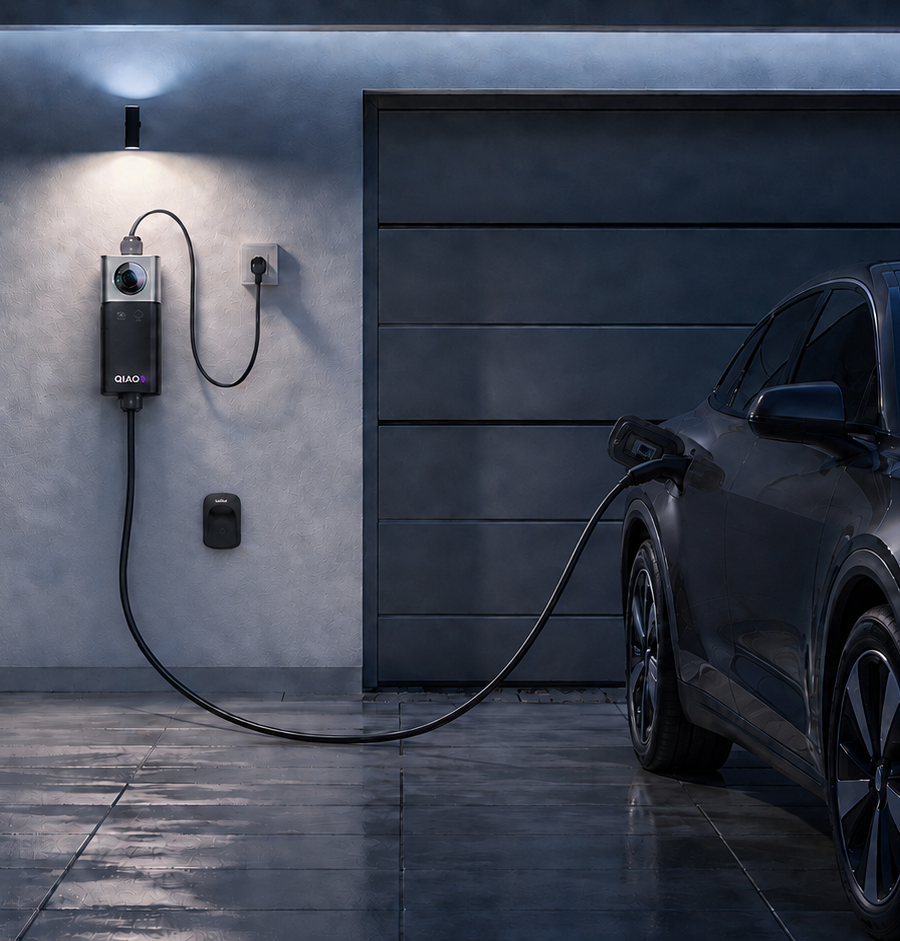
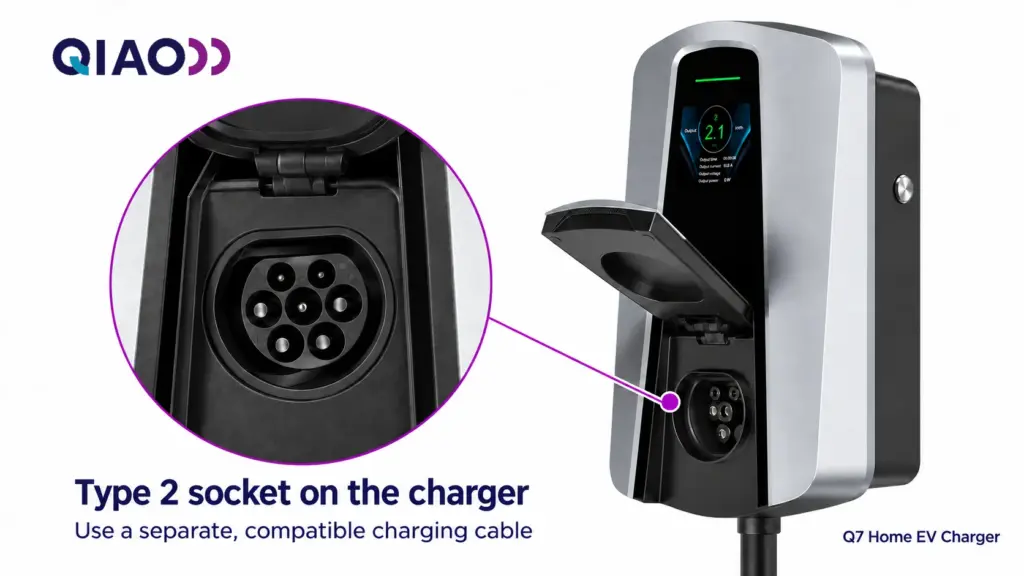
In the UK and much of Europe, many socketed AC chargers use a Type 2 socket. The station end of your removable cable must have a matching Type 2 connector. The socketed version of the QIAO Q7 Home EV Charger is one example: you bring a compatible cable to connect the charger to your car. A charger with a fixed, or tethered, cable already has a vehicle connector attached. At sites with several charging points, check the connection on the unit you plan to use; the units may differ.
Check the vehicle end
Many UK and European EVs use a Type 2 inlet for AC charging. With a socketed Type 2 charger, they commonly use a Type 2-to-Type 2 cable. Some older vehicles have a Type 1 inlet, so their vehicle end needs to be different. Check your owner’s manual or the marking by the car’s charging port if you are uncertain.
The additional pins below the Type 2 inlet on many CCS2-equipped cars is used for DC fast charging. It does not mean you need to buy a CCS cable for a socketed home AC charger. Look at the AC part of the car’s inlet when choosing an AC cable.
Travelling in North America? The buying pattern is different. AC charging commonly involves J1772 or NACS vehicle connectors, and home and public chargers commonly have their cable attached. Check your vehicle and the equipment at each stop; do not assume that a European Type 2-to-Type 2 cable is your travel solution. The US Department of Energy’s connector guidance is a useful starting point for North American vehicles.
When crossing borders, confirm the charging equipment at your destination.
Choose the Right Current and Phase Rating
Check the cable label for its current rating and whether it supports single-phase or three-phase AC charging.
The following examples use typical UK and European AC supply voltages. They are approximate charging-point power ratings, not promises about the speed your car will achieve.
| AC charging setup | Current and phases | Approximate power | What to check on the cable |
| Higher-power single-phase AC | 32 A, one phase | 7.4 kW | A suitable 32 A cable for the intended connection. |
| Three-phase AC | 16 A, three phases | 11 kW | A three-phase cable rated for at least 16 A. |
| Higher-power three-phase AC | 32 A, three phases | 22 kW | A three-phase cable rated for 32 A. |
Read both the current rating (A) and the phase rating. A cable rated for 11 kW three-phase charging may support only 16 A per phase, limiting it to about 3.7 kW on a single-phase charger. A 32 A single-phase cable, meanwhile, cannot deliver three-phase 22 kW charging. If you want one cable for a 7 kW single-phase home charger and three-phase public AC chargers, check that it is rated for 32 A and three-phase charging.
The car sets another limit. An 11 kW AC car will not charge at 22 kW just because the station and cable have that rating. Actual power also depends on the charging point and electrical supply.
For example, a driver with an 11 kW three-phase car could use a suitable 22 kW-rated three-phase cable at an 11 kW charger. The higher cable rating leaves room for another compatible setup; it does not increase that car’s 11 kW limit. The car’s AC charging limit also matters when choosing between 7 kW, 11 kW and 22 kW home EV chargers.
Check the car’s maximum AC rate, rather than its DC fast-charging rating, before ordering.
Measure the Cable Length You Actually Need
The best cable length is one that reaches your car without pulling tight. Measure the route the cable will follow, rather than guessing from the distance between the wall and the parked car.
Measure from the charging point along a practical route to your car’s port when parked as usual. Leave enough slack that the connectors are not under strain.
Then ask how that route might change:
- Do you sometimes reverse into the space and sometimes park nose-first?
- Will another car use the same charging point?
- Does the cable need to go around a pillar or along the edge of a parking area?
- When travelling, might the charging point be on the other side of the vehicle?
For example, a charger may sit 3 m from your parking space, yet the route around the car to a rear port may be longer. Measure both parking directions if you use both, and avoid stretching a cable across a walkway.
A longer cable gives you more flexibility, but it is also heavier to carry and takes up more space in the car. Choose a length that reaches the charge port comfortably, with some slack, without leaving unnecessary cable across the ground. Keep it clear of walkways and follow the manufacturer’s instructions for use and storage.
Check Durability, Storage and Everyday Use
Look for a clear product rating, secure connectors, a storage option and instructions covering your expected conditions.
Before each session, check the connector faces and cable jacket for damage, dirt or signs of overheating. Keep the connectors clean and dry as directed by the manufacturer. If a connector is cracked, a cable jacket is cut, or a plug shows heat damage, stop using that cable and seek advice from its supplier. Do not keep charging through a damaged lead.
For outdoor use, check the stated environmental rating. A product rating does not mean connectors can sit in water. Keep the cable clear of tyres and feet, and store it without sharp bends or heavy objects on top.
If the cable does not reach, do not join two removable charging cables together as an improvised extension. Recheck the route and select a correctly specified single cable of suitable length. For a portable charger connected to an electrical outlet, use only the input plugs and accessories approved for that charger.
When Do You Need a Portable EV Charger Instead?
You need a portable EV charger when your available power source is a suitable electrical outlet rather than a socketed EV charging point. The portable unit includes charging controls and has an input plug designed for a particular outlet and electrical supply. A plain Type 2-to-Type 2 cable does not provide those controls or plug into a household socket.
At a holiday property with an industrial outlet, you need portable equipment approved for that outlet and vehicle. Check the circuit, grounding and permission to use it; a plug that fits does not prove the supply can support the required current.
EV Charging Cable Buying Checklist
Before placing an order, check these six points:
- Charging point: Does it have its own cable, a socket or only an electrical outlet?
- Connectors: Does the cable fit both the charging point and your vehicle’s AC inlet?
- Rating: Do its current and phase ratings suit the charging setup you want to use?
- Length: Have you measured the full route to the charge port, with comfortable slack?
- Practical use: Can you carry, handle and store the cable where you plan to charge?
- Existing equipment: Did your car already come with a cable that meets these needs?
If one answer is unclear, check the car manual, charging-point details and cable specifications before buying. That is especially useful when you charge in more than one country or use several different parking spaces.
Final Thoughts
Before buying, use the checklist above to compare any cable you already own with the places you charge most often. If its connectors, current and phase ratings, and length meet those needs, you may not need another cable.
About QIAO Charger
QIAO Charger offers EV charging cables and accessories, portable EV chargers, and home EV chargers for different charging needs. Connector types and cable lengths vary by product and configuration, so check the options for the model you choose.
We also work with distributors, retailers and other channel partners bringing AC EV charging products to their markets. If you are building a local product range, explore QIAO’s partnership opportunities.