
To choose a portable EV charger, check both ends. The vehicle connector must fit your EV. The input plug must also match a suitable outlet. Charging power is limited by the outlet, circuit, portable EV charger, and vehicle’s onboard charger.
This guide covers plug-in portable AC charger powered by an external outlet. The eight checks below will help you compare safe, practical options for home and travel.
Key Takeaways
Use these six points to narrow your portable EV charger options before comparing additional features:
- Vehicle Connector: Confirm the AC inlet in your owner’s manual or on the charge-port label.
- Input Plug: Match the plug to a grounded outlet that is suitable for sustained EV charging.
- Actual Charging Power: Use the lowest limit set by the circuit, charger, onboard charger, or current conditions.
- Adjustable Current: Choose settings that match every outlet and circuit you plan to use.
- Safety and Compliance: Check protection functions and documents for the exact model and country.
- Outdoor and Travel Use: Compare cable reach, IP ratings, temperature limits, plug options, and storage size.
1. Confirm Your Vehicle’s AC Charging Connector
Match the charger’s vehicle connector to your EV’s AC charging inlet. Connector types can vary by country, model year, and vehicle setup. Do not rely only on the badge on the car.
| Connector | Common Market or Vehicle Context | What You Should Check |
| Type 1/SAE J1772 | North America and some vehicles in Japan | Confirm that the inlet accepts J1772 for AC charging. |
| Type 2/IEC 62196-2 | Europe and many other markets | Confirm the exact AC inlet and whether the vehicle supports single-phase or three-phase input. |
| NACS/SAE J3400 | Vehicles equipped for NACS in North America | Confirm AC compatibility, because the coupler may carry AC or DC depending on the charging setup. |
| GB/T | Vehicles built for the mainland China charging system | Confirm that the inlet follows the applicable GB/T AC interface. |
Check the manual and the label beside the inlet. An adapter must support the correct interface, voltage, current, grounding, and communication. It must also meet the required safety rules. Use only combinations approved by the manufacturer.
2. Match the Charger Plug to the Available Outlet
Choose the input plug according to the outlet you will actually use. Start with your regular parking location, then list any outlets you expect to use while traveling.
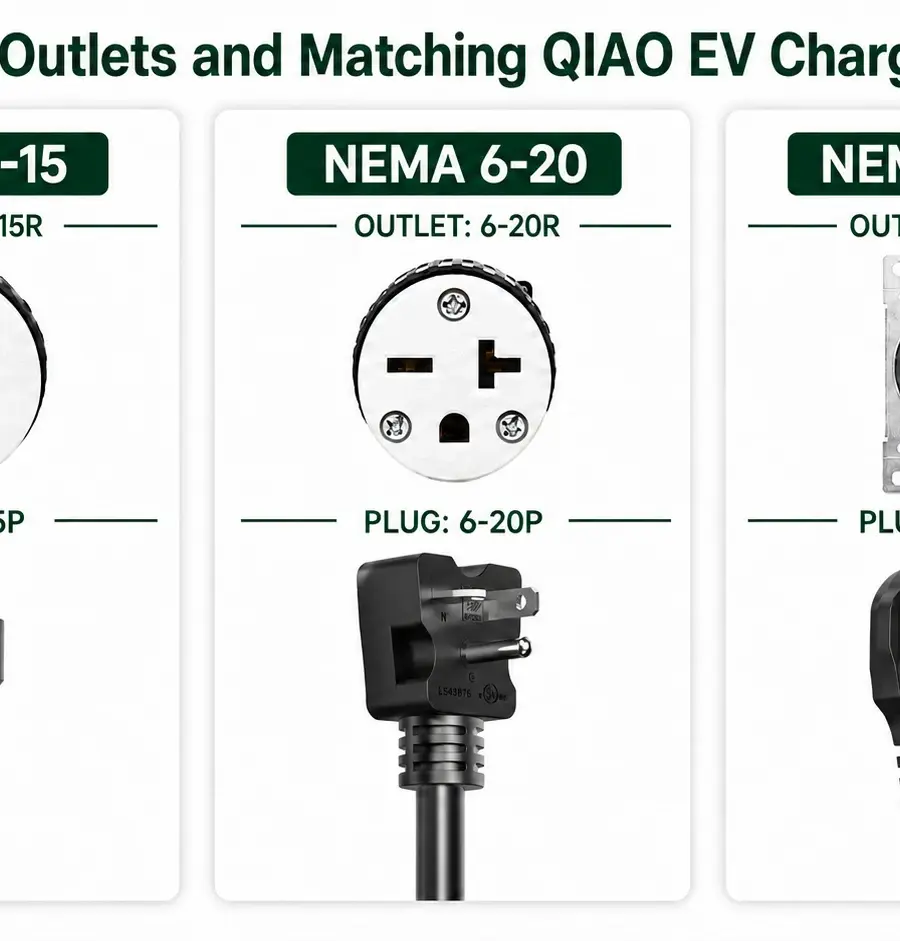
North American options include NEMA 5-15 or 5-20 outlets at 120 V. Common 240 V options include NEMA 6-20, 6-50, 14-30, and 14-50. A matching plug shape does not mean the outlet can supply any current you choose. European units may use Schuko or CEE plugs. The United Kingdom commonly uses BS 1363 13 A fused plugs and matching household outlets. Australia and New Zealand use Type I.
Elsewhere, verify local voltage, current, grounding, and outlet rules. A travel adapter does not change the electrical supply.
Confirm the outlet’s voltage, current, and grounding. Also check the breaker capacity and other loads on the circuit. Do not use a loose, damaged, discolored, or hot outlet. A household outlet is not automatically suitable for sustained EV charging. For Level 1 home charging, the U.S. Department of Energy recommends a dedicated branch circuit. It also recommends that a qualified electrician check the electrical capacity (AFDC home-charging guidance). Follow local rules elsewhere.
3. Choose the Right Voltage and Charging Power
Choose a charging power that your outlet, electrical circuit, and vehicle can all support. A larger number on the product label does not guarantee that the car will receive that power.
Level 1 and Level 2 in North America
Level 1 and Level 2 are common North American AC categories. Level 1 uses 120 V. Level 2 normally uses 208 V in commercial settings or 240 V in homes. These are not universal labels. The U.S. Alternative Fuels Data Center also links charge time to the battery, onboard charger, EVSE, and electrical service.
Common AC Power Ratings in Other Markets
Outside North America, AC charging is often described by power and phase. Common ratings include about 2-3.5 kW, 7-7.4 kW single-phase, and 11 kW or 22 kW three-phase.
An 11 kW or 22 kW charger usually needs three-phase power. The vehicle must also accept the matching three-phase AC input. Some EVs accept only single-phase AC even when connected to a three-phase charger.
Why Rated Power Is Not Always Actual Power
Actual charging power depends on the lowest limit in the system. That limit may come from the circuit, portable EV charger, onboard charger, or battery conditions. The onboard charger converts AC to DC and monitors the battery, as the AFDC glossary explains.
Use these approximate formulas for a quick electrical check:
Single-Phase AC: Power (kW) ≈ Voltage × Current ÷ 1,000.
Three-Phase AC: Power (kW) ≈ √3 × Line Voltage × Current ÷ 1,000.
Real charging power can change because of energy losses, temperature, battery level, and vehicle controls. Do not rely on a fixed miles-per-hour claim. The range added by each kilowatt-hour also varies. It depends on vehicle efficiency, temperature, battery condition, and driving conditions.
4. Check the Amperage and Adjustment Range
Adjustable amperage lets you lower the charging current. This is useful when an outlet or circuit cannot support the charger’s maximum output. Portable units may offer settings such as 8 A, 10 A, 13 A, 16 A, 24 A, or 32 A. The available settings vary by model.
Higher current does not always charge faster. The car may request less current because of its onboard charger, battery temperature, charging schedule, or another internal limit. Your setting must never exceed the outlet, wiring, breaker, charger, or vehicle limit.
Automatic input-plug recognition can reduce setting errors when a charger uses interchangeable plugs. It does not replace the product instructions or an electrical check. Adjustable current is useful in older homes, on shared circuits, and during travel. However, a lower setting cannot make a damaged, ungrounded, or noncompliant outlet safe. Stop and use another outlet if the connection becomes loose, discolored, or unusually hot.
5. Verify Safety Protection and Regional Compliance
Choose a portable EV charger with protection features and compliance documentation appropriate for the country where it will be used.
Protection may cover overcurrent, overvoltage, undervoltage, overtemperature, short circuits, residual current or leakage, ground faults, and plug temperature. Check fault reporting and required upstream protection.
Standards and marks serve different purposes:
- IEC 62752: This standard applies to in-cable control and protection devices for Mode 2 charging.
- IEC 61851: This series covers conductive charging; IEC 61851-1 contains general EVSE and electrical-safety requirements.
- IEC 62196: This series addresses plugs, socket-outlets, vehicle connectors, and vehicle inlets.
- UL Requirements: North American evaluation may use several UL standards. These include ANSI/UL 2594 for EVSE, UL 2251 for couplers, and UL 2231 for personnel protection, according to UL Solutions.
- CE Marking: CE is a compliance marking, not a technical standard or an EU safety approval.
- TÜV Testing or Certification: TÜV organizations provide testing, inspection, and certification services. TÜV is not an electrical standard alongside IEC.
More logos do not prove market suitability. Verify the document, model number, issuing body, scope, and region. This guide cannot replace product instructions, local code, or a licensed electrician.
6. Choose a Practical Cable Length and Portable Design
Measure the distance from the outlet to your vehicle’s charging port before choosing a cable length. Include the parking direction, outlet height, and charge-port position on the car.
A cable length of around 5–7.5 m (about 16–25 ft) works well for many home and travel situations. Choose the length based on the distance between the outlet and your vehicle’s charging port.
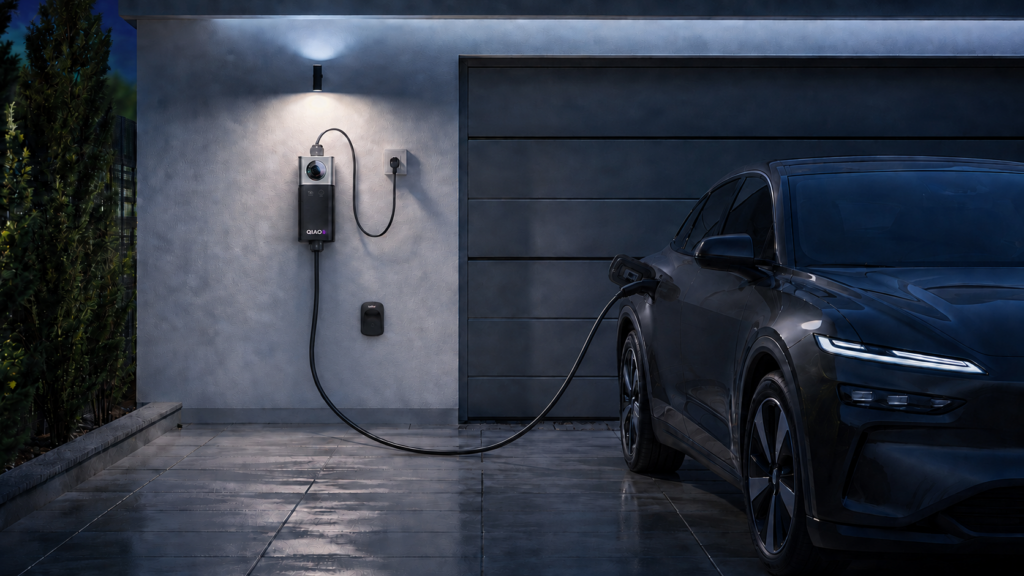
A longer cable adds weight, takes up more space, and can be harder to handle. Compare the control-box size, handle, cable flexibility, and storage design. Make sure the charger will fit in your trunk and that the cable can be packed away neatly after use. For example, the QIAO Q9 Portable EV Charger combines built-in cable storage with a heat-dissipation design for easier transport and storage. Also check the operating and storage temperatures if you will keep the charger inside a hot or cold vehicle. In cold weather, a stiff cable can be harder to uncoil and position.
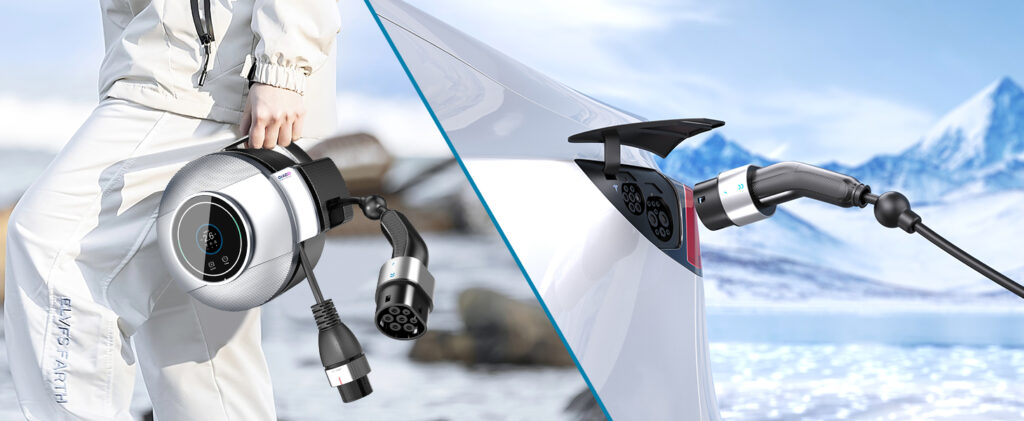
7. Check Weather Resistance and Operating Conditions
Choose an IP rating and operating-temperature range that match the charging and storage conditions. IEC 60529 defines the IP Code used to classify enclosure protection.
IP54, IP65, and IP66 do not offer the same protection. The first digit shows protection against solid objects and dust. The second shows protection against water. IP54 offers limited protection from dust and splashing water. IP65 is dust-tight and protects against water jets. IP66 protects against more powerful water jets. None of these ratings allows the equipment to be immersed or left in standing water.
Check which component carries the rating. The control box, vehicle connector, and input plug may have different ratings, especially while disconnected. The outlet, cover, and every connection point also need suitable outdoor protection.
8. Choose Features Based on How You Will Charge
Choose features that support your charging routine instead of paying for unused functions. Compare controls only after confirming the outlets and vehicles.
Features for Regular Home Charging
A clear display and simple on-unit controls can make everyday charging easier. Scheduling can help you charge during lower-cost periods, while app, Wi-Fi, or Bluetooth connectivity may provide remote status updates and charging records. These features depend on network and app support. Adjustable current helps when you use different circuits.
Features for Travel
Interchangeable input plugs can reduce the number of chargers you carry. Each plug still needs the correct voltage and current rating, and plug recognition should set an appropriate limit. A storage case, flexible cable choices, and a compact control box make frequent packing easier.
Which Portable EV Charger Fits Your Situation?
Turn the technical checks into a shortlist based on where and how often you charge.
| Charging Situation | Features to Prioritize | Features You May Not Need |
| Low daily mileage or backup charging | Correct connector, verified household plug, lower current, compact storage | Maximum AC power or several network functions |
| Renting or unable to install a wall charger | Plug-in design, adjustable current, useful cable reach | Hardwired controls or permanent load management |
| Regular overnight home charging | Dedicated suitable circuit, enough power for the vehicle, scheduling | Many travel adapters |
| Frequent travel | Interchangeable plugs, plug recognition, storage case, broad temperature range | Fixed installation hardware |
| More than one vehicle or connector | Verified connector options or approved adapters | A single fixed vehicle connector |
| Hot climates or trunk storage | Published storage temperature, heat-resistant design, compact cable storage | Features that depend on home Wi-Fi |
Portable EV Charger Buying Checklist
Complete these eight actions before placing an order:
- Check the Vehicle Connector: Read the vehicle manual and inspect the AC inlet label.
- Check the Input Plug and Outlet: Photograph the outlet and confirm its configuration, voltage, current, grounding, and condition.
- Check Voltage and Phase: Determine whether the supply is single-phase or three-phase and compare it with the charger label.
- Check the Onboard Charger Limit: Find the vehicle’s maximum AC input by voltage and phase.
- Check Adjustable Amperage: Make sure the available settings include a safe value for every planned circuit.
- Check Safety and Compliance: Match protection functions, certificates, declarations, and test marks to the exact SKU and country.
- Check Cable and Environment: Measure the required reach and compare IP, temperature, impact, and storage specifications.
- Check Warranty and Support: Read the written warranty, exclusions, claim process, and local after-sales contact before buying.
Conclusion
Choose the vehicle connector first, then confirm the outlet and input plug. Next, compare voltage, phase, amperage, and your vehicle’s onboard AC limit. Finish by checking safety documentation, cable reach, environmental ratings, and the few features that fit your routine.
Before comparing products, write down the exact outlets and vehicles you need to support. You can then use this list to compare the configurations in QIAO Charger’s portable EV charger range and rule out options that do not match your setup.
FAQs
Yes, you can use a portable EV charger every day if it is designed for regular charging and connected to a suitable outlet and circuit. Check the plug, cable, and outlet regularly for damage, looseness, discoloration, or unusual heat. If you plan to charge from the same outlet every day, ask a qualified electrician to confirm that the circuit can handle the load safely.
In general, plug the charger directly into a compatible grounded outlet. Standard household extension cords and cable reels may not support the sustained electrical load and can overheat. Only use an extension solution if both the charger manufacturer and vehicle manufacturer allow it for that setup. Never use an extension cord to reach an unsuitable, damaged, or ungrounded outlet.
A compatible portable EV charger should not overcharge the battery. The vehicle’s onboard charger and battery management system control how much power the battery accepts and when charging slows or stops. However, you should still use approved equipment, select a suitable current, and follow the charging limits recommended by the vehicle manufacturer.
Yes. QIAO portable EV chargers are designed for regular home charging and travel. The selected model must match the vehicle connector, outlet, voltage, current, and available circuit. A wall holder can provide convenient daily storage without removing portability. When comparing portable and wall-mounted EV chargers for home charging, also consider installation cost, daily handling, and home energy features. Follow the manufacturer’s instructions and local electrical requirements, especially for frequent or higher-power charging.