
Choose NEMA 5-15 for short daily trips, plug-in hybrids, or backup charging when your car can stay plugged in for many hours. NEMA 6-20 supplies about 3.8 kW and often covers moderate daily driving during an overnight charge. NEMA 14-50 can support up to 9.6 kW on a suitable 50A circuit, so it fits longer daily trips and shorter charging windows.
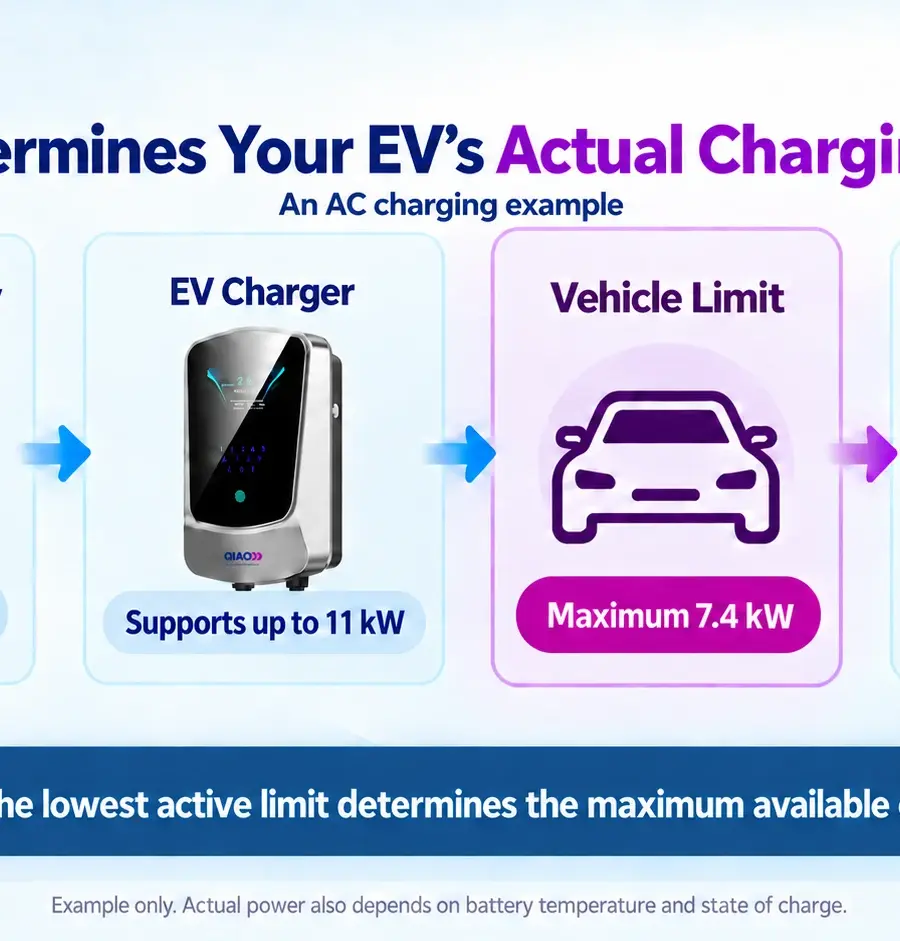
These outlets do not guarantee one charging speed. The circuit, charger, onboard charger, and voltage all set limits. Your car charges at the lowest limit in that chain.
It also helps to separate the two ends of the charging setup. A NEMA plug connects the EV charger to the wall outlet. J1772 or NACS connects the charger to the vehicle. Portable and plug-in wall chargers may use a NEMA outlet. A hardwired home charger connects directly to a dedicated circuit.
This guide compares all three options based on the energy you use each day.
NEMA 5-15 vs. 6-20 vs. 14-50: Quick Comparison
NEMA 5-15 provides slow 120V Level 1 charging, while NEMA 6-20 and 14-50 provide 240V Level 2 charging at different power levels.
| Comparison | NEMA 5-15 | NEMA 6-20 | NEMA 14-50 |
| Typical Charging Voltage | 120V | 240V | 240V |
| Receptacle Rating | 15A | 20A | 50A |
| Common Continuous Charging Current | 12A | 16A | 32A or 40A |
| Approximate Input Power | 1.4 kW | 3.8 kW | 7.7 or 9.6 kW |
| Charging Level | Level 1 | Level 2 | Level 2 |
| Approximate Range Added Per Hour | 2-5 miles | 8-15 miles | 20-35 miles |
| Approximate AC Input in 8 Hours | 11.5 kWh | 30.7 kWh | 61.4 (32A) or 76.8 kWh (40A) |
| Common Charger Type | Portable Level 1 | Portable or lower-power plug-in Level 2 | Portable or wall-mounted plug-in Level 2 |
| Best Fit | Short trips, PHEVs, and backup charging | Moderate daily driving | Longer trips or shorter charging windows |
| New Circuit Often Needed | Not always | Usually | Usually |
The energy figures show the maximum drawn from the circuit before charging losses. The battery will receive less. Range estimates also change with vehicle efficiency, temperature, and battery heating or cooling.
According to the U.S. Department of Energy’s home charging guidance, many EV owners can meet their daily driving needs with overnight Level 1 charging, provided that a suitable outlet on a dedicated branch circuit is available.
Tesla’s current Mobile Connector charging table shows another useful point: its NEMA 6-20 adapter supplies up to 16A, while its NEMA 14-50 adapter supplies up to 32A. A 14-50 outlet can support a 40A EV charger, but the charger itself must be rated for that output.
What Do the NEMA Numbers Mean?
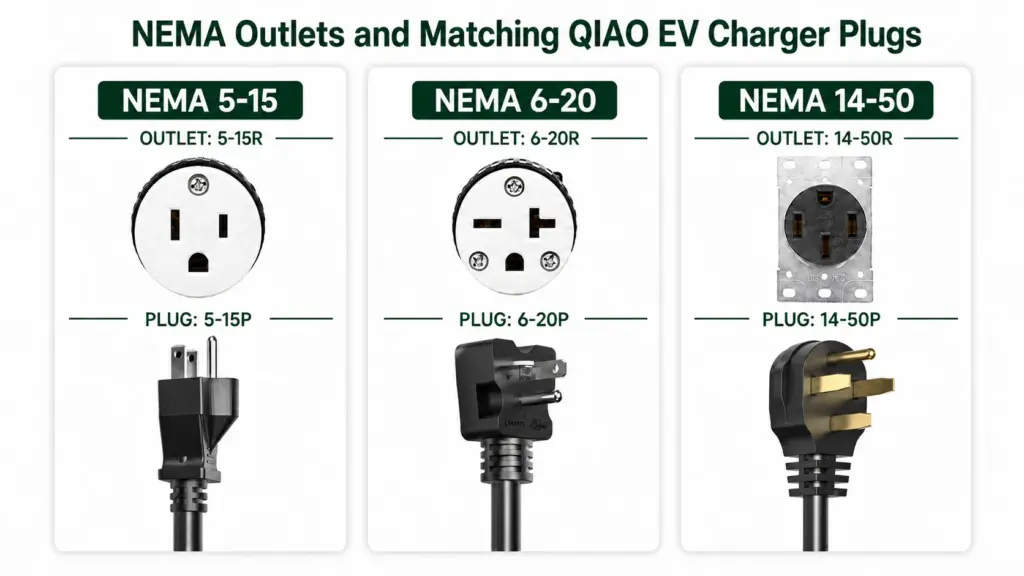
A NEMA number identifies a North American plug and receptacle configuration. The number before the hyphen refers to the voltage and wiring arrangement. The number after the hyphen shows the device’s current rating.
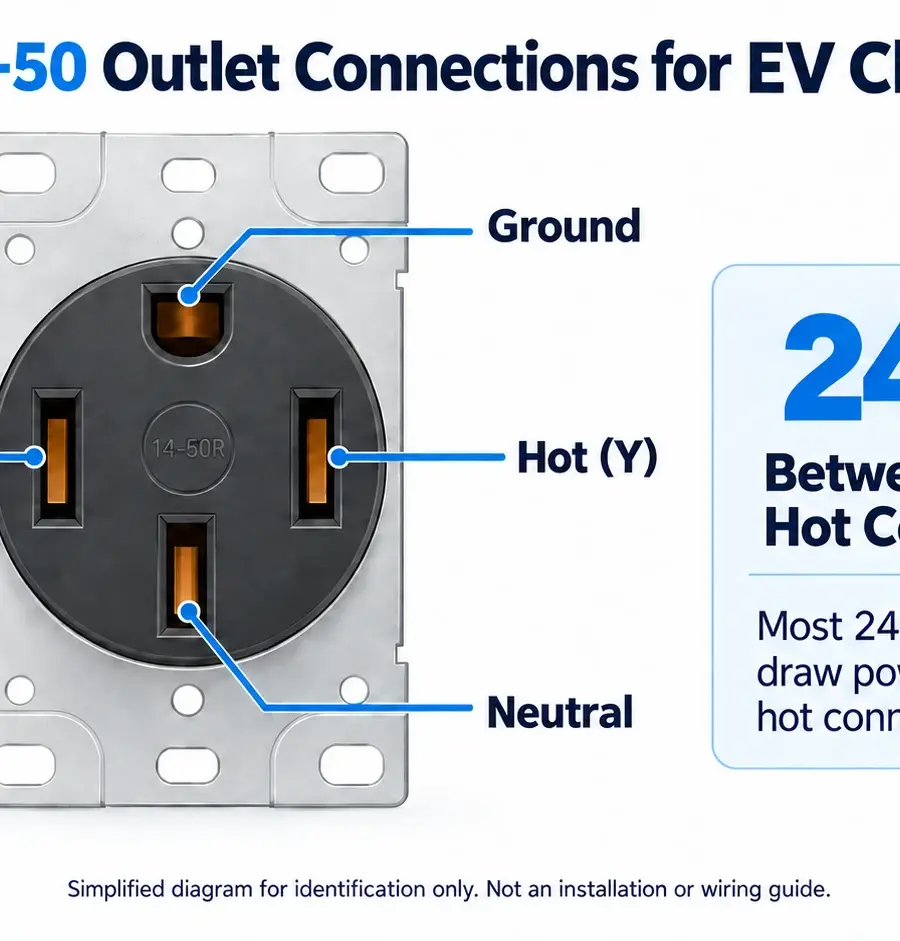
NEMA 5-15 has hot, neutral, and ground conductors. NEMA 6-20 has two hot conductors and a ground. NEMA 14-50 adds a neutral to that 240V layout, though most EV chargers do not use it.
The letter “P” means plug, as in 14-50P. The letter “R” means receptacle, as in 14-50R. Matching the shapes is only the first check. The wiring, breaker, grounding, and charger current must also match.
Which NEMA Outlet Should You Choose?
Choose a NEMA outlet based on daily energy use, charging time, charger current, vehicle limits, and available electrical capacity.
A simple calculation can narrow your options:
Minimum outlet power = daily battery energy to replace ÷ available charging hours
(plus about 10–15% for charging losses.)
For example, replacing 12 kWh in eight hours requires an average of 1.5 kW at the battery. After allowing for charging losses, the outlet may need to supply about 1.7 kW. A NEMA 5-15 outlet provides about 1.4 kW, so it may fall short. A NEMA 6-20 outlet provides enough power with room for normal losses.
Use these charging scenarios as a starting point:
- Choose NEMA 5-15: Pick this outlet when you drive short distances, charge for 8-12 hours, own a PHEV, or need a backup option. Have an existing outlet and circuit checked before using them for daily charging.
- Choose NEMA 6-20: Pick this outlet when Level 1 cannot replace your daily energy, but you can still charge overnight. It pairs with a 16A Level 2 charger and places less demand on the home than a 50A circuit.
- Choose NEMA 14-50: Pick this outlet when you need 32A or 40A charging, drive farther each day, or have fewer hours to plug in. Confirm that your vehicle can accept the available AC power.
- Choose a Hardwired Charger: Consider this setup for 48A charging, a fixed outdoor installation, or a permanent home charging location. Hardwiring also removes the plug-and-receptacle connection point.
Do not choose by battery size alone. A 100 kWh battery that uses 10 kWh per day may not need a 14-50 outlet. A smaller battery may need faster charging when parking time is short.
How Does Each NEMA Outlet Work for EV Charging?
Each NEMA outlet sets a different starting limit for voltage and current. The EV charger must stay within that limit.
NEMA 5-15: Standard Level 1 Charging
NEMA 5-15 supplies about 1.4 kW of continuous EV charging at 120V and 12A. It is the standard household outlet found in homes across the United States and Canada.
This option works for PHEVs, short commutes, overnight parking, and backup charging. It may not recover a full day of highway driving by morning.
A familiar outlet is not always ready for hours of charging. Loose contacts, worn receptacles, shared loads, poor grounding, or damaged wiring can create heat. Follow the charger instructions and have an electrician inspect any outlet with an unknown history.
NEMA 6-20: Lower-Power Level 2 Charging
NEMA 6-20 supplies about 3.8 kW at 240V and 16A. That is about 2.7 times the input power of typical 5-15 charging.
This outlet often covers moderate daily driving overnight. It fits drivers who do not need 7.7-9.6 kW at home. Its 20A circuit also places less demand on the home than a 50A circuit.
NEMA 6-20 still needs a correctly installed 240V circuit, a suitable two-pole breaker, grounding, and a compatible charger. Do not confuse it with NEMA 5-20. A 5-20 outlet supplies 120V, while a 6-20 supplies 240V.
NEMA 14-50: Higher-Power Plug-In Level 2 Charging
NEMA 14-50 can support 40A continuous charging, or about 9.6 kW, on a suitable 50A circuit. A 32A charger draws about 7.7 kW instead.
The receptacle is rated for 125/250V and 50A. Residential EV charging normally uses the 240V connection. A 14-50 setup needs larger conductors and more available electrical capacity than a 6-20 setup.
A 14-50 receptacle does not prove that the circuit behind it is rated for 50A. Follow the EVSE instructions and local rules.
What Determines Your Actual EV Charging Speed?
Your EV charges at the lowest limit set by the circuit, charger, vehicle, and available voltage.
Outlet and Circuit Capacity
The branch circuit sets the maximum current available to the charger. A 20A circuit cannot supply a 32A charging load. The breaker, conductors, receptacle, and grounding all need compatible ratings.
EV charging is treated as a continuous load because it can run for several hours. Common charging settings keep the current at 80% of the circuit rating: 12A on 15A, 16A on 20A, 32A on 40A, and 40A on 50A.
EV Charger Current Rating
The EV charger communicates the maximum current available from the circuit. The vehicle then draws up to that limit, subject to its onboard charger capacity. A 16A charger remains limited to 16A when plugged into a 14-50 outlet. A 32A model reaches about 7.7 kW at 240V, while a 40A model reaches about 9.6 kW.
An adjustable charger must be configured for the circuit and approved input plug. A physical adapter does not raise the circuit capacity.
Vehicle Onboard Charger
The onboard charger sets the vehicle’s maximum AC charging rate. A vehicle that accepts 7.2 kW AC will not take 9.6 kW from a higher-power EVSE. Check the owner’s manual or the vehicle maker’s charging specifications before paying for a larger circuit.
Vehicle Efficiency and Charging Conditions
Vehicle efficiency determines how many miles each kilowatt-hour adds. Sedans, crossovers, and pickups can gain different amounts of range from the same outlet. Cold-weather operation can reduce the result further. Battery temperature, cabin heating, battery conditioning, and conversion losses also affect the final rate.
Compare outlets by kW and overnight kWh first. Use miles per hour as a broad estimate, not a promise.
Can You Use an Existing NEMA Outlet?
You can use an existing NEMA outlet when the receptacle, circuit, charger, and local installation rules all match.
How to Check an Existing Outlet and Circuit
Ask an electrician to confirm these parts before regular EV charging:
- Identify the Receptacle: Confirm the exact NEMA type instead of relying on a general label like “dryer outlet.”
- Check the Breaker and Wiring: Make sure the breaker size, conductor size, grounding, and receptacle match the charging current.
- Confirm Circuit Use: Find out if lights, tools, appliances, or other outlets share the same branch circuit.
- Inspect the Contacts: Stop using a receptacle that feels loose or shows cracks, discoloration, burning, or unusual heat.
- Review the Location: Use outdoor-rated equipment and weather protection for exposed connections.
Can One EV Charger Work With Different NEMA Outlets?
Some portable EV chargers accept manufacturer-approved interchangeable plugs that set a suitable current for each outlet. Most plug-in wall chargers use one fixed NEMA plug, while hardwired units use none.
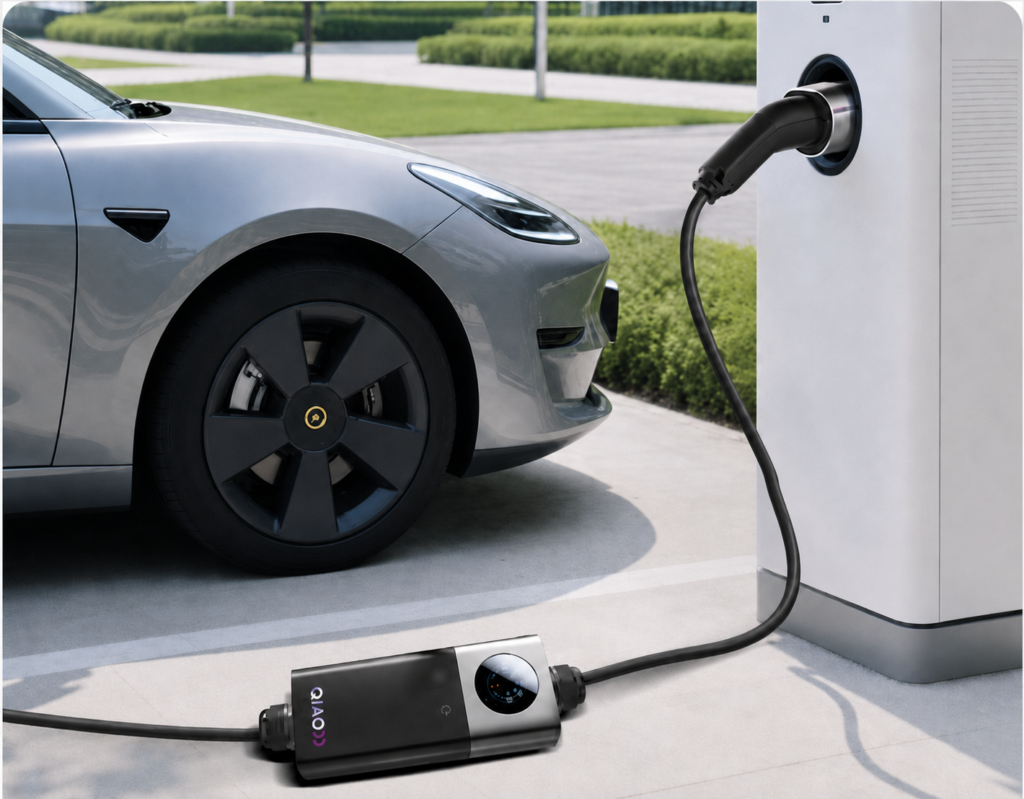
Use only input plugs and adapters approved for the specific EV charger. A generic adapter may change the shape without controlling current. It may also add another high-current connection that can loosen or overheat.
A NEMA 6-50P-to-14-50R adapter may work with some 240V EV chargers because most EV chargers do not use the neutral conductor. However, use it only when the charger manufacturer explicitly permits that connection. If the manufacturer prohibits conversion plugs or does not confirm compatibility, use a matching plug, matching receptacle, or hardwired installation instead.
Can You Use an Existing Dryer Outlet?
An existing dryer outlet may support EV charging when the outlet type, circuit, and EVSE match. Many dryers use NEMA 14-30 or older NEMA 10-30 outlets, not 14-50. A 30A circuit normally limits continuous EV charging to 24A.
Older NEMA 10-30 installations do not provide a separate equipment grounding conductor, so they should not be treated like a modern grounded EV charging outlet. Use only a manufacturer-approved charging solution designed for that connection and have the circuit checked by an electrician.
Do not connect a 32A or 40A charger through a basic adapter. Also avoid running the dryer and vehicle at the same time unless a listed load-sharing device is designed for that use. Have the outlet and wiring checked before starting regular charging.
Do You Need a New Circuit or Electrical Panel Upgrade?
NEMA 6-20 and 14-50 normally need dedicated 240V circuits, but neither one automatically requires a full panel upgrade.
Do You Need a New Circuit?
You will usually need a new circuit when no suitable dedicated outlet exists near the parking space. The electrician will consider circuit length, conductor size, breaker space, grounding, outlet location, and indoor or outdoor exposure.
A 6-20 circuit needs less capacity and smaller conductors than a 14-50 setup in many installations. A 14-50 circuit can cost more, especially when the parking area is far from the panel.
Does EV Charging Require a Panel Upgrade?
A panel upgrade depends on total household demand, not the outlet name alone. An electrician should complete a load calculation that includes heating, cooling, cooking, water heating, and other large loads.
An open breaker space does not prove that the home has enough service capacity. A panel may also need a different breaker arrangement.
Can Load Management Avoid a Panel Upgrade?
Dynamic load management may allow EV charging without a larger electrical service. A compatible system monitors home demand and reduces charger output when other loads rise. The charger can increase output again when capacity becomes available.
This option needs compatible equipment and an approved installation. Ask the electrician to compare load management with a service upgrade.
When Is a Hardwired Charger More Practical?
A hardwired charger fits permanent, outdoor, and higher-output installations. It is the common choice for 48A charging on a suitable 60A circuit and avoids receptacle wear.
Plug-in charging still offers easier replacement, while hardwired charging suits many permanent and higher-output installations. Compare home EV chargers by input connection, current rating, vehicle connector, and installation method.
How Can You Charge Safely From a NEMA Outlet?
Charge safely from a NEMA outlet by using a correctly installed circuit, matching the charger current, and stopping when a connection shows heat or damage.
Follow these NEMA outlet charging checks:
- Have the Circuit Checked: Confirm the breaker, wiring, grounding, receptacle, and charger settings all match.
- Match the Charging Current: Never set the EVSE above the continuous current allowed for the circuit.
- Use Listed Equipment: Choose a charger and accessories with safety certification accepted in your market.
- Avoid Extension Cords: Do not use household extension cords, power strips, or unapproved travel adapters for EV charging.
- Protect Outdoor Connections: Use outdoor-rated equipment, suitable covers, and installation methods required for the location.
- Inspect for Heat and Damage: Stop charging after repeated breaker trips, a loose plug, discoloration, a burning smell, or unusual heat.
- Follow Local Requirements: Ask a licensed electrician about permits, GFCI protection, and the electrical code adopted in your area.
A 14-50 receptacle used for EV charging may carry a high load for hours and face repeated plug insertions. Use a receptacle suited to the expected load and follow its installation instructions.
Final Thoughts
Choose NEMA 5-15 for low daily mileage, PHEVs, and backup charging. Choose NEMA 6-20 for moderate daily energy needs and overnight parking. Choose NEMA 14-50 when you need 32A or 40A Level 2 charging for longer trips or a shorter charging window.
Maximum power should not decide the outlet by itself. Calculate the energy you use each day, divide it by the hours your car stays parked, and leave room for charging losses. Then compare that need with the charger’s current rating, the vehicle’s AC limit, and the home’s available capacity.
Have a licensed electrician check the outlet or design the new circuit. QIAO Charger offers home and portable EV chargers with different input connections, current ratings, and vehicle connectors. Compare each configuration carefully before choosing your setup.
FAQs
NEMA 5-20 is a 120V, 20A configuration, while NEMA 6-20 is a 240V, 20A configuration. EV charging normally uses up to 16A continuously on either circuit. That equals about 1.9 kW on 5-20 and 3.8 kW on 6-20. Their blade layouts differ, so the plugs are not interchangeable.
NEMA 14-50 is not always better than NEMA 6-50 for EV charging. Both can support 240V charging at up to 40A continuously on a suitable 50A circuit. NEMA 6-50 has two hot conductors and ground. NEMA 14-50 adds a neutral that most EV chargers do not use. Choose the receptacle that matches the charger and approved circuit design.
Yes. A standard NEMA 6-20R receptacle has a T-shaped slot that accepts both NEMA 6-15P and 6-20P plugs. However, a 6-20P plug will not fit a 6-15R receptacle. A charger with a 6-15 plug remains limited to its rated current and will not charge faster simply because it is connected to a 20A outlet.