
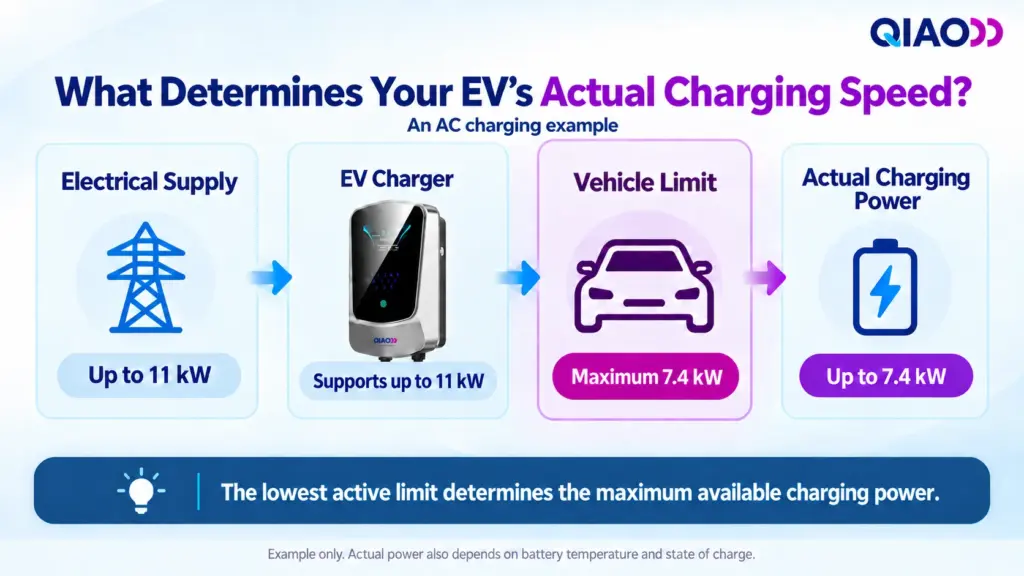
Your EV may charge slowly because the car, charging equipment, electrical supply, battery, or charging conditions are limiting power. The lowest limit in that chain sets the actual charging speed.
A 22 kW AC charger, for example, cannot deliver 22 kW to a car with a 7.4 kW onboard charger. At a DC fast charger, a cold or nearly full battery can reduce power below the station rating.
This guide helps you identify the likely limit, check what you can safely check, and decide who to contact if the problem continues.
Is Your EV Actually Charging Slower Than It Should?
Your EV is charging slower than expected only when its actual power is below the lowest available limit under the same conditions. Charger advertising alone does not set that expectation.
Charging time depends on more than the charger’s rated output. The U.S. Department of Energy explains on its Electric Vehicle Charging Stations page that battery level and capacity, battery type, the vehicle’s internal charger, charging equipment, and electrical service can all affect how long charging takes.
Start by recording five details from the vehicle or charging app:
- Charging Type: Note whether the session uses AC or DC charging.
- Actual Power: Record the displayed power in kilowatts, or the voltage and current when available.
- Battery Level: Record the state of charge when the lower speed appears.
- Conditions: Note the outside temperature and whether the battery was preconditioned.
- Warnings: Save any error message, fault code, or reduced-power notice.
Compare those details with the car’s AC or DC limit and the charger’s available output. A larger battery may take longer to charge, but battery capacity alone does not determine AC charging speed. The vehicle’s onboard charger still limits how much AC power it can accept.
Also, check what the displayed number measures. Charger output is the power entering the vehicle. Some of that energy may run battery heating, battery cooling, or cabin climate control. The battery may gain energy more slowly even when the charger is working as expected.
Check Whether You Are Using AC or DC Charging
AC and DC charging slow down for different reasons. Identify the charging type before changing settings or blaming the charger.
| Charging Type | Where You May Use It | Common Power Limits |
| AC charging | Home wallboxes, portable chargers, workplace chargers, and many public destination chargers | Electrical circuit, available phase, EVSE current, vehicle settings, onboard charger, and load balancing |
| DC fast charging | Highway sites and rapid public charging stations | Vehicle DC acceptance, battery temperature, state of charge, charging curve, station output, and power sharing |
During AC charging, the car’s onboard charger converts AC power into DC power for the battery. The AC session cannot exceed the limits of the electrical supply, charging equipment, cable, settings, or onboard charger.
During DC fast charging, the station supplies DC power to the battery through the vehicle’s charging controls. The onboard AC charger is not the main limit. The car’s battery management system controls how much DC power the battery can accept.
Charging names and power ranges vary by region, so compare the AC EV charging power levels used in your market before deciding that a session is slower than expected.
Quick Diagnostic: Is the Car, Charger, Power Supply, or Battery Causing It?
The pattern often reveals where to start. Compare the current session with a similar session, using the same battery level and weather when possible.
| What You Notice | What to Check First |
| Charging is slow on every compatible charger | Vehicle current limit, charging schedule, battery temperature, state of charge, vehicle charging limit, or vehicle fault |
| Charging is slow only at home | Circuit capacity, outlet or hardwired supply, charger setting, onboard charger limit, connector condition, or home load management |
| Charging is slow at one public station | Station output, shared power, failed hardware, or a station-specific limit |
| Charging slows as the battery fills | Normal charging taper, especially during DC fast charging |
| The same setup gives different speeds on different days | Battery level, battery temperature, building demand, or station congestion |
| Charger power looks normal, but battery percentage rises slowly | Battery heating or cooling, cabin climate control, or other vehicle loads |
| Speed suddenly drops under similar conditions | Changed setting, loose or hot connection, equipment fault, or vehicle warning |
Charging at different speeds in different locations does not always mean something is broken. The same EV can charge at different speeds on different chargers because each station may have a different power rating, power-sharing setup, or site limit.
8 Common Reasons Why Your EV Is Charging Slowly
Most slow EV charging comes from one or more of eight factors: the vehicle’s power limit, the available electrical supply, current settings, a high battery level, battery temperature, shared power, connection problems, or power used by the car while plugged in.
1. Your EV Cannot Accept the Charger’s Full Power
Your EV sets its own charging limit, which may be lower than the charger’s rated output.
For AC charging, the onboard charger is often the limit. A car with a 7.4 kW onboard charger will accept about 7.4 kW or less from an 11 kW or 22 kW AC charger. A higher-rated wallbox does not raise the car’s AC limit.
DC charging uses a separate vehicle limit. A station rated at 350 kW will not make every EV charge at 350 kW. The vehicle may accept a lower peak, and it may hold that peak for only part of the session.
Check the vehicle manual or manufacturer specifications for both values. Look for “maximum AC charging power” and “maximum DC charging power.” They are not interchangeable.
You cannot change a fixed vehicle limit through the charger. Match your expectations to the car’s specifications and the available electrical supply. When the wallbox rating is higher than the power shown by your car, the vehicle’s onboard charger may be limiting AC charging power.
2. The Electrical Supply Provides Less Power
Your charger cannot deliver more power than the circuit and electrical service can safely provide.
This issue is common at home. Supply voltage, circuit rating, wiring, phase, plug type, and installation settings can all affect available power. A 230 V supply at 13 A provides about 3.0 kW before conversion losses. In this case, a reading close to 3 kW may be normal rather than a charger fault.
Single-phase and three-phase service can also change the result. Three-phase power can support 11 kW or 22 kW AC charging in many regions. The vehicle, charger, wiring, and local supply must all support it. A three-phase installation will not increase the speed of a car that accepts only single-phase AC power.
Do not increase a circuit breaker, replace a plug, or alter wiring to chase a higher number. Ask a qualified electrician to confirm the circuit rating, cable size, protective devices, voltage, and installation settings. The vehicle’s AC limit and the available electrical service help determine whether three-phase power is needed for EV charging.
3. The Vehicle or Charger Is Set to a Lower Current
A saved current limit or charging mode can reduce power even when the equipment supports more.
Check the vehicle screen, vehicle app, and charger app for settings linked to the current location. Some cars remember a reduced current for a specific address. A schedule may delay charging, while a solar-only or surplus-solar mode may vary output with available generation. A charger may also reduce current after an installer sets a lower site limit.
Review these settings before resetting equipment:
- Vehicle Current Limit: Confirm that the car is not using a lower saved current.
- Charger Output Limit: Check the user setting without changing installer-only limits.
- Charging Schedule: Confirm the session is allowed to start and run at the expected time.
- Energy Mode: Check whether solar, off-peak, or building-load controls are reducing output.
- Software Alert: Read any message before updating or restarting the system.
Only raise an adjustable current after checking the maximum charging current for your EV, the charger rating, and the circuit capacity. Never use an app setting to override the limits of the electrical installation.
4. Charging Slows as the Battery Fills
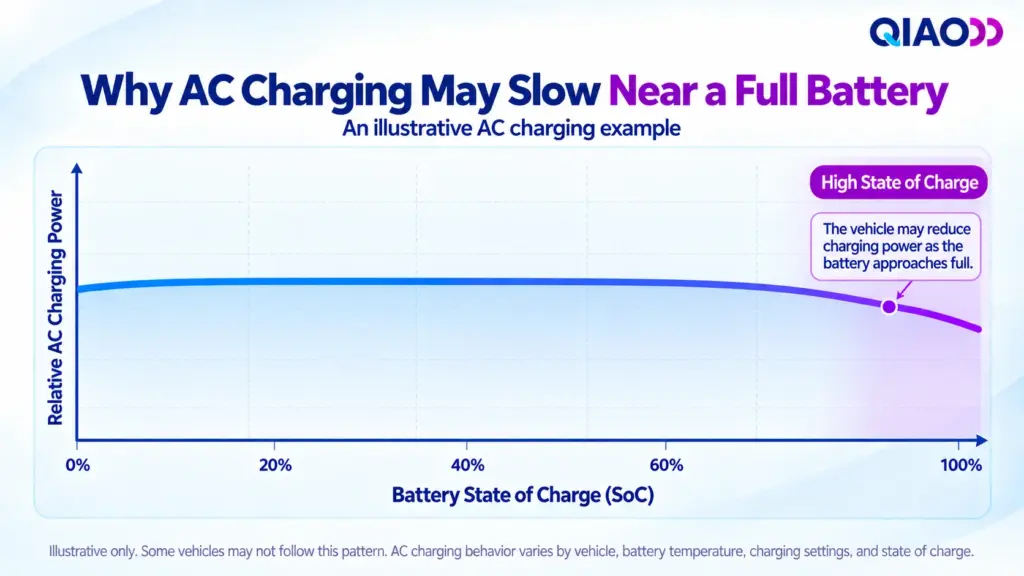
EV charging often slows at a high state of charge because the battery management system reduces power to protect the cells.
The change is usually easier to see during DC fast charging. Many vehicles accept their highest DC power at a lower state of charge, then reduce it as the battery fills. Drivers often notice this near 80%, but 80% is not a fixed rule for every EV. The charging curve depends on the vehicle, battery, temperature, and session conditions.
AC charging may also reduce power near the charge limit. The change is often less dramatic because AC power was lower from the start. Balancing cells and managing the final part of the charge can also extend the remaining time.
Compare the charging speed at the same charger when the battery is at a lower level. A faster session at 20% than at 85% usually points to normal battery control. During home charging, a drop near the end may follow the vehicle’s AC charging power curve rather than indicate a charger fault.
5. The Battery Is Too Cold or Too Hot
Battery temperature can limit charging power until the pack reaches a suitable operating range.
In cold weather, the vehicle may use incoming energy to warm the battery before raising the charging rate. DC fast charging can stay below its expected peak when you arrive with a cold battery. In hot weather, the cooling system may run and the vehicle may lower power to control battery temperature.
Use battery preconditioning when your vehicle provides it. Some EVs start preconditioning when you select a fast charger in the vehicle’s route planner. The process varies by model, so follow the vehicle manual.
For home charging, parking in a sheltered location may reduce exposure to extreme temperatures. Both cold and hot weather can reduce EV charging performance when the vehicle limits power to protect the battery. Do not cover the charger or charge port in a way that blocks cooling or traps moisture
6. The Available Power Is Being Shared
Load management can lower charging power when a home, building, or public station must divide limited capacity.
At home, dynamic load balancing may reduce EV charging when appliances, heating, cooling, or other large loads raise total demand. Power can increase again after those loads switch off. This is expected when the system is protecting the electrical supply from overload.
At public sites, two charging ports may share a power cabinet or site connection. Available power can fall when another vehicle starts charging.
Check the charger app or station display for a shared-power notice. At home, compare charging power when major household loads are lower. Load balancing may be needed for EV charging when the charger shares limited electrical capacity with other household loads, so do not disable it without installer approval.
7. A Cable, Connector, Adapter, or Outlet Has a Problem
A damaged, loose, dirty, or overheated connection can reduce current or interrupt charging.
Inspect only the parts the manufacturer allows the user to handle. Stop the session first, then look for visible damage, bent or contaminated contacts, poor connector fit, discoloration, melting, or moisture. Check the vehicle and charger for an error message.
A connector that is not fully inserted may fail to lock or communicate correctly. An incompatible or damaged adapter can also cause reduced power or repeated stops. For plug-in home charging, a worn outlet or poor connection may heat under a long, continuous load.
Do not open the charger, repair a cable, clean energized contacts, or keep charging through a hot connection. Stop using the equipment if you notice excessive heat, a burning smell, melted plastic, dark marks, exposed conductors, or repeated breaker trips. Contact the charger provider, installer, or a qualified electrician.
Normal cable length is rarely the first cause of a large speed loss when the cable is approved and undamaged. Check connection condition and equipment ratings first.
8. The Car Is Using Some of the Incoming Power
Battery heating, battery cooling, and cabin climate control can reduce the power left for charging the battery.
This effect is easier to notice during lower-power AC charging. A heating system that uses part of a 2 kW or 3 kW input leaves less power for the battery. On a higher-power charger, the same vehicle load may make a smaller percentage difference.
Look at both charger output and battery gain. The charger may show steady power while the estimated completion time changes or the battery percentage rises slowly. Reduce cabin heating or cooling when practical, but do not switch off battery thermal management. The vehicle controls that system for battery safety and performance.
These vehicle loads do not always indicate a fault. Compare the session again after the cabin is empty and the battery temperature has stabilized.
How Do You Fix Slow EV Charging?
Fix slow EV charging by identifying the active limit before changing equipment or settings. Work through these seven steps in order.
- Record the Session: Note AC or DC charging, actual kW, battery level, temperature, charge limit, and any warning message.
- Compare the Power Limits: Check the charger rating, available electrical supply, vehicle AC limit, and vehicle DC limit.
- Review User Settings: Check current, schedules, location-based limits, solar modes, and charge limits.
- Check Battery Conditions: Compare performance at a lower state of charge and use approved preconditioning when available.
- Inspect Accessible Connections: Look for poor insertion, damage, moisture, unusual heat, odor, or discoloration without opening equipment.
- Try Another Compatible Charger: A second home unit or public station can help separate a vehicle issue from a charger or site issue.
- Contact the Right Service Provider: Use the pattern you found to contact the station operator, installer, electrician, charger provider, or vehicle service center.
Change one condition at a time when possible. Test another compatible charger at a similar battery level before changing several app settings. This makes the cause easier to identify.
When Is Slow Charging Normal and When Should You Stop?
Slow charging is often normal when the battery is cold, nearly full, or connected to a lower-power supply. Heat, damage, repeated interruptions, and electrical warnings need attention.
| Usually Normal | Stop Charging and Get Help |
| Power falls as the battery approaches its charge limit | The plug, connector, adapter, cable, or outlet becomes unusually hot |
| A cold battery charges slowly before warming | You smell burning or see melting, dark marks, or exposed conductors |
| A 3 kW supply delivers close to 3 kW | A breaker or protective device trips repeatedly |
| Home charging drops while load balancing is active | Charging repeatedly stops with fault messages |
| Public charging slows when station power is shared | Water is inside the connector or charge port |
| Charger output is partly used for cabin or battery conditioning | The vehicle or charger tells you to stop using the equipment |
Follow the warnings in the vehicle and charger manuals. Do not keep reconnecting equipment that shows the same electrical or temperature fault.
FAQs
Slow charging is not normally bad for an EV battery. Lower-power AC charging usually produces less heat than high-power DC charging, although the vehicle manages both methods. Slow charging needs attention when it appears with overheating, a burning smell, repeated interruptions, or warning messages. Follow the charging limits recommended by the vehicle manufacturer.
Your EV may charge at about 3 kW because of the supply, current setting, onboard charger, or load management. A 230 V supply at 13 A provides about 3.0 kW before losses, so this reading can be normal. Check the vehicle’s AC limit, charger setting, circuit rating, and any active household load control.
A sudden drop can come from battery level, temperature, a saved current setting, building demand, shared station power, or a connection fault. Compare the new session with an earlier one under similar conditions. Test another compatible charger if the lower speed continues.
Battery aging can reduce usable capacity and may affect charging performance in some vehicles. One slow session does not prove that the battery has degraded. First compare state of charge, temperature, charger output, and vehicle settings. Ask the vehicle service center to check battery health if charging stays slower across several compatible chargers.
·Contact the public charging operator if the issue occurs at one station.
·Contact the installer or a qualified electrician if it occurs only at home.
·Contact the vehicle manufacturer or service center if the car charges slowly on several compatible chargers.
Stop charging first if you notice heat, odor, melting, repeated trips, or exposed wiring.
Final Thoughts
Slow EV charging does not always mean the charger has failed. Start with the charging type, actual power, battery level, temperature, and vehicle settings. Then compare the lowest limit across the car, charger, and electrical supply.
Replace or upgrade equipment only after that check shows a real mismatch. Compare QIAO home EV chargers and portable EV chargers if your setup cannot meet your daily needs. Choose by connector, power, input type, and vehicle compatibility. A qualified electrician should confirm the circuit and installation requirements before you raise charging power.