
Charging an electric car can take under an hour for a DC fast-charge top-up or several hours with home AC charging. Fully recharging a large EV battery from a standard 120 V outlet can take more than a day.
Your charging time depends on how much energy you need to add and how much power your car can accept. Replacing the energy used on your daily commute may take much less time than charging from empty.
This guide compares charging methods and explains how to estimate your charging time, so you can check whether your car will be ready when you need it.
EV Charging Times at a Glance
Charging time changes with the power available, even when you add the same amount of energy. The AC examples below show the estimated time to charge a battery with 60 kWh of usable capacity from 20% to 80%, adding 36 kWh.
| Charging Setup | AC Input Power Used in Example | Estimated Time, 20%–80% |
| North American 120V outlet, 12A — Level 1 | 1.44 kW | About 27.8 hours |
| 230V household outlet, 10A | 2.3 kW | About 17.4 hours |
| Home or public AC charging | 7 kW | About 5.7 hours |
| North American 240V supply, 40A — Level 2 | 9.6 kW | About 4.2 hours |
| AC charging with a suitable vehicle and supply | 11 kW | About 3.6 hours |
| AC charging with a suitable vehicle and supply | 22 kW | About 1.8 hours |
These are calculated examples, not vehicle test results. They assume steady input power, 90% charging efficiency and no interruptions.
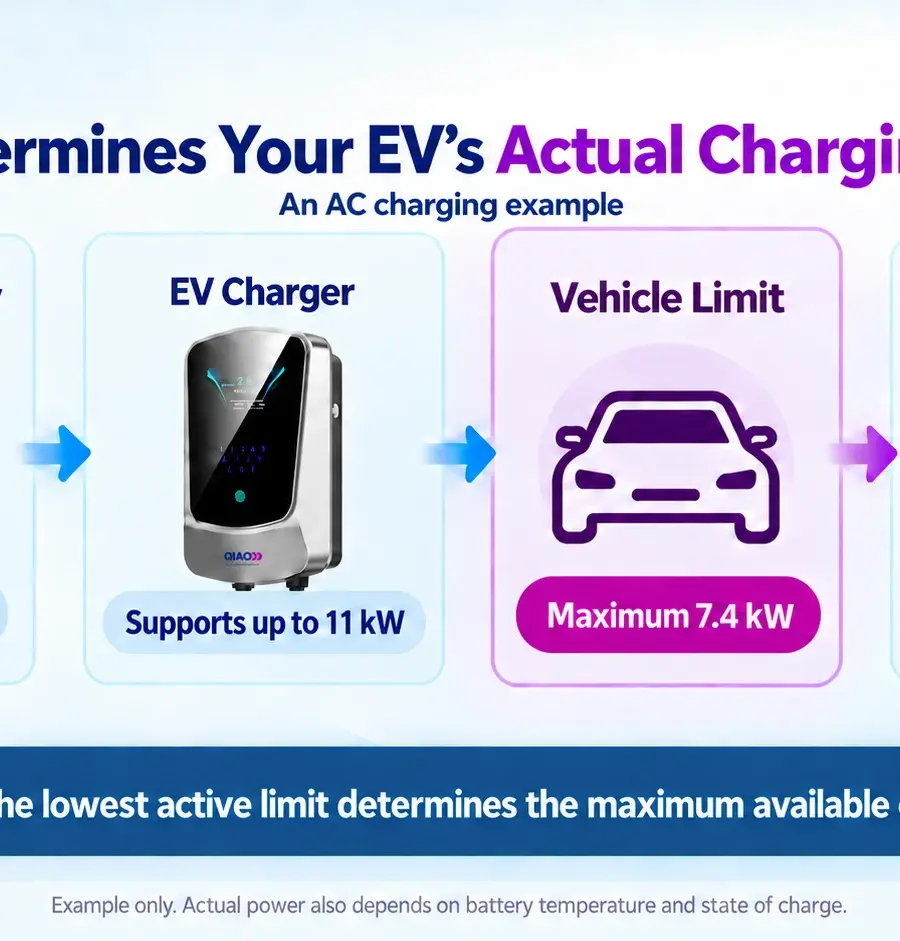
Your car, charging equipment, cable and electrical supply must support the power shown. A car limited to 11 kW AC would take about 3.6 hours in this example, even on a 22 kW charger.
In the UK and much of Europe, 11 kW and 22 kW AC charging typically require a three-phase supply and a vehicle that supports three-phase AC charging.
Charging efficiency also varies. Cold conditions, battery heating and lower efficiency can extend these times, particularly when charging at low power.
DC fast charging needs a separate comparison. Hyundai’s IONIQ 5 performance page lists an 18-minute charge from 10% to 80% for its 84 kWh Long Range version using a 350 kW DC station.
That figure applies to a specific vehicle and charging conditions. Check the starting and target battery levels, vehicle version and charger requirements before comparing DC charging times.
How Can You Calculate Your EV’s Charging Time?
Estimate AC charging time using three details: the energy you need to add, your average charging power and charging efficiency.
Work Out How Much Energy You Need
Start with your vehicle’s usable battery capacity, current battery level and target level.
Energy needed = usable battery capacity × (target % − starting %) ÷ 100
For a 60 kWh usable battery charging from 20% to 80%:
60 × (80 − 20) ÷ 100 = 36 kWh
You need to add 36 kWh to the battery. Keep battery capacity and charging speed separate: kWh measures energy, while kW measures how quickly that energy is supplied.
Check Your Actual AC Charging Power
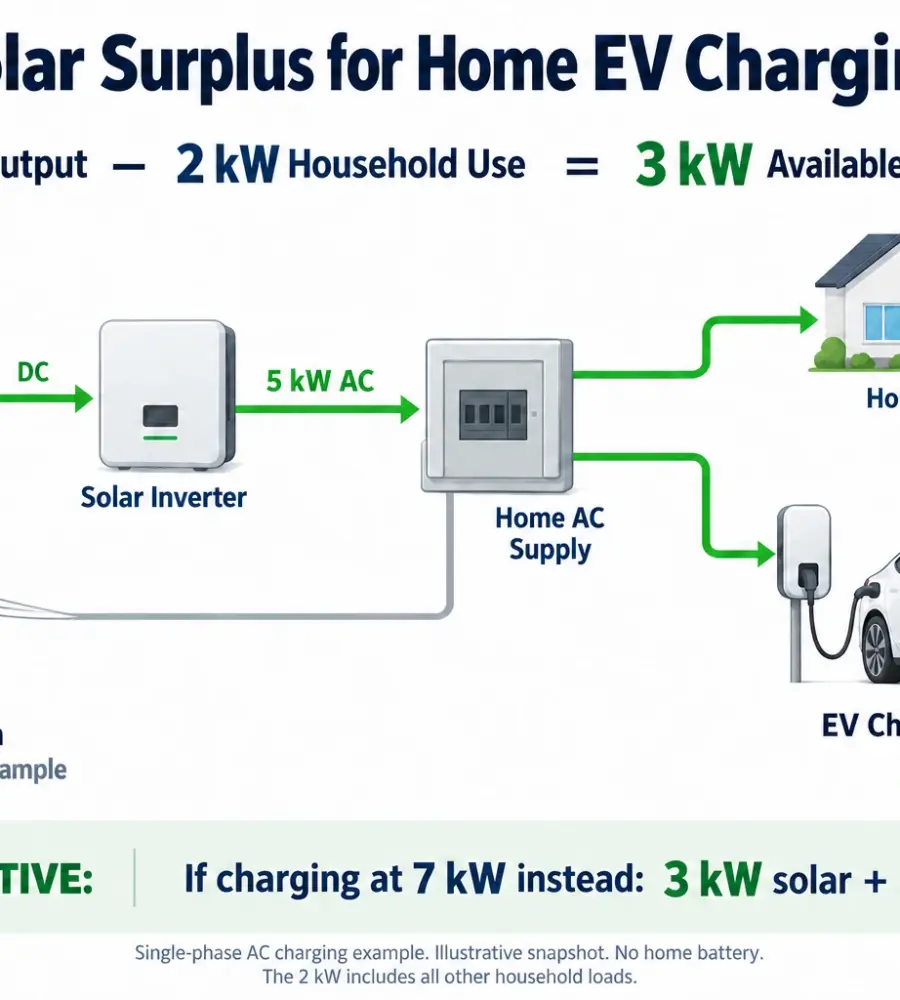
Find your car’s maximum AC charging rate in its specifications or owner’s manual. Then check the power shown by the vehicle or charging equipment during a session. Supply limits, current settings and household demand can reduce the available power.
A session record can help you find the average. For example, an AC charger supplying 18 kWh over three hours averages 6 kW. That measures AC energy supplied to the car, before losses inside the vehicle.
Use energy and time figures from the same session. Check whether the recorded duration includes pauses, especially when estimating total time before departure.
Allow for Charging Losses
Some supplied electricity powers vehicle systems or becomes heat instead of being stored in the battery. Include these charging losses in your estimate:
Charging time = energy needed ÷ (average AC input power × estimated efficiency)
Adding 36 kWh at an average input of 7 kW, with an assumed efficiency of 90%, takes:
36 ÷ (7 × 0.90) ≈ 5.7 hours
Efficiency varies, so 90% is an example assumption. If your power figure already measures what reaches the battery, do not deduct losses again.
For DC fast charging, use your vehicle’s published time for the relevant battery range or reliable test data. Dividing energy by the station’s peak power can underestimate the time needed.
How Long Does It Take to Charge an Electric Car at Home?
At home, replacing a day’s driving energy may take a few hours, while recharging a nearly empty battery can take much longer. Compare the energy you need with the hours available before your next journey.
Charging From a Household Outlet
A household outlet can meet some daily charging needs, but a large recharge may extend beyond one night.
The earlier examples use 1.44 kW from a 120V supply at 12A, and 2.3 kW from a 230V supply at 10A. Available power depends on your outlet, circuit and charging equipment.
For North American homes, NEMA outlet options provide different power levels. Have an electrician confirm that the outlet and circuit suit the intended charging load.
Charging With a Dedicated Home Charger
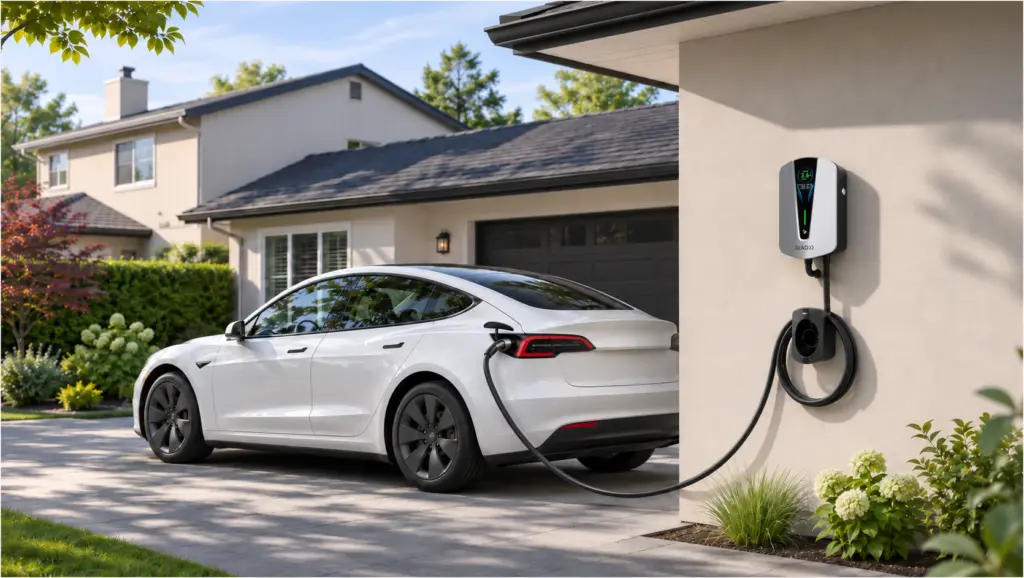
A home EV charger may plug into a suitable outlet or connect directly to a dedicated circuit. Faster charging requires a power supply, charging equipment and vehicle that all support the higher rate. A charger connected to an ordinary household outlet remains limited by the power that outlet and its circuit can safely supply.
Check your car’s maximum AC charging rate before choosing a power level. A portable charger can also provide higher AC power with a suitable configuration and supply. Charging speed depends on the equipment’s power rating and the limits of the vehicle and supply.
Replacing Your Daily Driving Energy
Suppose you need to replace 12 kWh of battery energy each day. At steady input power and an assumed 90% charging efficiency, the estimated times are:
| AC Input Power Used in Example | Time to Replace 12 kWh |
| 1.44 kW | About 9.3 hours |
| 2.3 kW | About 5.8 hours |
| 7 kW | About 1.9 hours |
These are examples, not average driving requirements. Use your own energy consumption and available charging hours to judge whether overnight charging is enough.
Allow Extra Time After a Longer Trip
A setup that covers daily commuting may need several nights to recover from a longer journey.
Suppose charging adds 18 kWh to your battery each night, while daily driving uses 12 kWh. That leaves 6 kWh per day to rebuild your reserve.
A further 36 kWh shortfall after a long trip would take about six nights to close, assuming those daily figures stay unchanged. Allow for this recovery time when assessing your home charging needs.
How Long Does It Take at a Public Charging Station?
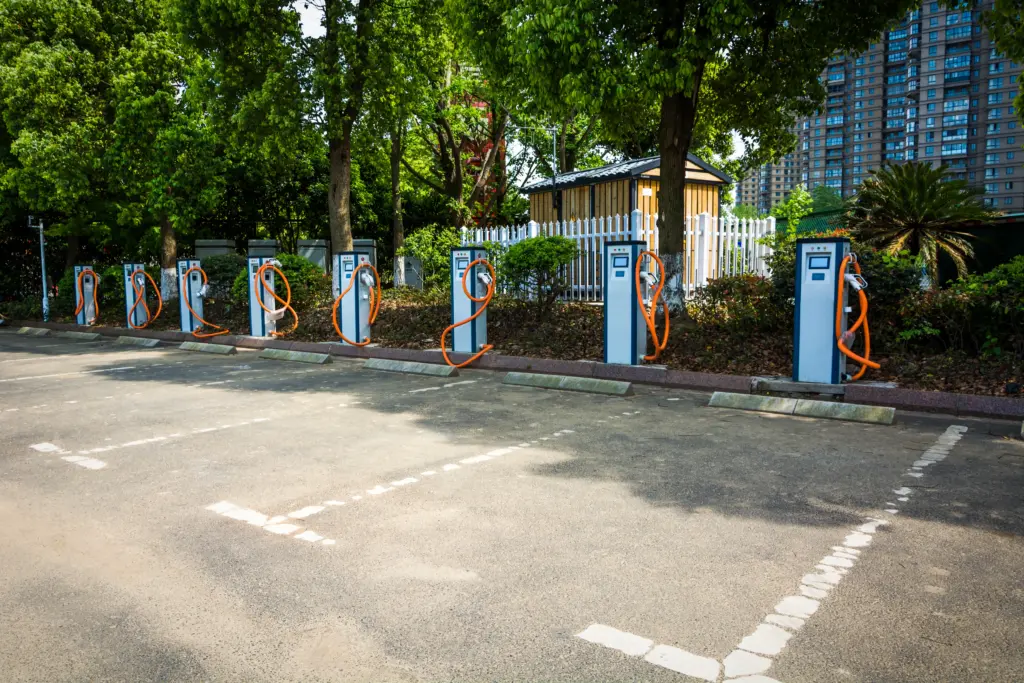
A substantial recharge can take tens of minutes or longer with DC fast charging, or several hours with public AC charging.
Public AC Charging During Longer Stops
Public AC chargers at hotels, workplaces and car parks use your vehicle’s onboard charger, just as home AC charging does. Check the station’s available power against your car’s AC limit.
Use the AC estimates above to judge how much charging fits your visit. A short shopping stop may add useful energy without filling the battery. Overnight hotel parking gives you a longer charging window.
DC Fast Charging During a Road Trip
The IONIQ 5 example above shows why the station matters. For the same 84 kWh Long Range version, Hyundai lists 76 minutes at a 50 kW DC station, compared with 18 minutes at a 350 kW station, both from 10% to 80%.
These are manufacturer figures for that configuration. Battery temperature, starting charge level and available station power affect your result. A 350 kW station rating does not mean the car receives 350 kW throughout the session.
Plan each stop around the energy needed for the next part of your journey, with a reserve. You may not need to charge to 100%.
Also allow time for reaching the station, queuing, connecting and starting the session. Your total stop can be longer than the charging time shown on the screen.
Why Does Charging to 100% Take Longer Than Charging to 80%?
Charging to 100% requires more energy than stopping at 80% from the same starting level. During DC fast charging, many vehicles also reduce the power they accept as the battery fills.
This slowdown means the final 20% can take longer than you might expect. A published 10%–80% charging time therefore cannot tell you how long a full charge will take. The point where power falls, and how quickly it drops, varies by vehicle and charging conditions.
AC charging can behave differently. Its lower power may remain fairly steady until closer to full. Avoid applying a DC charging curve directly to your home charging estimate.
Choose your target battery level according to your vehicle’s guidance and next journey. For example, Tesla’s Model Y charging instructions direct owners to the car’s screen or app for recommended daily and trip charging limits.
An 80% target is not a universal rule for every EV. You may need a higher level before a longer journey, while routine daily driving may require less energy.
Why Is Your EV Taking Longer to Charge Than Expected?
Start by checking whether your EV is charging at lower power than expected or spending time connected without charging. Both extend the time needed, but they point to different causes.
| What You Notice | What to Check |
| Power stays below the charger’s rating | Your car’s AC or DC limit, the available supply and current settings |
| Charging slows when household demand rises | Whether home load management is reducing charging power |
| Power changes at a public station | Whether the station is sharing power or has an output restriction |
| Overnight charging adds less energy than expected | Vehicle and charger schedules, interruptions and the battery charge limit |
| Charging takes longer in cold or hot conditions | Battery temperature, vehicle messages and any recommended battery preparation |
| Power falls as the battery approaches full | Whether this matches the vehicle’s normal charging behaviour |
Compare sessions with similar starting and target battery levels. A longer session may simply involve adding more energy.
For example, a charger may be connected for eight hours but supply power for only four because of a schedule. That differs from charging continuously at reduced power. Check both the actual power and the time spent charging.
These checks help explain why charging speed varies between chargers, but a sudden, repeated slowdown deserves closer attention.
Record the starting and ending battery levels, charging power, session duration and any error messages. Contact your vehicle or charger support team if the change continues under similar conditions, especially when a warning appears.
Is Your Available Charging Time Enough?
Your charging window is enough when it can supply the energy you need before departure, with some spare time for interruptions or reduced power.
Count the hours when charging is actually possible. A car parked overnight may have a shorter charging window because of vehicle settings or an electricity tariff. You can schedule charging within your off-peak window, but check that the available hours meet your needs.
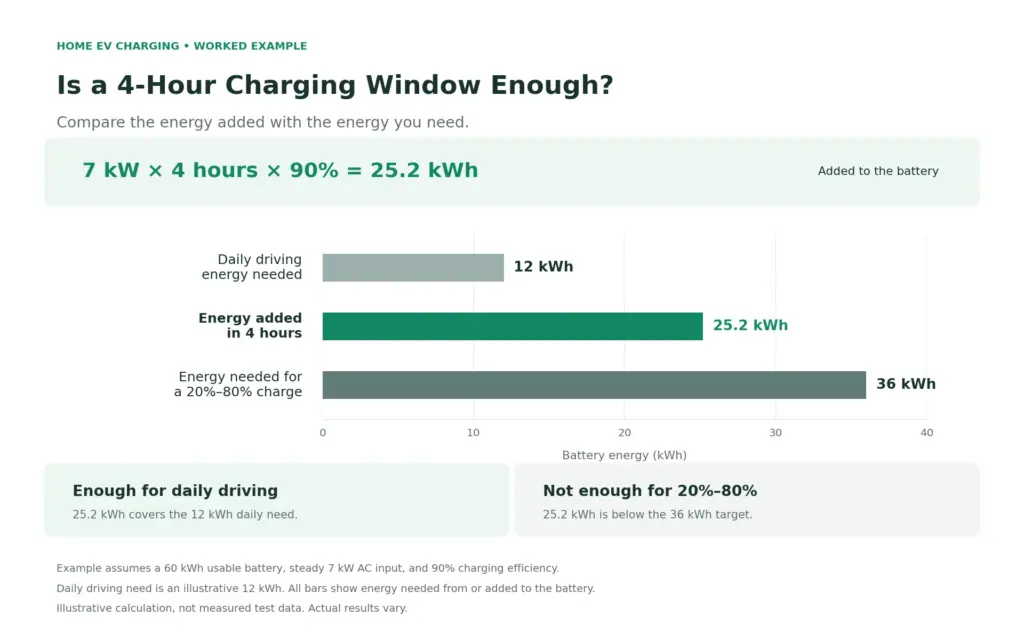
For example, four hours at a steady 7 kW input adds about 25.2 kWh to the battery, assuming 90% charging efficiency:
7 × 4 × 0.90 = 25.2 kWh
That covers the earlier 12 kWh daily top-up, but falls short of the 36 kWh needed for a 60 kWh battery to go from 20% to 80%.
You can also work backwards to estimate the average input power required:
Required average AC input power = energy needed ÷ (available hours × estimated efficiency)
| Energy Needed | Available Time | Required Average AC Input |
| 12 kWh daily top-up | 4 hours | About 3.3 kW |
| 36 kWh larger recharge | 4 hours | About 10 kW |
Both examples assume 90% efficiency and include no extra time allowance.
Allow for lower power when planning. Adding 36 kWh takes about 5.7 hours at an average input of 7 kW, but eight hours at 5 kW under the same efficiency assumption.
Use this estimate when comparing 7 kW, 11 kW and 22 kW home charging options.
About QIAO Charger
At QIAO Charger, we develop and manufacture AC charging equipment with our own R&D team and factory. Our range includes home wallboxes, portable EV chargers and commercial AC charging stations.
We help you compare charger configurations based on your vehicle’s AC charging limit, available power supply and parking hours. Share your vehicle model, model year, country and daily charging needs with our team through the website’s WhatsApp contact.
We also work with distributors, retailers and partners delivering EV charging projects. Contact QIAO Charger about a partnership to discuss product selection, documentation, supply and project requirements.