Table of Contents
AC Charging Load Management Algorithms: Static vs Dynamic vs AI-Based
As EV adoption grows, one of the biggest challenges in deploying AC EV charging infrastructure is not hardware—but power allocation.
When multiple vehicles charge simultaneously, unmanaged loads can:
- overload electrical systems
- trigger circuit breakers
- increase peak demand charges
This is where load management algorithms become critical.
They determine how power is distributed across chargers in real time.
What Is Load Management in EV Charging?
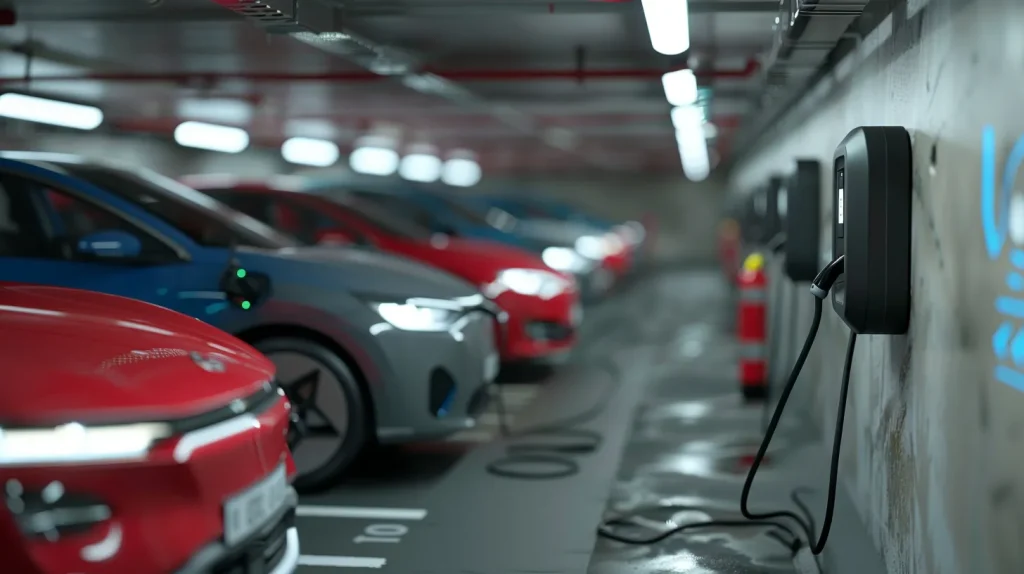
Load management refers to controlling how electricity is allocated across multiple chargers to stay within system limits.
Overview:
https://en.wikipedia.org/wiki/Load_management
In AC charging scenarios, load management ensures:
- grid stability
- safe operation
- optimal energy usage
Why Load Management Matters
Without proper load control:
| Issue | Impact |
| Peak overload | System shutdown |
| Uneven power distribution | Poor user experience |
| High demand charges | Increased electricity cost |
With load management:
- infrastructure cost can be reduced by 30–50%
- more chargers can be installed on the same grid capacity
- energy efficiency improves
Three Core Load Management Algorithms
1. Static Load Management
Static load management is the simplest approach.
Each charger is assigned a fixed maximum power limit
How It Works
- Total available power is divided equally
- No real-time adjustment
- No communication between chargers
Example
| Total Capacity | Chargers | Power per Charger |
| 60 kW | 6 | 10 kW each |
Advantages
- easy to deploy
- low cost
- stable operation
Limitations
- inefficient when chargers are idle
- cannot adapt to real-time demand
2. Dynamic Load Management
Dynamic load management adjusts power allocation based on real-time conditions.
Power is redistributed depending on active charging sessions.
How It Works
- monitors active chargers
- reallocates unused capacity
- integrates with building load
Smart charging concept:
https://en.wikipedia.org/wiki/Smart_grid
Example
| Scenario | Active Chargers | Power Allocation |
| Low usage | 2 chargers | 30 kW each |
| Medium usage | 4 chargers | 15 kW each |
| High usage | 6 chargers | 10 kW each |
Advantages
- higher efficiency
- better user experience
- supports more vehicles
Limitations
- requires communication system
- slightly higher cost
3. AI-Based Load Management
AI-based systems represent the next evolution.
They use data, prediction, and optimization algorithms to manage charging.
Artificial intelligence overview:
https://en.wikipedia.org/wiki/Artificial_intelligence
How It Works
- analyzes historical charging behavior
- predicts demand patterns
- optimizes charging schedules
Often integrated with:
- energy pricing data
- renewable energy sources
- battery storage systems
Example Capabilities
| Feature | Benefit |
| Demand prediction | Avoid peak loads |
| Time-of-use optimization | Lower electricity cost |
| User prioritization | VIP / fleet optimization |
Advantages
- maximum efficiency
- cost optimization
- future-ready infrastructure
Limitations
- higher implementation complexity
- requires data infrastructure
Static vs Dynamic vs AI-Based: Comparison
| Feature | Static | Dynamic | AI-Based |
| Complexity | Low | Medium | High |
| Efficiency | Low | Medium | High |
| Cost | Low | Medium | High |
| Scalability | Limited | Good | Excellent |
| Real-time control | No | Yes | Yes |
| Predictive capability | No | No | Yes |
When to Use Each Algorithm
| Scenario | Recommended Approach |
| Small residential | Static |
| Apartment / MUD | Dynamic |
| Commercial / office | Dynamic |
| Fleet / depot | AI-based |
| Large-scale networks | AI-based |
Integration with Energy Systems
Modern load management systems often integrate with:
- renewable energy
- energy storage systems
- demand response programs
Demand response overview:
https://en.wikipedia.org/wiki/Demand_response
This enables:
grid-friendly and cost-efficient charging ecosystems
Business Impact of Load Management
For operators and developers, load management enables:
- reduced infrastructure upgrades
- lower peak demand charges
- higher charger utilization
- scalable deployment
In many cases:
dynamic load management alone can reduce infrastructure cost by 20–40%

About QIAO
QIAO delivers intelligent AC EV charging solutions with advanced load management capabilities.
Our systems support:
- static and dynamic load balancing
- AI-based smart charging optimization
- OCPP-compatible backend integration
- scalable deployment for residential and commercial projects
QIAO helps businesses build efficient, future-ready EV charging networks.
FAQ
What is the simplest load management method?
Static load management with fixed power allocation.
Is dynamic load management necessary?
Yes, for multi-charger environments to improve efficiency.
What makes AI-based charging different?
It predicts demand and optimizes charging automatically.
Can load management reduce electricity cost?
Yes, especially when combined with smart charging and time-of-use pricing.