
As EV adoption accelerates globally, one critical question emerges:
Will AC charging remain relevant in the future, or be replaced by fast DC charging?
Despite the rapid growth of DC fast charging, data shows that:
AC charging will remain a foundational part of EV infrastructure
—but its role will evolve significantly.
Global EV Growth: The Foundation of Charging Demand
EV adoption is the key driver behind charging demand.
According to the International Energy Agency:
- Global EV sales exceeded 14 million in 2023
- EVs could represent over 60% of new car sales by 2030
Source (add external link):
- IEA Global EV Outlook: https://www.iea.org/reports/global-ev-outlook-2024
Insight:
More EVs = more demand for all types of charging, including AC.
Trend 1: Larger Batteries Increase Charging Demand
Future EVs are equipped with:
- Larger battery capacities
- Longer driving ranges
Impact:
- More energy needed per charge
- Longer charging sessions
According to BloombergNEF:
- Average EV battery size is continuously increasing
- Long-range EVs are becoming mainstream
Source (add external link):
- BloombergNEF EV Outlook: https://about.bnef.com/electric-vehicle-outlook/
What this means:
AC charging sessions may become longer—but still highly relevant for overnight charging.
Trend 2: Faster Onboard Chargers (OBC)
One major evolution is in onboard charger (OBC) technology.
- Older EVs: 3.7–7 kW
- Newer EVs: 11 kW / 22 kW
Especially in Europe, where three-phase power is common.
Source (add external link):
- NREL EV charging fundamentals: https://www.nrel.gov/docs/fy17osti/69031.pdf
Insight:
AC charging is becoming faster and more efficient, not obsolete.
Trend 3: AC Charging Dominates Daily Use
Data shows that most charging happens:
- At home
- At workplaces
According to the U.S. Department of Energy:
- 80–90% of EV charging occurs at home or work
Source (add external link):
- DOE EV charging basics: https://afdc.energy.gov/fuels/electricity_infrastructure.html
Conclusion:
AC charging will remain the primary daily charging method
Trend 4: Smart Charging Will Redefine AC Value
Future AC charging will not just deliver energy—it will become intelligent.
Key developments:
- Load management
- Time-of-use optimization
- AI-based scheduling
According to National Renewable Energy Laboratory:
- Smart charging can significantly reduce grid stress and costs
Source (add external link):
- NREL smart charging research: https://www.nrel.gov/transportation/ev-smart-charging.html
Insight:
AC charging will evolve into a smart energy management tool
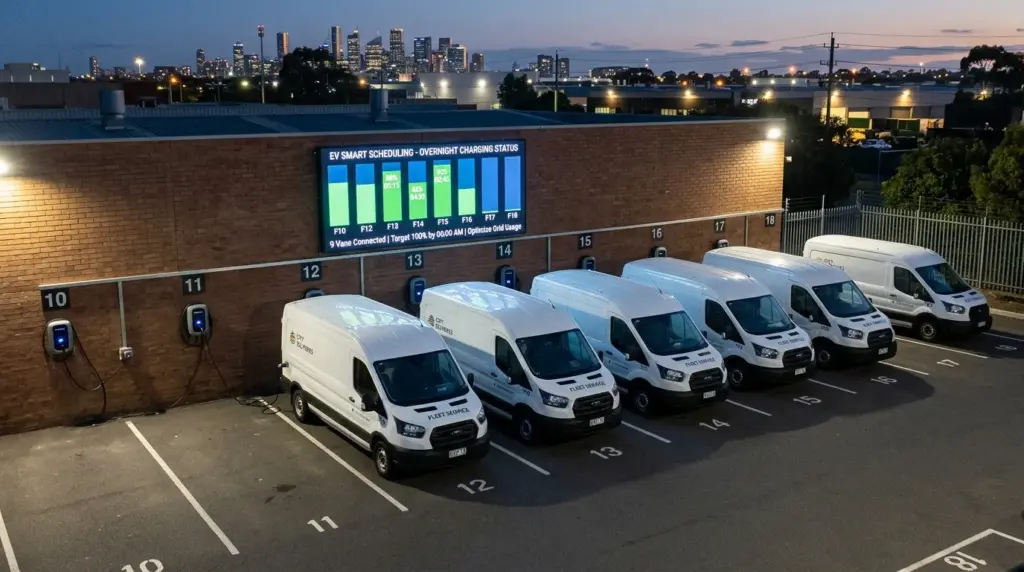
Trend 5: Fleet Electrification Drives AC Demand
Fleet electrification is accelerating globally.
- Taxis
- Ride-hailing
- Logistics fleets
These fleets rely heavily on:
- Overnight charging
- Depot-based systems
According to the McKinsey & Company:
- Fleet electrification is one of the fastest-growing EV segments
Source (add external link):
- McKinsey EV fleet insights: https://www.mckinsey.com/industries/automotive-and-assembly/our-insights
Impact:
AC charging becomes essential for cost-efficient fleet operations
Trend 6: Integration with Renewable Energy
Future charging systems will integrate with:
- Solar energy
- Energy storage
AC charging is particularly suitable because:
- Lower power demand
- Easier integration
According to the International Renewable Energy Agency:
- Renewable integration is a key trend in future energy systems
Source (add external link):
- IRENA renewable energy outlook: https://www.irena.org/publications
AC vs DC: Future Role Comparison
| Factor | AC Charging | DC Charging |
| Daily use | High | Low |
| Cost | Low | High |
| Speed | Moderate | High |
| Future role | Core infrastructure | Supplementary |
Key takeaway:
AC charging will remain the backbone, DC will serve as a complement
What Will Change for AC Charging?
From “Basic Charging” → “Smart Energy Node”
Future AC chargers will:
- Communicate with the grid
- Optimize energy usage
- Integrate with smart systems
From “Slow Charging” → “Strategic Charging”
AC charging will be:
- Scheduled
- Optimized
- Cost-driven
Why This Matters for B2B Buyers
1. Infrastructure Planning
- AC charging remains essential
- Over-investing in DC can hurt ROI
2. Cost Optimization
- AC offers lower CAPEX and OPEX
3. Scalability
- Easier to deploy at scale
Where QIAO Fits In
At QIAO, we focus on:
- Future-ready AC EV charging solutions
- Designed for:
- Smart charging
- Fleet applications
- Renewable integration
Our solutions help clients:
- Adapt to future EV trends
- Optimize cost and performance
- Build scalable charging infrastructure
Turning AC charging into a long-term strategic asset
Key Takeaways
- EV growth will increase overall charging demand
- AC charging will remain dominant for daily use
- Technology improvements will enhance AC performance
- Smart charging will redefine its value
AC charging is not declining—it is evolving
FAQ
1. Will AC charging disappear in the future?
No, it will remain the main charging method for daily use.
2. Is DC charging replacing AC charging?
No, DC complements AC but does not replace it.
3. Will AC charging become faster?
Yes, due to improved onboard chargers.
4. Why is AC charging still important?
Because most charging happens at home and work.
5. What is the future of EV charging?
Smart, integrated, and optimized systems.