Table of Contents
How EV Chargers Protect the Grid with Load Balancing & DLM
As EV adoption accelerates across commercial fleets, workplaces, hotels, and industrial sites, EV chargers are no longer simple charging devices. They are becoming an integral part of modern power infrastructure.
To prevent grid overload, reduce operational risk, and enable scalable deployment, two technologies play a critical role: Load Balancing and Dynamic Load Management (DLM).
The Grid Challenge in Commercial EV Charging
From a B2B perspective, the main challenge is not charging speed — it is power availability.
Commercial sites typically face:
- Fixed electrical capacity
- Multiple EV chargers operating simultaneously
- Existing loads such as HVAC, lighting, and machinery
Without intelligent control, adding EV chargers can easily lead to:
- Circuit breaker trips
- Unstable power supply
- Expensive grid upgrades
- Higher demand charges from utilities
This is where smart EV charging control becomes essential.
What Is Load Balancing in EV Chargers?
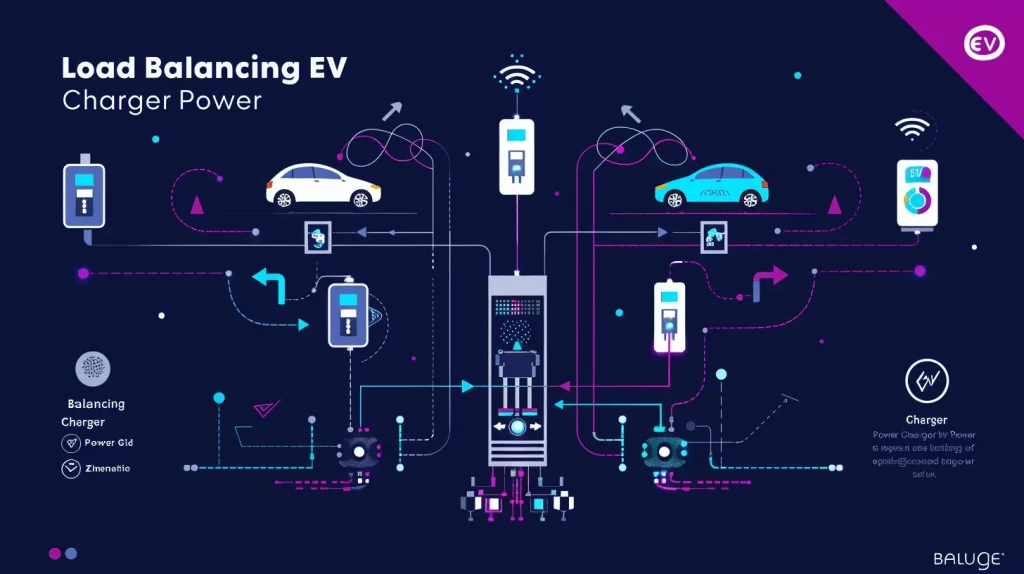
Load balancing refers to distributing available electrical power across multiple EV chargers to prevent overload.
Instead of allowing every charger to operate at full power simultaneously, the system:
- Sets a maximum total power limit
- Shares power evenly or by priority
- Ensures the site never exceeds its electrical capacity
In practice, this means:
All vehicles can charge safely, even if individual charging speed is reduced.
Load balancing is commonly used in small to mid-size commercial installations with predictable power demand.
What Is Dynamic Load Management (DLM)?
Dynamic Load Management (DLM) is a more advanced and intelligent approach.
DLM continuously monitors:
- Total building power consumption
- Real-time available capacity
- Charging demand from each EV
Based on this data, the system dynamically adjusts charging power in real time, often within seconds.
In simple terms:
EV chargers automatically adapt to the grid, not the other way around.
Load Balancing vs Dynamic Load Management
| Feature | Load Balancing | Dynamic Load Management |
| Real-time monitoring | No | Yes |
| Power adjustment | Static / Semi-dynamic | Fully dynamic |
| Integration with building load | Limited | Full |
| Grid protection level | Medium | High |
| Best use case | Small sites | Commercial & fleet deployments |

How EV Chargers Protect the Power Grid
1. Preventing Electrical Overload
DLM reduces charging power automatically when total site consumption increases, avoiding breaker trips.
2. Avoiding Costly Grid Upgrades
Smart power allocation allows more EV chargers to be installed within existing capacity.
3. Reducing Peak Demand Charges
By smoothing power demand, EV chargers help lower utility peak fees.
4. Improving System Stability
EV chargers become controlled loads instead of unpredictable risks.
Why AC EV Chargers Are Ideal for Load Management
For most B2B scenarios, AC EV chargers combined with DLM offer the best balance of cost, scalability, and grid compatibility.
Key advantages include:
- Adjustable power levels (7kW / 11kW / 22kW)
- Lower impact on electrical infrastructure
- Easier integration with energy management systems
- Ideal for long-duration parking and fleet charging
This is why 22kW AC charging is increasingly the preferred choice for commercial and fleet environments.
Business Value for Commercial Operators
Implementing EV chargers with load balancing and DLM enables operators to:
- Reduce capital expenditure
- Minimize operational risk
- Increase charger density
- Improve long-term ROI
For growing EV infrastructure, smart power management is no longer optional — it is a requirement.
QIAO’s Approach to Grid-Friendly EV Charging
At QIAO, load balancing and dynamic load management are built into our AC EV charging solutions from a system-design perspective.
Our solutions are designed to:
- Support scalable commercial deployment
- Enable intelligent multi-charger coordination
- Help partners build grid-friendly, future-ready EV charging networks
This approach ensures reliable operation while protecting both the electrical infrastructure and long-term business performance.
Conclusion
As EV charging scales across commercial environments, protecting the power grid becomes a strategic priority.
Through load balancing and dynamic load management, EV chargers evolve from simple devices into intelligent energy assets.
Smart EV charging is not about charging faster — it is about charging smarter.