Table of Contents
How to Choose the Right EV Charging Plug Type for Commercial Use
Selecting the correct EV charging plug type is a foundational decision in any commercial EV charging deployment. Unlike residential charging, B2B scenarios must balance vehicle compatibility, regional standards, power availability, operational efficiency, and long-term scalability.
For fleet operators, property owners, energy companies, and EV charging solution providers, the wrong plug choice can result in underutilized assets, higher retrofit costs, and limited future expansion.
This guide provides a technical and strategic framework to help decision-makers choose the right EV charging plug type for commercial environments.
Why EV Charging Plug Selection Matters in B2B Projects
In commercial applications, charging infrastructure is not just hardware—it is part of a long-term operational system.
An incorrect plug decision can lead to:
- Limited vehicle compatibility
- Increased operational friction
- Higher maintenance and replacement costs
- Regulatory non-compliance in certain markets
From a business perspective, plug type selection directly impacts ROI, uptime, and scalability of EV charging investments.
EV Charging Plug Types and Global Standards
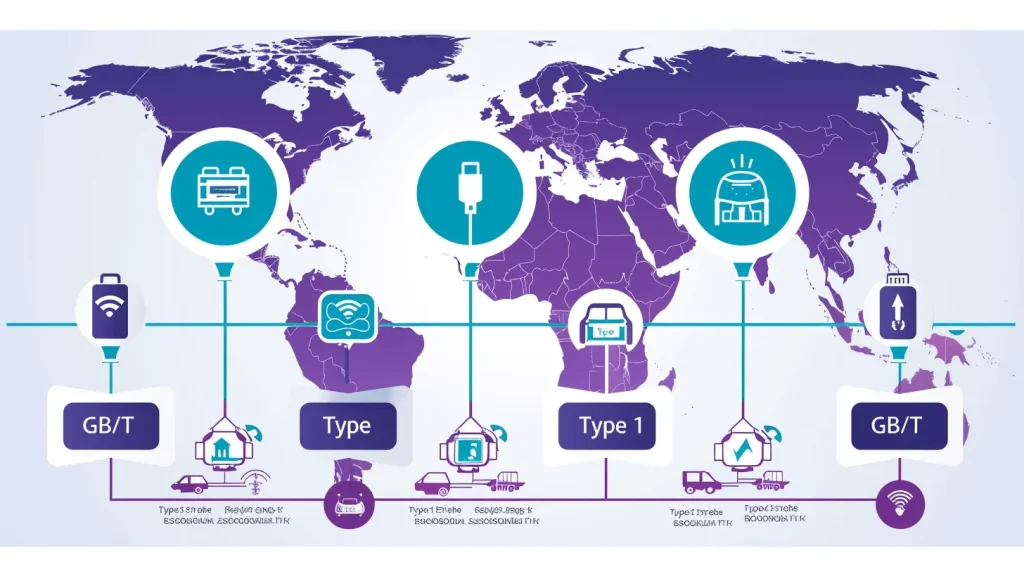
Common AC and DC Plug Standards by Region
| Region | AC Plug Type | DC Plug Type |
| Europe | Type 2 (IEC 62196-2) | CCS2 |
| North America | Type 1 (SAE J1772) | CCS1 / NACS |
| China | GB/T AC | GB/T DC |
| Southeast Asia | Type 2 | CCS2 |
| Latin America | Type 1 / Type 2 | CCS1 / CCS2 |
Commercial insight:
Most B2B EV charging projects should prioritize regionally dominant standards, even if vehicles technically support adapters. Adapters introduce operational risk and are unsuitable for public or fleet environments.

AC vs DC: Choosing the Right Power Level First
Before selecting a plug type, define the charging strategy.
AC Charging (7kW–22kW)
AC charging is the backbone of most commercial EV charging deployments.
Typical use cases:
- Fleet depots
- Workplace parking
- Hotels and commercial buildings
- Long-dwell public parking
Advantages:
- Lower installation and grid upgrade cost
- Better energy management
- Higher charger-to-vehicle ratio
- Easier scalability
Industry trend:
For B2B scenarios, 11kW–22kW AC charging using Type 2 plugs has become the global mainstream outside North America.
DC Fast Charging (50kW+)
DC charging is best suited for:
- Highway corridors
- Public fast-charging hubs
- High-turnover locations
Limitations in B2B contexts:
- High CAPEX and OPEX
- Grid capacity constraints
- Lower station density
Strategic guidance:
If vehicles remain parked for more than 2–3 hours, AC charging delivers significantly better cost efficiency than DC solutions.
Vehicle Compatibility and Onboard Charger Constraints
A common mistake in EV charging plug selection is assuming that vehicle inlet rating equals charging capability.
Key considerations:
- Many EVs with Type 2 inlets support up to 22kW physically, but onboard chargers may be limited to 7kW or 11kW
- Mixed fleets often include vehicles with different onboard charger specifications
- Imported vehicles may not align with local standards
For commercial operators, this means:
- Standardization is more important than peak power
- The most compatible plug is often the most profitable one
Fixed Cable vs Socket Outlet: Operational Impact
Beyond plug type, commercial buyers must decide between fixed cable and socket outlet configurations.
Fixed Cable Chargers
- Faster user experience
- Reduced connection errors
- Ideal for controlled environments (fleet depots)
Socket Outlet Chargers
- Higher flexibility
- Easier maintenance and cable replacement
- Better for public and semi-public use
In many B2B deployments, Type 2 socket outlets are preferred to support multiple vehicle brands and reduce long-term operational constraints.
Compliance, Safety, and Future-Proofing
A professional EV charging plug selection must also consider:
- Local electrical codes and incentives
- Certification requirements (CE, UL, TUV)
- Smart charging compatibility
- OCPP backend integration
- Load balancing and energy management
Future-ready charging infrastructure should:
- Support grid-constrained environments
- Integrate with energy management systems
- Align with evolving EV adoption trends
Common Plug Selection Mistakes in Commercial Projects
- Over-investing in DC charging where AC is sufficient
- Ignoring regional fleet composition
- Choosing proprietary or niche plug types
- Designing without future expansion in mind
Conclusion: Plug Selection Is a Strategic Infrastructure Decision
Choosing the right EV charging plug type is not a minor technical detail—it is a strategic infrastructure decision that affects cost, usability, and scalability over the entire lifecycle of a charging project.
For most commercial and fleet applications, Type 2 AC charging at 11–22kW provides the best balance between compatibility, efficiency, and long-term value.
At QIAO, we support partners with commercial EV charging solutions that align plug standards, power levels, and deployment scenarios with real-world business needs. Whether you are planning a fleet rollout or a regional charging network, selecting the right plug type is the foundation of a sustainable EV charging strategy.