
As fleet electrification moves from pilot programs to large-scale deployment, charging infrastructure decisions increasingly impact operational efficiency, capital expenditure, and long-term asset performance. For fleet operators, the question is no longer whether to install charging—but what type of charging delivers the best return on investment.
Across logistics fleets, corporate vehicles, taxis, and service fleets, 22 kW AC charging has emerged as the most cost-effective and operationally balanced solution.

Understanding Fleet Charging Demand Profiles
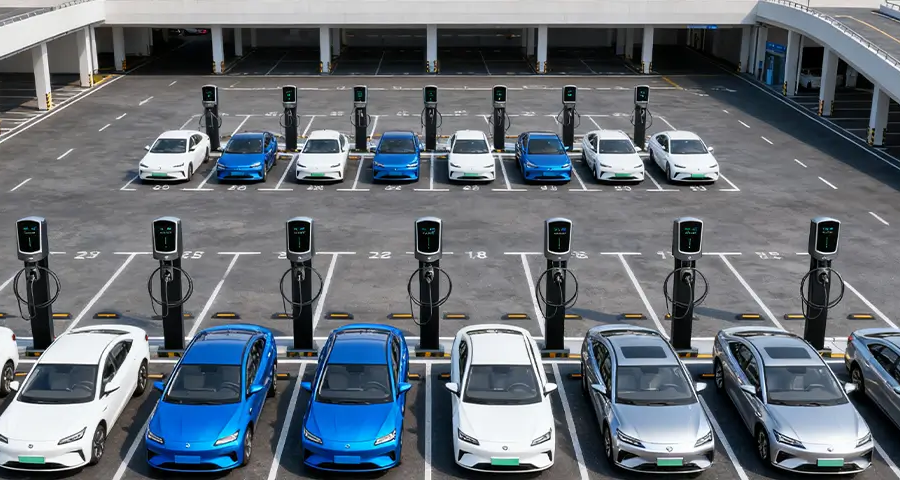
Fleet charging requirements differ fundamentally from public fast-charging use cases. Most fleet vehicles operate within predictable daily routes and return to centralized depots or parking facilities.
Key characteristics of fleet charging include:
- Long dwell times (6–10 hours, typically overnight)
- Predictable energy demand per vehicle
- High concurrency (multiple vehicles charging simultaneously)
- Emphasis on operational readiness rather than rapid turnaround
In this context, charging consistency and scalability outweigh maximum charging speed.
Technical Comparison: 22 kW AC vs DC Fast Charging for Fleets
| Criteria | 22 kW AC Charging | DC Fast Charging |
| Typical use case | Overnight fleet charging | Public & emergency charging |
| Equipment cost | Low to moderate | High |
| Installation complexity | Low | High |
| Grid upgrade requirement | Often unnecessary | Frequently required |
| Simultaneous charging | Highly scalable | Limited by grid capacity |
| Maintenance intensity | Low | High |
| Battery impact | Gentle charging | Higher long-term stress |
This comparison highlights why DC fast charging, while essential in specific scenarios, is often over-engineered for daily fleet operations.
Total Cost of Ownership (TCO) Favors 22 kW AC Charging
From a financial perspective, fleet operators must consider not only upfront investment, but also long-term operating costs.
Key TCO Advantages of 22 kW AC Charging
- Lower capital expenditure per charging point
- Reduced civil and electrical installation costs
- Minimal impact on demand charges and peak tariffs
- Lower maintenance and service requirements
With equivalent budgets, fleets can deploy significantly more AC charging points, improving fleet availability and reducing operational risk.
Grid Efficiency and Load Management at Scale
One of the most overlooked challenges in fleet electrification is electrical capacity planning. High-power charging infrastructure can quickly overwhelm local grid connections.
22 kW AC charging provides:
- Manageable power levels for commercial buildings
- Easy integration with dynamic load balancing systems
- Flexible scheduling based on vehicle priority and state of charge
- Compatibility with on-site renewable energy and storage solutions
This makes AC charging far more suitable for future fleet expansion without major grid reinforcements.
Operational Integration and Fleet Management Compatibility
Fleet charging infrastructure must integrate seamlessly with broader operational systems:
- Fleet Management Systems (FMS)
- Charging Management Systems (CMS, OCPP-based)
- Energy Management Systems (EMS)
- Cost accounting and ESG reporting platforms
AC charging infrastructure offers:
- Simpler standardization across large deployments
- Centralized monitoring and reporting
- Predictable charging behavior for operational planning
These factors significantly reduce complexity in day-to-day fleet operations.
Battery Health and Lifecycle Optimization
Fleet operators manage vehicles as long-term assets. Frequent reliance on DC fast charging can accelerate battery degradation, increasing total lifecycle costs.
AC charging supports:
- Lower thermal stress on battery systems
- More stable charging curves
- Extended battery lifespan
- Improved residual vehicle value
From an asset management perspective, battery longevity directly impacts fleet economics.
Why 22 kW AC Is the Optimal Power Level for Fleets
22 kW AC represents a practical balance between charging speed and infrastructure efficiency:
| Aspect | Outcome |
| Overnight charging window | Fully utilized |
| Power-to-cost ratio | Optimized |
| Scalability | High |
| Operational risk | Low |
| Future expansion | Grid-friendly |
Rather than maximizing power per charger, fleet operators benefit more from maximizing charging coverage and system resilience.
Implications for Fleet Operators and EV Charging Solution Providers
For Fleet Operators
- Prioritize scalable AC charging over limited fast charging
- Focus on multi-point availability rather than peak power
- Evaluate charging solutions based on long-term TCO
For EV Charging Solution Providers
For companies like QIAO, the fleet segment represents a core application for AC charging solutions. Success depends on delivering:
- Reliable 22 kW AC hardware
- Compliance with regional standards
- Seamless system integration
- Long-term service and partnership support
Conclusion
As fleet electrification accelerates globally, 22 kW AC charging stands out as the most cost-effective, scalable, and operationally sound solution for fleet environments. By aligning with real-world usage patterns, grid constraints, and long-term cost considerations, it provides fleets with a future-proof foundation for sustainable mobility.
For organizations planning large-scale fleet charging deployments, choosing the right AC charging infrastructure today will shape operational efficiency and financial performance for years to come.