
As electric vehicle adoption expands worldwide, EV charging infrastructure must adapt to vastly different electricity ecosystems. Grid standards, voltage levels, charging power, and connector types vary significantly across regions, directly influencing charger design, deployment strategies, and operational reliability.
Understanding global EV charging infrastructure requires a clear view of regional electricity systems, voltage standards, and power availability. A detailed overview of the global electricity ecosystem for EV charging can be found in our Eco Electricity resource.
For manufacturers, system integrators, and commercial operators, understanding these regional differences is essential when planning scalable and compliant EV charging solutions.
The Global Diversity of Electricity Standards
Unlike consumer electronics, EV charging systems interact directly with local power grids. Each region has developed its own electrical standards based on historical infrastructure, regulatory frameworks, and energy policies.
Key variables include:
- Grid voltage and frequency
- Single-phase vs. three-phase power availability
- Maximum allowable charging power
- Local safety and certification requirements
These factors define how EV chargers are designed, installed, and operated across global markets.

Regional Overview of EV Charging Electricity Standards
Europe
Europe is characterized by widespread three-phase power availability, making it well-suited for higher-power AC charging.
- Grid voltage: 230V (single-phase) / 400V (three-phase)
- Frequency: 50Hz
- Common AC charging power: 7kW, 11kW, 22kW
- Standard connector: Type 2
This environment has enabled AC charging to become the dominant solution for residential, commercial, and fleet applications across the region.
North America
North America operates on a different electrical architecture, which influences charging power levels.
- Grid voltage: 120V / 240V
- Frequency: 60Hz
- Common AC charging power: 7.2kW, 9.6kW, 11.5kW
- Standard connector: J1772 (Type 1)
While single-phase charging is prevalent, commercial installations often require careful load planning to avoid peak demand issues.
Southeast Asia
Southeast Asia presents a mixed electricity landscape, with significant variation between countries.
- Grid voltage: typically 220V–240V
- Frequency: 50Hz
- Power availability: often limited in older buildings
- Charging focus: cost-effective AC solutions
In many markets, AC EV chargers are favored due to grid constraints and infrastructure readiness.
Latin America
Latin America features diverse electrical systems, sometimes varying within the same country.
- Grid voltage: 110V–127V or 220V–240V
- Frequency: 50Hz or 60Hz
- Infrastructure maturity: uneven across regions
This diversity makes flexible, adaptable EV charging solutions particularly important for successful deployment.
AC Charging Power Levels and Their Practical Impact
AC charging power is determined by a combination of grid capacity, phase availability, and regulatory limits.
| AC Power Level | Typical Use Case |
| 7kW | Residential and small commercial sites |
| 11kW | Office buildings, apartments, fleet depots |
| 22kW | Commercial hubs, public AC charging |
Higher power does not always translate to better outcomes. In many B2B scenarios, balanced power allocation and long dwell time matter more than peak charging speed.
Voltage, Frequency, and Charger Design
EV chargers must be engineered to operate reliably across different voltage and frequency conditions. Variations in grid quality, voltage stability, and grounding practices further increase complexity.
A globally deployable charger must support:
- Wide voltage input ranges
- Stable operation under fluctuating loads
- Compliance with local electrical codes
- Compatibility with regional connectors
This is particularly critical for manufacturers serving multiple international markets.
Why Grid-Aware Charging Matters for B2B Deployments
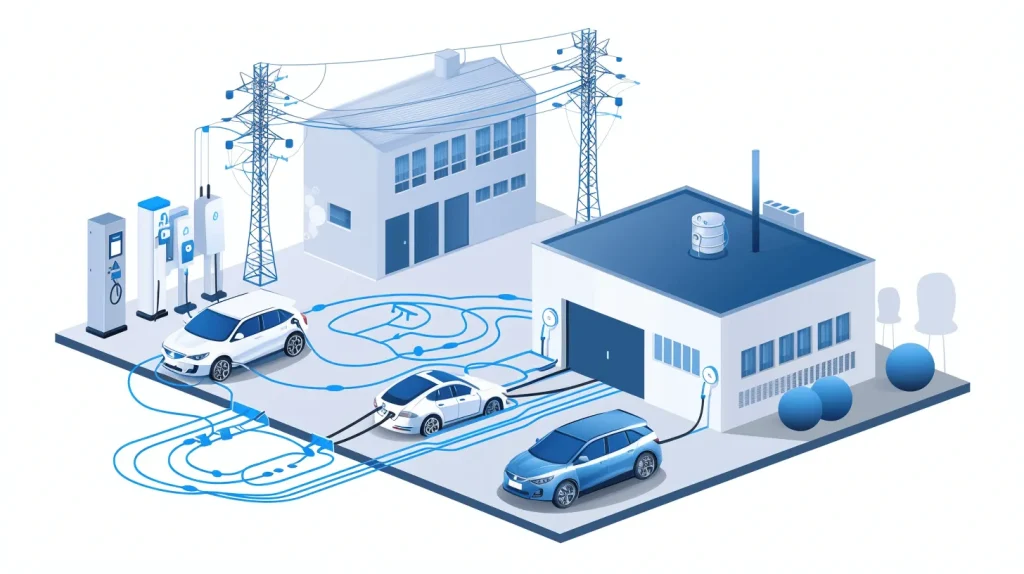
For commercial and fleet operators, mismatches between charger specifications and local grid conditions can lead to:
- Installation delays
- Increased infrastructure costs
- Reduced charger lifespan
- Operational instability
Grid-aware AC charging solutions help mitigate these risks by aligning charger performance with real-world electrical environments.
QIAO’s Approach to Global EV Charging Compatibility
At QIAO, we design AC EV charging solutions with global electrical diversity in mind. Our products support multiple voltage ranges, regional connector standards, and grid conditions, enabling partners to deploy charging infrastructure across different markets with confidence.
By focusing on adaptability, safety, and long-term reliability, QIAO helps businesses navigate the complexities of global EV charging ecosystems.
Conclusion: Designing for a Global EV Charging Future
As EV adoption continues to grow, understanding the global electricity ecosystem is no longer optional. Successful EV charging deployment depends on aligning technology with local power realities—especially in commercial and international projects.
AC charging, when designed with regional compatibility in mind, remains one of the most scalable and grid-friendly solutions for global EV infrastructure.