
As EV charging networks scale across commercial properties, fleets, and public locations, operational efficiency and long-term maintainability have become just as important as charging power or hardware design.
For B2B stakeholders, one requirement is often underestimated but increasingly critical:
remote firmware update capability.
This article explains why remote upgrades are no longer optional for commercial EV chargers, and how they directly impact cost, security, and scalability.
EV Chargers Are No Longer Static Hardware
Modern EV chargers are connected energy devices, not standalone equipment.
They rely on software for:
- OCPP communication
- User authorization and billing
- Load balancing and energy management
- Security and compliance
- Compatibility with vehicles and backend systems
Without remote upgrade capability, chargers become fixed-function assets that age quickly in a fast-evolving ecosystem.
Reducing Operational Costs at Scale
For B2B operators, the cost of on-site maintenance grows exponentially with network size.
Without remote firmware updates:
- Technicians must visit each charger for updates
- Downtime increases
- Labor and travel costs escalate
- Site access coordination becomes complex
With remote upgrades:
- Firmware updates are deployed centrally
- Issues can be resolved without site visits
- Charging networks scale with minimal marginal cost
At scale, remote updates are not a convenience — they are a cost-control mechanism.
Security and Compliance Require Continuous Updates
Cybersecurity risks in EV charging are increasing, especially for public and commercial installations.
Remote firmware updates allow operators to:
- Patch security vulnerabilities
- Update encryption and certificates
- Comply with evolving regulations
- Meet enterprise and municipal security standards
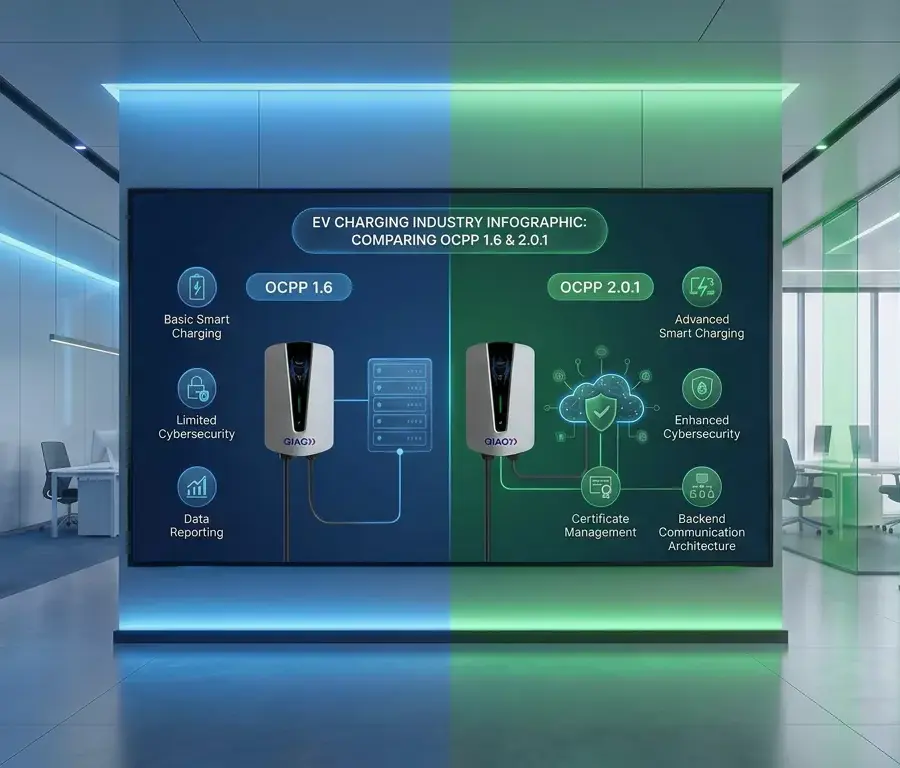
For chargers connected via OCPP, security without remote updates is unsustainable.
Supporting OCPP Evolution and Backend Compatibility
Backend platforms evolve continuously:
- OCPP message handling changes
- Smart charging logic improves
- New backend features are introduced
- Protocol requirements become stricter
Chargers that cannot be remotely upgraded risk:
- Backend incompatibility
- Feature fragmentation
- Forced hardware replacement
Remote upgrades ensure chargers remain backend-agnostic and future-compatible, protecting long-term investments.
Enabling Smart Charging and Energy Optimization
Many advanced features are software-driven, including:
- Dynamic Load Management (DLM)
- Time-of-use optimization
- Grid-responsive charging
- Integration with solar or storage systems
These capabilities are often refined over time.
Remote firmware updates allow operators to unlock new value from existing hardware, instead of replacing it.
Faster Issue Resolution and Higher Network Uptime
In real-world deployments, issues are inevitable:
- Edge-case vehicle compatibility
- Communication instability
- Regional grid differences
Remote diagnostics and updates enable:
- Faster bug fixes
- Reduced charger downtime
- Improved user experience
- Higher SLA compliance for enterprise clients
For B2B customers, uptime directly affects revenue and reputation.
Long-Term Asset Value and ROI Protection
Commercial EV chargers are long-term assets, often deployed with 5–10 year lifecycle expectations.
Chargers without remote upgrade capability:
- Become obsolete faster
- Limit future feature adoption
- Increase total cost of ownership (TCO)
Remote-upgradable chargers maintain functional relevance over time, improving ROI and reducing replacement risk.
What B2B Buyers Should Look For
When evaluating EV chargers, B2B buyers should verify:
- Stable remote firmware update mechanism
- Secure update delivery (TLS, certificates)
- Rollback and version control support
- Compatibility with OCPP-based backends
- Proven update performance at scale
Remote upgrade capability should be treated as a core infrastructure requirement, not an optional feature.
Final Thoughts: Remote Updates Are a Strategic Requirement
For B2B EV charging deployments, remote firmware updates are essential for:
- Cost efficiency
- Security and compliance
- Platform interoperability
- Feature scalability
- Long-term asset protection
Choosing chargers without this capability creates hidden operational risk that compounds over time.
About QIAO: Built for Scalable B2B AC Charging
QIAO focuses on B2B AC EV charging solutions, offering wall-mounted and portable AC chargers designed for commercial properties, fleets, and charging operators.
Our chargers are engineered with:
- Reliable remote firmware upgrade support
- Stable OCPP integration
- Commercial-grade hardware for long-term deployment
- Global AC standards compatibility
By combining open protocols, remote manageability, and durable AC hardware, QIAO helps businesses deploy EV charging infrastructure that remains secure, scalable, and future-ready.