
A NEMA 14-50 outlet can support Level 2 EV charging at up to 40 amps on a properly installed 50-amp circuit. At 240 volts, that equals up to 9.6 kW. Your actual charging rate may be lower because the EV charger and the vehicle’s onboard charger also set limits.
The NEMA 14-50 is one of the most common plug-in options for home EV charging in North America. Still, the outlet shape alone does not tell you if an installation is ready for hours of continuous charging. The circuit, wiring, receptacle, EV charger, and vehicle must all work together.
This guide explains charging speed, existing-outlet checks, new installation planning, and the choice between a NEMA 14-50 outlet and a hardwired charger.
What Is a NEMA 14-50 Outlet?
A NEMA 14-50 is a four-wire, 125/250-volt connection rated for up to 50 amps. It has two hot conductors, one neutral, and one equipment ground. An EV charger normally draws 240-volt power from the two hot conductors.
The outlet does not charge the car by itself. It supplies power to the EV charger, technically known as electric vehicle supply equipment (EVSE). The EV charger communicates the maximum available current to the vehicle, while the vehicle’s onboard charger determines how much current it actually draws within that limit.
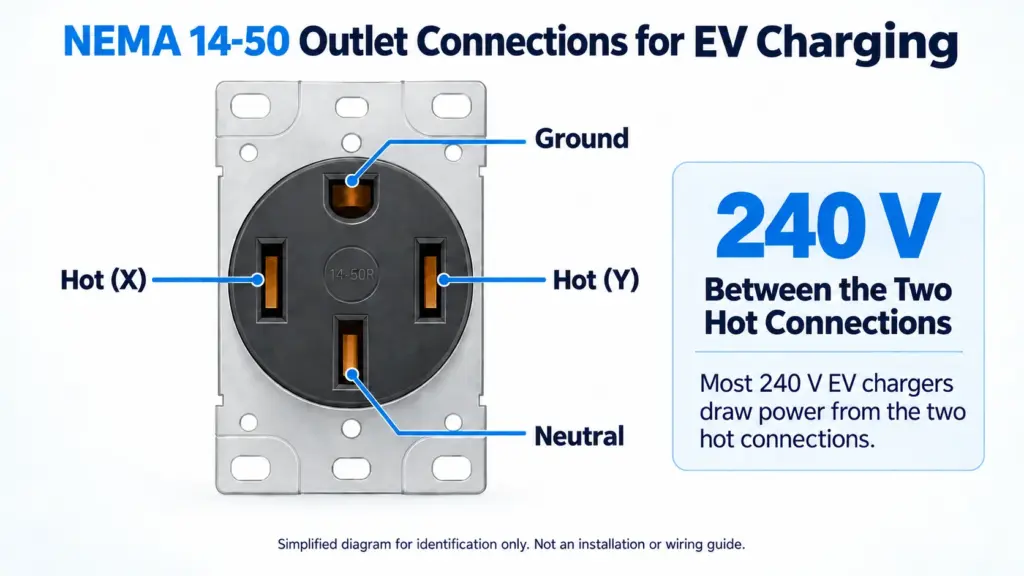
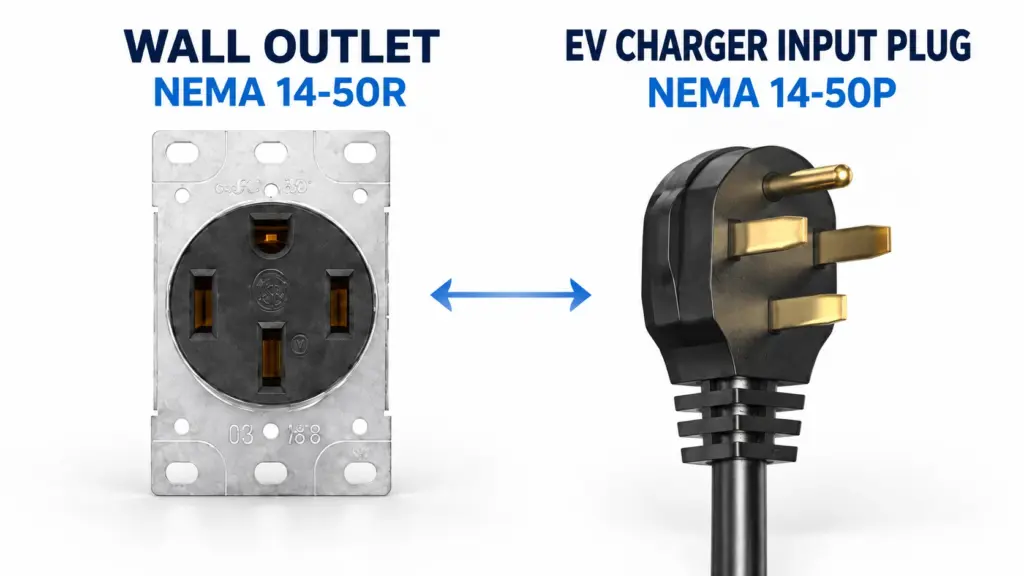
You may also see the terms NEMA 14-50P and NEMA 14-50R:
- NEMA 14-50P: The “P” means plug. This is the male connector on the EV charger’s input cable.
- NEMA 14-50R: The “R” means receptacle. This is the outlet installed on the wall.
- NEMA 14-50: This is the general name for the connection configuration.
Do not confuse the wall connection with the vehicle connector. A charger may use a NEMA 14-50P at the wall and a J1772 or NACS connector at the vehicle.
How Fast Can a NEMA 14-50 Outlet Charge an EV?
A NEMA 14-50 outlet can provide up to 9.6 kW when a compatible charger draws 40 amps at 240 volts. EV charging is treated as a continuous load, so a 50-amp circuit does not support 50 amps of continuous charging. The usual maximum is 40 amps, or 80% of the circuit rating.
| EV Charger Output | Approximate Power at 240 V | Common Use |
| 32 A | 7.7 kW | Mobile connectors and some plug-in home chargers |
| 40 A | 9.6 kW | Maximum common output on a 50 A NEMA 14-50 circuit |
| 48 A | 11.5 kW | Usually hardwired on a 60 A circuit |
The slowest part of the system sets the final rate. For example, a 40-amp EV charger will still deliver only 32 amps if the vehicle accepts no more than 32 amps.
Example: What Determines the Actual Charging Rate?
Suppose you connect a 40-amp EV charger to a NEMA 14-50 outlet:
- On a suitable 50-amp circuit, with a vehicle that can accept at least 40 amps, the charger may deliver up to 40 amps, or about 9.6 kW at 240 volts.
- If the outlet is connected to a 40-amp circuit, the charger should normally be limited to 32 amps, or about 7.7 kW.
- If the circuit and charger support 40 amps but the vehicle accepts only 32 amps, the actual charging rate will still be about 7.7 kW.
In each case, the lowest active limit determines the available charging power.
Charging time also changes with battery size, starting charge level, temperature, and vehicle efficiency. For that reason, kW is more useful than a fixed “miles per hour” claim.
Is a NEMA 14-50 Outlet Right for Your Home?
A NEMA 14-50 setup fits drivers who want faster home charging and the option to unplug or replace the EV charger. It can work well for renters with approval, owners who may move, and households whose cars do not need more than 32 or 40 amps.
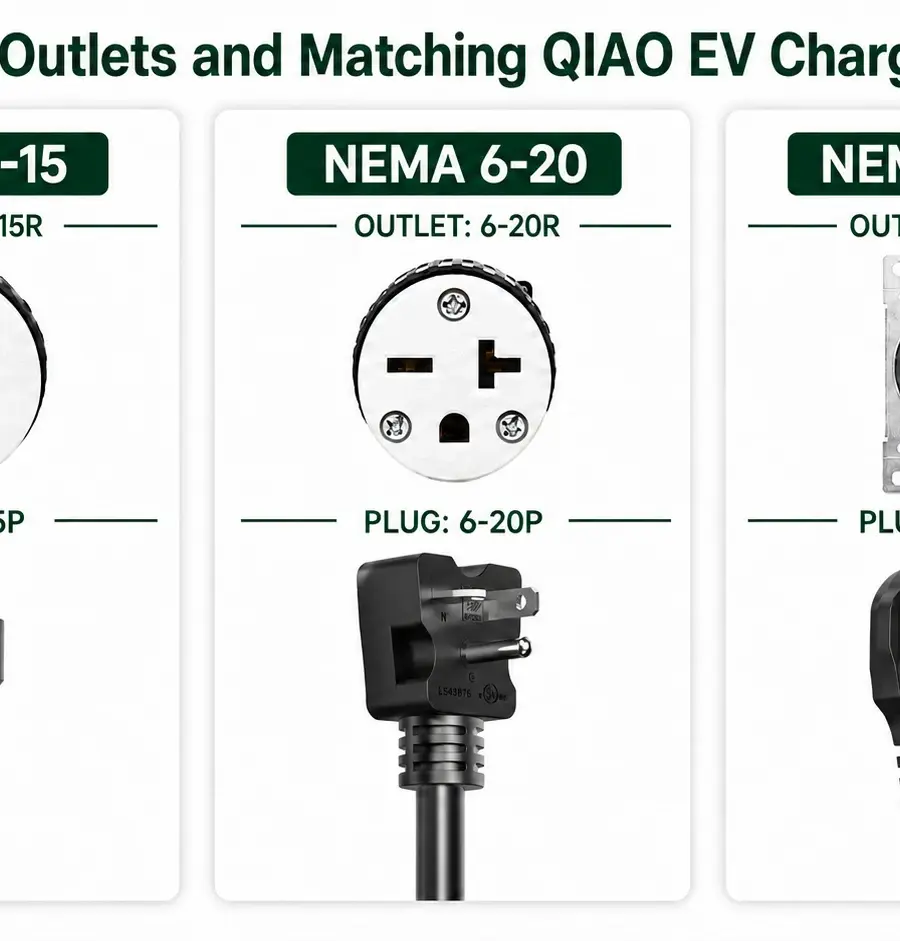
Hardwiring may be a better fit when you want 48-amp charging, a permanent outdoor installation, or fewer electrical connection points. Drivers with shorter daily mileage or limited panel capacity may find a lower-power outlet sufficient. The differences between NEMA 5-15, 6-20, and 14-50 outlets for EV charging mainly involve voltage, circuit capacity, charging speed, and installation needs.
Is Your NEMA 14-50 Outlet Ready for EV Charging?
An existing NEMA 14-50 outlet may support EV charging, but an electrician should assess the full installation first. An outlet that powered an RV, range, or welder without trouble may not have been installed for a high load that can run for several hours.
If You Already Have a NEMA 14-50 Outlet
Ask a licensed electrician to check these parts of an existing NEMA 14-50 installation:
- Circuit Use: Confirm that the EV charger will use a dedicated branch circuit rather than a circuit shared with another appliance.
- Breaker and Conductors: Verify that the breaker, conductor material, conductor size, wiring method, and terminal ratings match the planned charging load. Do not determine the available charging current from the outlet shape alone. A NEMA 14-50 receptacle may be connected to a 40-amp circuit, which normally limits continuous EV charging to 32 amps.
- Receptacle Condition: Look for cracks, discoloration, loose contact pressure, melted material, or other signs of heat damage.
- Grounding and Polarity: Test the connection instead of relying on the outlet’s appearance.
- EV charger Settings: Set the charger no higher than the circuit and installation allow. Adjustable settings do not increase the circuit’s capacity.
- Location: Confirm that a garage or outdoor installation has the enclosure and protection required for that environment.
Stop using the outlet if the plug fits loosely or you notice heat damage, a burning smell, buzzing, or repeated breaker trips. Turn off the circuit and arrange an inspection before charging again.
If You Are Installing a New NEMA 14-50 Outlet
Start with a load calculation and the EV charger’s installation manual. Free breaker spaces do not prove that the home’s electrical service can support another large load. In some homes, load management can reduce the need for a full service upgrade.
For frequent EV charging, ask the electrician to select a listed receptacle whose manufacturer permits the expected installation and duty. Do not choose a receptacle only by price or appearance. Avoid prescribing one wire size or terminal torque for every job. Conductor sizing depends on the wiring method, conductor type, terminal temperature rating, distance, equipment instructions, and local rules. Tighten each terminal to the value printed in its own product instructions.
Permits, inspection, and GFCI protection also depend on the code adopted in your area. NEC Article 625 includes GFCI requirements for receptacles that supply cord-and-plug-connected EV charging equipment. The exact requirement still depends on the NEC edition and amendments adopted by your state or local authority. Follow the EV charger instructions and have the electrician confirm the rule that applies at the installation address.
How Do You Keep a NEMA 14-50 EV Charging Setup Safe?
Keep a NEMA 14-50 charging setup safe by using compatible listed equipment, limiting current correctly, and watching for changes at the connection. The U.S. Department of Energy explains that home Level 2 equipment uses 240-volt power and should be installed for the home’s charging needs.
Follow these practices after installation:
- Leave the Plug Connected When Allowed: Frequent plugging and unplugging can wear the contact surfaces. Follow the EV charger and receptacle manufacturers’ instructions.
- Skip General-Purpose Adapters and Extension Cords: Use only connection options that the EV charger manufacturer approves for that exact device.
- Support the Cable: Keep the charger’s weight from pulling on the plug or outlet.
- Check for Visible Changes: Inspect the plug, receptacle face, cable, and wall plate for looseness, dark marks, or damaged plastic.
- Respond to Excess Heat: Stop charging if the connection becomes unusually hot, smells burned, or shows melting.
Do not increase the charger’s current to solve slow charging. The current setting must stay within the limits of the circuit, outlet, EV charger, and vehicle.
NEMA 14-50 vs. Hardwired EV Charger
A NEMA 14-50 charger offers more flexibility, while a hardwired charger supports a permanent connection and may allow higher output. Neither choice is best for every home.
| Feature | NEMA 14-50 Plug-In Charger | Hardwired Charger |
| Common Maximum Output | Up to 40 A on a 50 A circuit | Often 40 A or 48 A, depending on the unit and circuit |
| Portability | Easier to remove or replace | Fixed to the electrical system |
| Connection Points | Includes a plug and receptacle | Removes the plug-and-receptacle connection |
| Outdoor Use | Needs suitable outlet protection and equipment ratings | Often preferred for permanent outdoor installation |
| Service | EV charger can be unplugged after power is turned off | Electrical work may be needed for replacement |
Choose NEMA 14-50 when 32- or 40-amp charging meets your needs and removability has value. Consider hardwiring when you need 48-amp charging, want to eliminate the plug-and-receptacle connection point, or plan a permanent outdoor installation. A properly installed plug-in system can also support regular charging when the receptacle, circuit and EV charger are suitable for that use.
How Do You Choose a Compatible NEMA 14-50 EV Charger?
Choose a NEMA 14-50 EV charger by matching its input plug, output current, vehicle connector, cable length, and environmental rating to your installation.
Check these six details before buying:
- Input Plug: Confirm that the input is a NEMA 14-50P, not a similar-looking plug.
- Output Current: Choose 32 or 40 amps based on the circuit, vehicle, and expected charging time.
- Vehicle Connector: Select J1772 or NACS based on the vehicle and any automaker-approved adapter plan.
- Safety Listing: Look for a certification accepted in your market and required by local authorities.
- Installation Location: Match indoor or outdoor ratings to the actual parking area.
- Cable Reach: Measure the route to the vehicle’s charge port without stretching the cable across a walkway.
The QIAO home EV charger includes North American configurations with NEMA 14-50P, NEMA 6-50P, or hardwired input, along with J1772 or NACS vehicle connectors. Confirm the input plug, output current, and vehicle connector before ordering.
NEMA 14-50 vs. NEMA 6-50: Can You Use an Adapter?
NEMA 14-50 and NEMA 6-50 can both supply 240-volt power, but they are different configurations. A 14-50 connection has two hot conductors, a neutral, and a ground. A 6-50 connection has two hot conductors and a ground, with no neutral.
Do not use a general adapter only because it makes the plugs fit. Use an adapter only when the EV charger or adapter manufacturer approves the exact combination and the charging current matches the circuit. A purpose-built EV charger with the correct plug is a better long-term choice.
Conclusion
Choose a NEMA 14-50 outlet when you want removable Level 2 equipment and up to 40 amps of continuous charging. Have the full circuit evaluated before using an existing outlet, and plan a new installation around the electrical load, equipment instructions, and local code.
Choose hardwiring instead if you need 48 amps, prefer a permanent outdoor connection, or want to remove the receptacle as a connection point. Once the electrical plan is clear, select a home EV charger with the correct input, current, and vehicle connector.
QIAO Charger offers North American home EV chargers with NEMA 14-50P, NEMA 6-50P or hardwired input, along with J1772 and NACS vehicle connectors. Confirm your circuit capacity, charging current and vehicle connector before choosing a model.
FAQs
Follow the EV charger manufacturer’s shutdown and unplugging instructions. Stop charging and disconnect the vehicle before removing the wall plug. De-energize the circuit first if the instructions require it or if the plug, outlet or cable shows signs of damage or overheating.
Many 240-volt EV chargers use the two hot conductors and equipment ground but do not use the neutral for charging. The NEMA 14-50 receptacle must still be wired and installed according to its listing, the EV charger instructions, and local code. Do not alter the connection based on this general rule.
No. The NEMA 14-50 is the power outlet, while the Level 2 EV charger manages the electrical connection to the car. You still need a compatible charger with the right input plug, output current, and J1772 or NACS vehicle connector.
Do not connect two chargers with a basic splitter. Two-EV charging needs equipment designed for load sharing, separate circuits supported by the home’s capacity, or an approved energy-management system. Ask an electrician to design the setup around the panel capacity and both vehicles’ charging schedules.