Table of Contents
Dynamic Load Management (DLM) for EV Charging
As EV adoption accelerates, one of the biggest challenges for commercial charging deployments is not charger availability—but power availability.
Dynamic Load Management (DLM) has become a core capability for B2B EV charging projects, enabling businesses to scale charging infrastructure without costly grid upgrades.
This article explains what DLM is, how it works, and why it is essential for commercial EV charging.

What Is Dynamic Load Management (DLM)?
Dynamic Load Management (DLM) is a system that intelligently distributes available electrical capacity across multiple EV chargers based on real-time conditions.
Instead of each charger drawing maximum power independently, DLM ensures that:
- The total site load stays within grid limits
- Power is allocated efficiently
- Charging demand does not overload the electrical infrastructure
In commercial environments, DLM is typically managed through software integrated with OCPP-enabled chargers.
Why Load Management Matters for B2B Deployments
Commercial sites face strict electrical constraints:
- Limited transformer capacity
- High peak demand charges
- Multiple energy-consuming systems (HVAC, lighting, machinery)
- Unpredictable EV charging behavior
Without DLM, adding more chargers often requires:
- Expensive grid upgrades
- Electrical panel replacement
- Long approval timelines
DLM allows businesses to scale charging capacity using existing power infrastructure.
How DLM Works in Practice
A typical DLM system includes:
- Site Power Monitoring
Measures total building or site electricity usage in real time. - Available Capacity Calculation
Determines how much power can be safely allocated to EV charging. - Dynamic Power Allocation
Distributes power across chargers based on rules and priorities. - Continuous Adjustment
Updates charging power as site load changes.
All of this happens automatically, without user intervention.
Static vs Dynamic Load Management
| Feature | Static Load Management | Dynamic Load Management |
| Power Allocation | Fixed limits | Real-time adjustment |
| Grid Awareness | No | Yes |
| Scalability | Limited | High |
| Energy Efficiency | Low | High |
| Suitability | Small sites | Commercial & public sites |
For B2B environments, static solutions quickly become bottlenecks.
Key Benefits of DLM for Commercial EV Charging
Avoid Grid Upgrades
DLM reduces or eliminates the need for transformer or panel upgrades.
Lower Operating Costs
By avoiding peak demand spikes, businesses can reduce electricity charges.
Higher Charger Density
More chargers can be installed within the same power envelope.
Improved Reliability
Prevents breaker trips and unplanned downtime.
Better User Experience
Charging sessions remain stable even during peak site load.
DLM in Multi-Charger and Fleet Scenarios
DLM is especially critical for:
- Office buildings
- Retail parking
- Logistics depots
- Corporate and municipal fleets
In fleet applications, DLM can:
- Prioritize vehicles with earlier departure times
- Balance charging across overnight windows
- Optimize total energy delivery without overload
The Role of OCPP in Load Management
Modern DLM systems rely heavily on OCPP communication between chargers and backend platforms.
OCPP enables:
- Real-time power control
- Load profiles and charging rules
- Integration with energy management systems
- Remote configuration and updates
Without OCPP-compatible hardware, true dynamic load management is difficult to achieve.
DLM as a Long-Term Infrastructure Strategy
For B2B decision-makers, DLM is not just a technical feature—it is a strategic infrastructure choice.
It supports:
- Gradual network expansion
- Future EV adoption growth
- Integration with solar and storage systems
- Long-term cost predictability
Deployments without DLM often face early capacity limits and higher total cost of ownership.
What to Look for in DLM-Ready EV Chargers
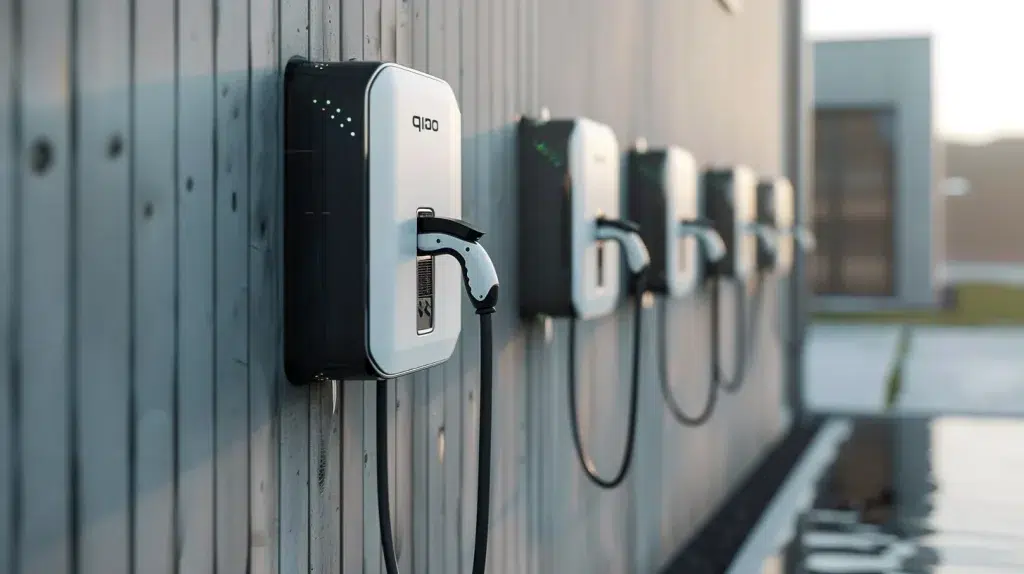
When selecting chargers for commercial use, businesses should ensure:
- Native support for load control via OCPP
- Reliable real-time communication
- Compatibility with external meters or EMS
- Stable firmware with remote update capability
- Proven performance in multi-charger environments
DLM is only effective when hardware and software are designed to work together.
Conclusion: DLM Is Essential for Scalable EV Charging
As EV charging demand increases, power constraints—not charger quantity—become the limiting factor.
Dynamic Load Management enables businesses to:
- Scale efficiently
- Control costs
- Maintain reliability
- Protect long-term infrastructure investments
For any serious B2B EV charging deployment, DLM is no longer optional.
About QIAO: AC Chargers Designed for Smart Load Management
QIAO specializes in B2B AC EV charging solutions, offering wall-mounted and portable chargers for commercial properties, fleets, and charging operators.
Our AC chargers are designed to support:
- Dynamic Load Management (DLM)
- Stable OCPP-based power control
- Remote configuration and firmware upgrades
- Global AC charging standards
By combining smart load management capability with commercial-grade AC hardware, QIAO helps businesses deploy EV charging infrastructure that is scalable, grid-friendly, and future-ready.