Table of Contents
Global EV Charging Connector Comparison
Electric vehicle (EV) charging infrastructure depends heavily on connector standards, which define how vehicles receive power in different regions and charging scenarios. Understanding these standards is essential for businesses planning commercial EV charger deployments, ensuring compatibility, future-proofing, and customer satisfaction.
This article compares the major EV charging connector types used around the world, including their applications, regions, power capabilities, and practical differences.
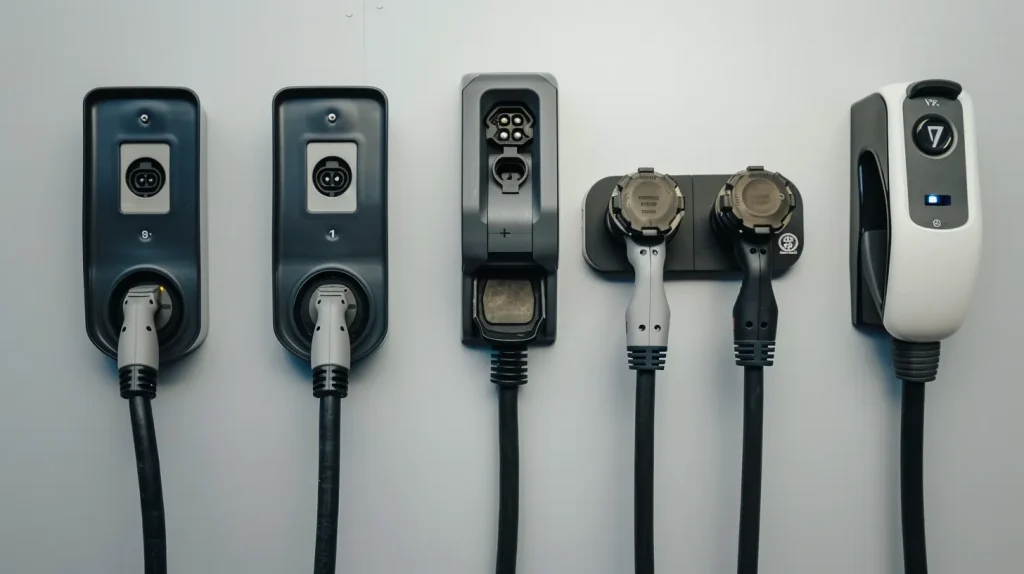
Type 1 (SAE J1772) – Standard AC Charging
Description:
Type 1, also known as SAE J1772, is a single-phase AC charging connector widely used in North America and Japan. It supports residential and public AC charging where single-phase power is standard.
Key Characteristics:
- AC charging only
- Used mainly for Level 1 and Level 2 charging
- Typical current: up to ~80 A single-phase
- Power: up to ~7.4 kW depending on installation
Common Usage:
- Residential homes
- Workplace and light commercial charging
- Regions: United States, Canada, Japan
Pros: Ubiquitous in North America, simple and reliable.
Cons: No three-phase support, lower maximum AC power than Type 2.
Data Source:
Global connector field guide — WorkersBee 2025 Field Guide (Aug 11, 2025)
Type 2 (IEC 62196) – Europe’s AC Connector Standard
Description:
Type 2 is the European AC charging standard defined under IEC 62196. It supports both single-phase and three-phase AC charging, enabling higher AC power delivery than Type 1.
Key Characteristics:
- AC charging up to ~22 kW or more
- Supports three-phase supply (important outside North America)
- Mandatory in many European countries
Use Cases:
- Public AC charging points
- Residential and commercial AC chargers
- Mixed environments with three-phase grid supply
Pros: Higher AC power potential, widely adopted globally.
Cons: Larger connector size than Type 1.
Data Source:
Connector standards overview — Beihai Powers guide
Combined Charging System (CCS) – AC + DC Fast Charging
Description:
The Combined Charging System (CCS) integrates AC and DC charging using a common vehicle inlet by combining a Type 1 or Type 2 AC socket with additional DC pins. There are two main variants:
- CCS1 (North America) — based on Type 1
- CCS2 (Europe & global) — based on Type 2
Key Characteristics:
- Supports AC charging (via base connector)
- Enables high-speed DC FAST charging through extra DC pins
- Typical DC power: up to ~350 kW or higher
Usage:
- Highway fast charging corridors
- Urban rapid chargers
- Compatible with most modern EVs in North America & Europe
Pros: High flexibility—supports both destination AC and DC ultra-fast charging.
Cons: Larger vehicle inlet complexity and higher infrastructure cost than AC-only connectors.
Data Source:
QIAO EV charging standards comparison ✦ GB/T vs Type 2 vs CCS
GB/T – China’s National Standard
Description:
GB/T is the Chinese EV charging standard covering both AC and DC charging. Unlike CCS—where AC and DC are combined in one vehicle inlet—GB/T defines separate connectors for AC and DC in China’s charging ecosystem.
Key Characteristics:
- AC connector for slower charge
- DC connector for fast charge, typically up to ~250–300 kW
- Mandatory on all EVs and chargers produced for the China market
Use Cases:
- Nationwide in China
- Standard on brands such as BYD, NIO, Geely
Pros: Unified standard within China’s large market.
Cons: Not compatible with Type 1/Type 2 connectors without adapters.
Additional Standards Worth Knowing
CHAdeMO (Japan)
- Legacy DC fast charging standard from Japan
- Supported fast charging up to around ~50–100 kW historically
- Still present, though being phased out relative to CCS in some markets
NACS (North American Charging Standard)
- A newer standard based on Tesla’s connector design
- Designed to support AC and DC charging with one port
- Increasing adoption in North America by major automakers outside Tesla (see NACS adoption global trends)
Comparison Table – Connector Types at a Glance
| Connector | Charging Type | Typical Region | Power | Notes |
| Type 1 (SAE J1772) | AC only | North America, Japan | ~7 kW | Single-phase AC |
| Type 2 (IEC 62196) | AC | Europe & global | 7–22 kW+ | Single/three-phase |
| CCS1/CCS2 | AC + DC | NA / EU & global | 50–350 kW | Integrated fast charging |
| GB/T | AC + DC | China | AC & DC modes | Separate connectors |
| CHAdeMO | DC | Japan / legacy | ~50–100 kW | Legacy DC standard |
| NACS | AC + DC | North America (growing) | 50–250+ kW | Tesla-based |
Why Connector Choice Matters for B2B Charging Projects
- Regional Compatibility: Chargers must match the local dominant connector, or offer multiple standards.
- Power Requirements: Connector type determines whether only AC or also high-power DC charging is feasible.
- Installation Planning: Single vs combined connectors affect cable management, hardware selection, and cost.
- User Experience: Standardized connectors reduce confusion and increase charger utility.
Conclusion
Understanding the global landscape of EV charging connectors is essential for commercial charger procurement, infrastructure planning, and interoperability.
Type 1 and Type 2 serve as the backbone of AC charging, while CCS (Combo) enables high-speed DC charging in most modern markets. China’s GB/T remains a unique national standard with significant domestic adoption. Meanwhile, evolving standards like NACS reflect continuing shifts in connector trends.
If you are evaluating EV chargers for global deployment, ensure you match connector standards to regional norms, vehicle compatibility, and expected charging power levels—a core step for successful EV charging infrastructure rollouts.
Authority Sources & Further Reading
- Global connector types and use cases — WorkersBee 2025 Field Guide
- Type 1, Type 2, CCS & GB/T comparison — Beihai Powers
- CCS technical overview and hybrid design — QIAO Standards Comparison
Worldwide connector trends including NACS — EV Charging Connector Types Worldwide.