
EV charging plug standards follow regional vehicle and electrical systems. North America uses Type 1, CCS1, and NACS. Europe and the UK rely mainly on Type 2 and CCS2. China uses separate GB/T connectors for AC and DC. Japan and several import-led markets have a more mixed fleet.
There is no single plug for every country, vehicle, and charging job. The best choice matches the local vehicle inlet, charging mode, grid supply, and installation rules. A mismatch can leave a distributor with unsold stock or support problems.
This guide explains EV charging plug standards by market. It also shows distributors how to configure AC chargers for local demand.
EV Charging Plug Standards by Market at a Glance
The table below gives a practical starting point for product planning. It shows the most common patterns, not a legal rule for every vehicle or charging site.
| Market | Common AC Vehicle Connector | Common DC Fast-Charging Connector | Distributor Planning Note |
| United States and Canada | Type 1 (SAE J1772) and NACS | CCS1 and NACS | Support the installed Type 1 fleet while tracking the NACS transition by brand and model year. |
| Europe and the UK | Type 2 | CCS2 | Confirm single-phase or three-phase power, then choose a tethered cable or socketed charger. |
| Mainland China | GB/T AC | GB/T DC | Use separate AC and DC product plans. Check the current national standard and local certification. |
| Japan | Type 1 is common in the installed fleet | CHAdeMO remains present; newer vehicles vary | Check the exact vehicle mix instead of treating Japan as a one-standard market. |
| Australia and New Zealand | Type 2 | CCS2 | Type 2 and CCS2 are common, but electrical approvals and supply conditions remain local. |
| Middle East | Often Type 2, with imported Type 1 and other vehicles | Often CCS2, with market exceptions | Research each country and its imported fleet before setting stock ratios. |
| Southeast Asia | Type 2 is common in several countries; imports vary | CCS2, GB/T DC, and CHAdeMO may appear | Build the range around local registrations, dealer networks, and charging projects. |
| Latin America | Type 1 or Type 2, depending on country and vehicle source | CCS1 or CCS2, with other legacy formats | Confirm the country, vehicle origin, grid connection, and local approval route. |
Markets with mixed vehicle imports, including parts of the Middle East, Southeast Asia, and Latin America, cannot be assigned one connector standard at the regional level. Distributors should confirm the target country, local vehicle registrations, import sources, electrical supply, and approval requirements before setting inventory ratios.
Identify These 3 Connections Before You Compare Plugs
A reliable product plan starts by distinguishing three types of connection. They prevent many specification and ordering errors.
1. Vehicle Connector and Grid-Side Plug
The vehicle connector plugs into the EV. Type 1, Type 2, GB/T, and NACS are examples. The grid-side plug connects a portable charger to a wall outlet or industrial socket. Examples include NEMA 14-50, Schuko, BS 1363, and CEE plugs.
These ends solve different problems. A portable Type 2 charger may use a red or blue CEE plug. Its vehicle end remains Type 2. Specify both ends when ordering.
The same vehicle connector can be paired with different grid-side arrangements because voltage, frequency, phase configuration, and common socket types vary by country. A Type 2 charger sold in two markets may therefore require different input cables, plugs, or hardwired configurations.
Wall-mounted chargers may be hardwired. A qualified installer must still review the cable, breaker, earthing, and residual-current protection.
2. AC Charging and DC Fast Charging
AC chargers send power through the vehicle’s onboard charger. They suit homes, workplaces, hotels, and other long parking sessions. Common classes include 7 kW, 11 kW, and 22 kW, subject to the vehicle and supply.
DC fast chargers convert power inside the station and feed the battery directly. They serve highway stops and fast-turnaround fleets. This group includes CCS1, CCS2, GB/T DC, CHAdeMO, and NACS DC.
Do not treat a DC connector name as an AC wallbox requirement. A vehicle with a CCS2 inlet normally takes AC through the Type 2 portion of that combined inlet. A CCS1 vehicle takes AC through its Type 1 portion.
3. Vehicle Inlet and Charger Connector
The inlet sits on the vehicle, while the connector sits on the cable. Physical fit is only one part of compatibility. Electrical limits, signaling, and safety controls must also match.
For an unfamiliar import, ask for the make, model, year, inlet photo, charging specification, and country of use. Then check these details against a global EV charging connector comparison to identify the charging mode and likely interface standard.
North America: Type 1, NACS, and CCS1
North America is transitioning from widespread Type 1 and CCS1 use toward broader NACS adoption. During this transition, distributors need to support both the installed vehicle fleet and new model releases.
Type 1 Still Covers a Large AC Charging Base
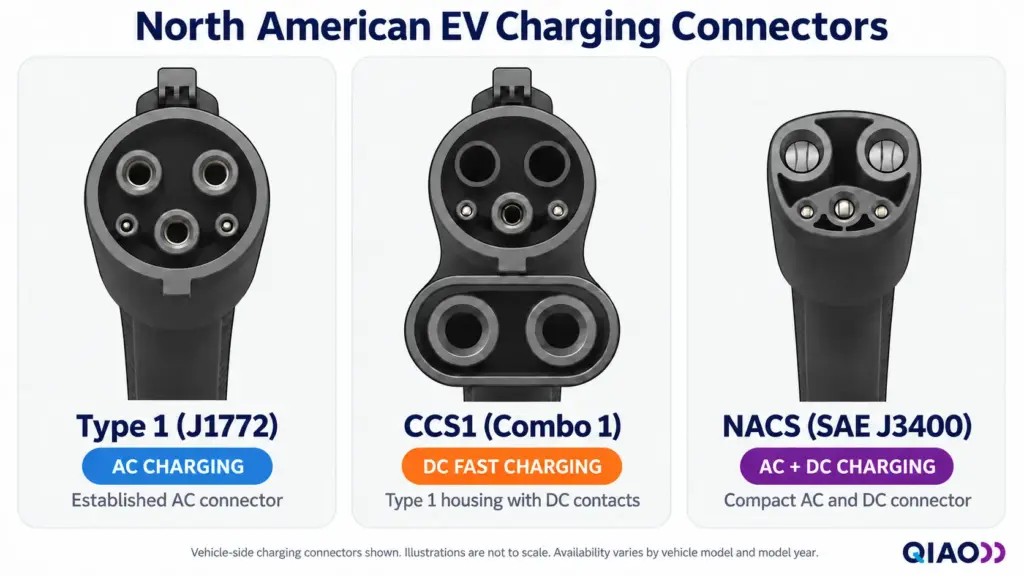
Type 1 is also called SAE J1772. It is the established AC connector for many EVs and plug-in hybrids in the United States and Canada. A large base of Type 1 vehicles and Level 1 or Level 2 equipment remains in use.
Demand for Type 1 products will not disappear as soon as new models adopt NACS. Used-EV sales extend the market for compatible home and portable EV chargers. Do not stop carrying Type 1 products based only on new-model announcements.
NACS Is an Important Growth Standard
NACS uses one vehicle interface for AC and DC charging. SAE International standardizes the North American Charging System under SAE J3400. Launch dates and adapter programs still differ by brand.
Segment the market into native-NACS vehicles, approved-adapter users, and vehicles that still require J1772. Not every 2025 or later EV uses NACS.
CCS1 Extends Type 1 for DC Charging
CCS1 adds two DC contacts below the Type 1 interface. The combined inlet accepts Type 1 for AC charging. It accepts CCS1 for DC fast charging. This relationship often causes confusion when buyers compare a home charger with a highway fast charger.
When planning an AC charger range, classify vehicles by their AC inlet first. Mixed-fleet dealers may need chargers fitted with Type 1 and NACS connectors at the same time, plus adapter guidance approved by the vehicle manufacturer.
Europe and the UK: Type 2 and CCS2
Across the European Union and the UK, Type 2 is the main connector for AC charging, while CCS2 is widely used for DC fast charging. This gives distributors a relatively consistent connector baseline, but the EU and the UK follow separate regulatory frameworks.
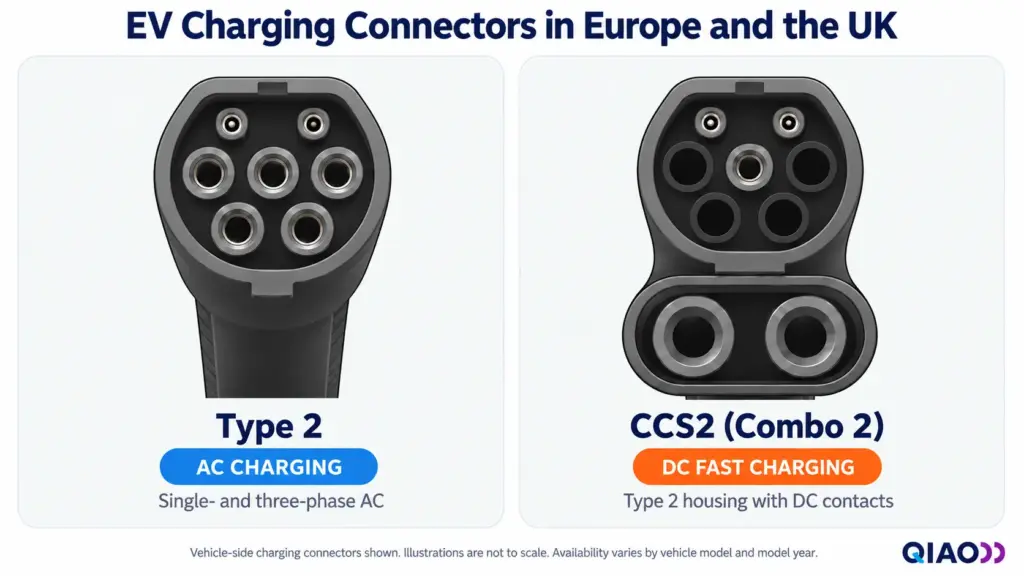
Type 2 Supports Single-Phase and Three-Phase AC
Type 2 can support both single-phase and three-phase AC charging. That makes it suitable for home, workplace, destination, and public AC installations. Common charger ratings include 7 kW for single-phase service and 11 kW or 22 kW for three-phase service.
The nameplate rating does not guarantee the same rate at every site. A 22 kW wallbox requires a suitable three-phase supply and a vehicle that supports 22 kW AC charging. An EV limited to 11 kW AC stays at that limit.
CCS2 Adds DC Contacts to the Type 2 Layout
CCS2 combines the Type 2 layout with two larger DC contacts. A vehicle with a CCS2 inlet can use the Type 2 portion for AC charging or the complete CCS2 interface for DC fast charging. In the European Union, the Alternative Fuels Infrastructure Regulation specifies Type 2 for covered publicly accessible AC charging points and Combo 2 for covered publicly accessible DC charging points. These EU-level connector requirements do not replace country-specific rules covering electrical installation, accessibility, payment, and site operation.
AFIR does not apply in the UK. Although the UK follows a similar Type 2 and CCS2 connector pattern, distributors should separately verify UK product conformity, electrical installation, and public-charging requirements. Great Britain and Northern Ireland follow different product-market frameworks.
Choose Tethered or Socketed Charging for the Sales Channel
A tethered wallbox has a fixed Type 2 cable. A socketed unit lets the driver supply the cable and may suit public or shared parking.
Match the choice to local buying habits. Home buyers may prefer tethered charging, while property managers may want a socketed unit for easier cable replacement.
China: GB/T AC, GB/T DC, and ChaoJi
Mainland China uses the GB/T charging system, with different physical connectors for AC and DC charging.
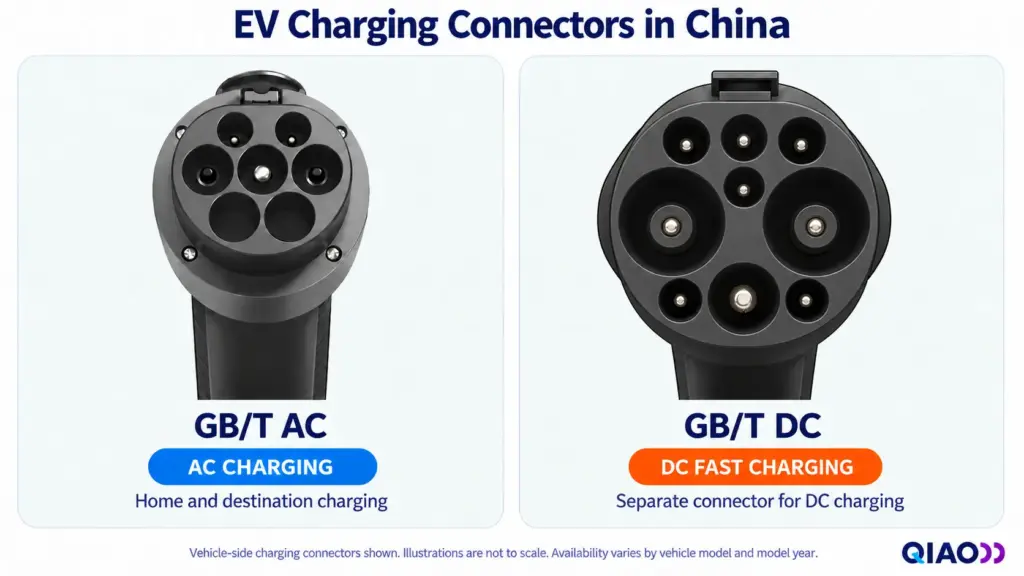
GB/T AC and DC Need Separate Product Plans
GB/T AC covers standard AC charging for homes, workplaces, and destination sites. Unlike CCS1 and CCS2, the two GB/T connectors do not share one combined vehicle inlet. This AC and DC architecture is examined more closely in the GB/T vs Type 2 vs CCS comparison.
For an AC distributor, a request for “GB/T” is incomplete. Confirm GB/T AC, then check the rating, signaling, cable, grid connection, and certification. Do not specify an AC unit from a GB/T DC photo.
GB/T also appears abroad on exported or privately imported vehicles. This can create focused demand inside a Type 2 market. It does not mean the whole country has moved to GB/T.
One related development is ChaoJi, a high-power DC charging system jointly developed by the China Electricity Council and the CHAdeMO Association. China published GB/T 20234.4-2023 for the high-power DC charging coupler, and the standard took effect in 2024. CHAdeMO has also released CHAdeMO 3.0 specifications based on the ChaoJi concept, while related international standardization continues. Commercial deployment remains at an early stage. For distributors focused on AC chargers, ChaoJi does not affect current AC charger selection.
Japan: Type 1, CHAdeMO, and a Changing Vehicle Mix
Japan has a large installed base of Type 1 AC and CHAdeMO DC vehicles. Current product planning should still use model-level data. Imported vehicles and newer platforms can add other connectors to the market.
Type 1 remains relevant for AC charging on many Japanese vehicles. CHAdeMO remains visible in the DC network and on older EVs, including many Nissan Leaf models. Many of these vehicles pair CHAdeMO DC with Type 1 AC.
Review local registrations, dealer sales, and supported models. Country-level assumptions can overlook imported vehicles and older models. Confirm the AC inlet, grid connection, and local approval.
How Distributors Should Choose an EV Charger Configuration
Choose a charger configuration through a six-step market review. This process links the connector to the vehicles, electrical system, sales channel, and compliance path.
Step 1: Measure the Local Vehicle Mix
Start with registrations and current dealer sales. Group vehicles by AC inlet, model year, and import source. Separate the installed fleet from announced future models. Installed vehicles drive replacement and accessory sales now, while new models guide the next purchasing cycle.
This review may lead to separate Type 1 and NACS stock. It may also support a focused GB/T range for imported vehicles.
Step 2: Match the Charger to the Parking Session
Choose AC or DC based on dwell time and operating need. Homes, offices, hotels, and apartment buildings usually allow several hours for charging, so AC equipment often fits the job. Highway sites and high-use fleets may require DC fast charging.
Keep AC and DC product categories separate. A home-charger distributor does not need every connector used by public DC networks.
Step 3: Confirm Available Power
Check voltage, phase, current, frequency, and the site’s spare electrical capacity. Then compare those limits with the vehicle’s onboard AC charger. A three-phase 22 kW product offers little value in a single-phase home market. The same is true when target vehicles accept only 7 kW AC.
Common AC charging power levels include 7 kW, 11 kW, and 22 kW, but the output available in practice depends on the site supply and the vehicle’s onboard charger. State both limits clearly so buyers do not expect the charger’s rated maximum at every site.
Step 4: Specify the Grid-Side Connection
List the connection method separately from the vehicle connector. A wallbox may be hardwired. A portable unit may use NEMA 14-50, NEMA 6-50, Schuko, BS 1363, or a CEE plug. The choice depends on its market and rating.
Use interchangeable grid plugs only when the charger supports them. Confirm which plugs are approved, how the charger identifies each plug’s current limit, whether temperature monitoring is included, and what operating instructions users must follow.
Step 5: Choose the Cable and User Interface
Decide whether the charger should use a tethered vehicle cable, a socketed design, or an approved interchangeable input-plug system. Then specify cable length, connector holster, display, current adjustment, access control, app functions, and mounting accessories. Available features vary by charger model.
Fit the package to the channel. Retail units may need a carry case and vehicle list. Installer packages need commissioning guidance and mounting hardware. Property projects may request RFID or network management.
Step 6: Verify Certification and Installation Rules
Connector type does not determine full product compliance. Certification can cover the charger, cable, plug, radio module, energy meter, and other components. The required route depends on the country, product category, and sales channel.
Match certificates and reports to the quoted model, rating, and standard. Then ask a local specialist or authority to confirm acceptance.
Do not treat CE marking as proof of global market access. It indicates conformity with applicable EU requirements, but other markets may impose additional product, documentation, labeling, or installation rules. Great Britain currently recognizes CE marking for many regulated product categories, while Northern Ireland follows a separate framework. Always verify the rules for the specific product and target market.
Common Plug-Standard Mistakes to Avoid
Most ordering errors come from treating one technical label as the whole product specification. Watch for these six mistakes:
- Choosing by region alone: Use country, vehicle, and model-year data because imported and older EVs can follow another standard.
- Confusing the vehicle connector with the wall plug: Specify both ends of a portable charger, including voltage and current.
- Calling CCS an AC charger plug: CCS adds DC contacts, while a CCS vehicle uses its Type 1 or Type 2 section for AC charging.
- Assuming connector shape sets charging power: The electrical supply, charger, cable, and vehicle each place a limit on the session.
- Using adapters as the main stock plan: Adapters add another compatibility and safety check and may not support every charging mode.
- Planning only for new vehicles: Many vehicles that use CHAdeMO for DC fast charging still rely on Type 1 for AC charging. The installed vehicle fleet therefore continues to support demand for older AC connector formats.
Distributor Checklist Before Ordering
Collect the same details for every quote. A consistent intake form reduces revisions and makes product comparisons easier.
- Define the Sales Market: Record the country, sales channel, expected annual volume, and intended user group.
- List the Target Vehicles: Include make, model, year, AC inlet, onboard charging limit, and import source.
- Name the Charging Mode: State home AC, portable AC, workplace AC, public AC, or DC fast charging.
- Confirm the Electrical Supply: Record voltage, phase, frequency, breaker capacity, and required grid-side connection.
- Select the Vehicle Interface: Choose Type 1, Type 2, GB/T AC, or NACS for the planned AC product.
- Choose the Product Format: State wall-mounted or portable, tethered or socketed, cable length, and mounting needs.
- Request Model-Specific Compliance Files: Match certificates, test reports, labels, manuals, and packaging to the quoted SKU.
- Plan After-Sales Support: Agree on spare parts, warranty steps, technical contacts, training, and product traceability.
Start With the Target Market
The right EV charging plug standard starts with local vehicles, not a global popularity chart. North American distributors may need Type 1 and NACS during the market transition. European and UK channels can begin with Type 2 for AC and CCS2 for DC. China needs separate GB/T AC and DC planning. Japan and mixed import markets require a closer look at the models already on the road.
Confirm the vehicle connector first. Then add the power level, grid-side connection, cable format, product features, and local compliance route. That sequence produces a market-ready charger instead of a product that only looks compatible.
QIAO Charger supplies home and portable AC chargers with vehicle-side connector options for different markets. Available configurations include Type 1, Type 2, GB/T, and Tesla-compatible options, depending on the product model and target market. Power ratings, cables, grid-side connections, and control functions also vary by model. Contact us with your target country, vehicle list, and electrical requirements to plan the appropriate distributor range.