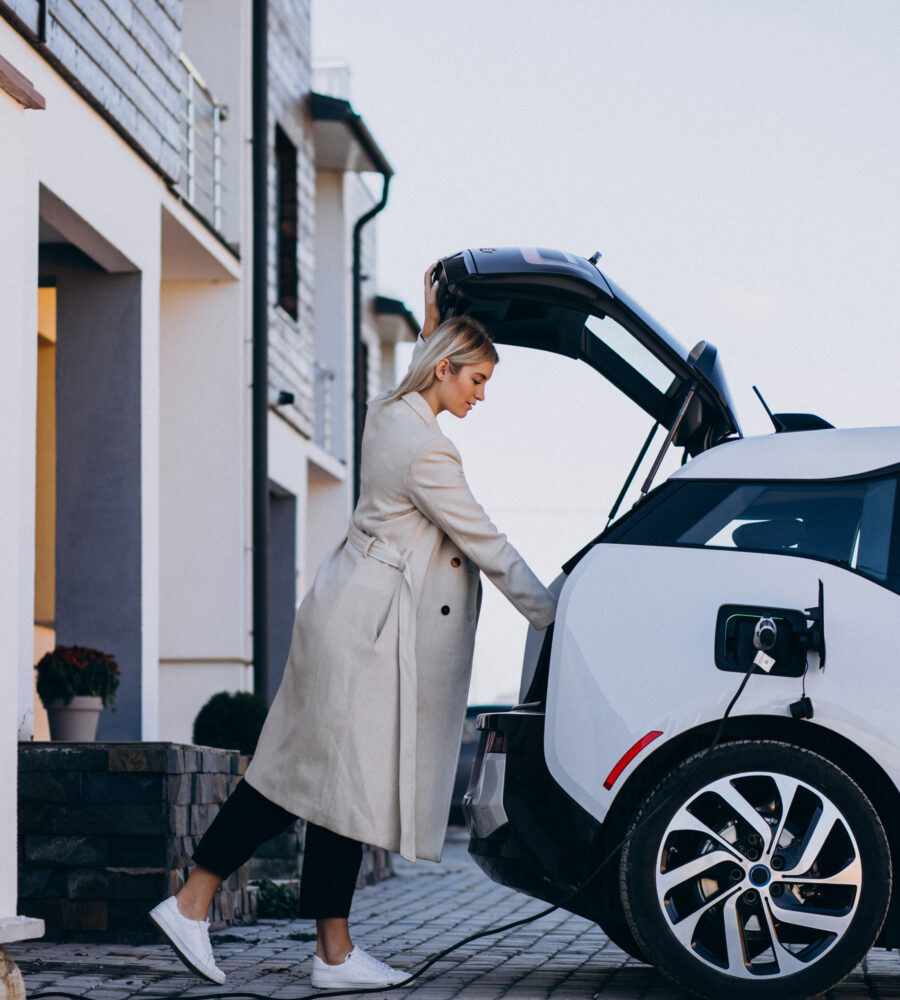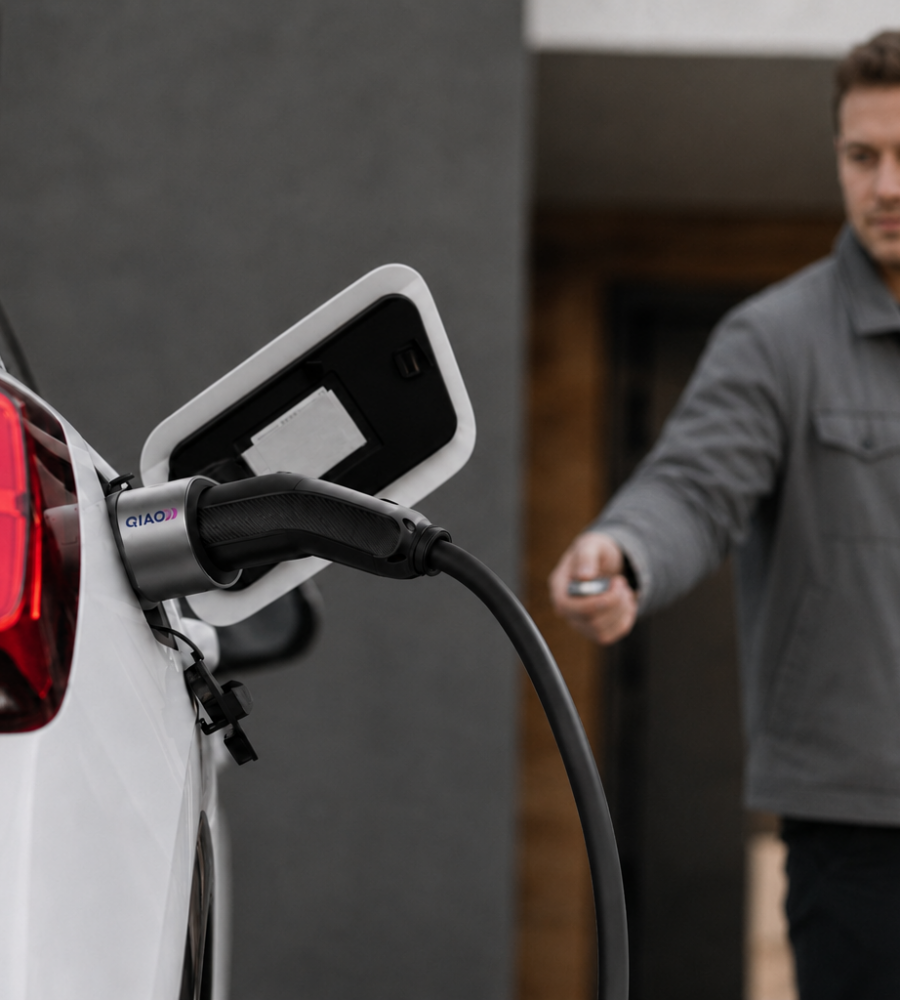
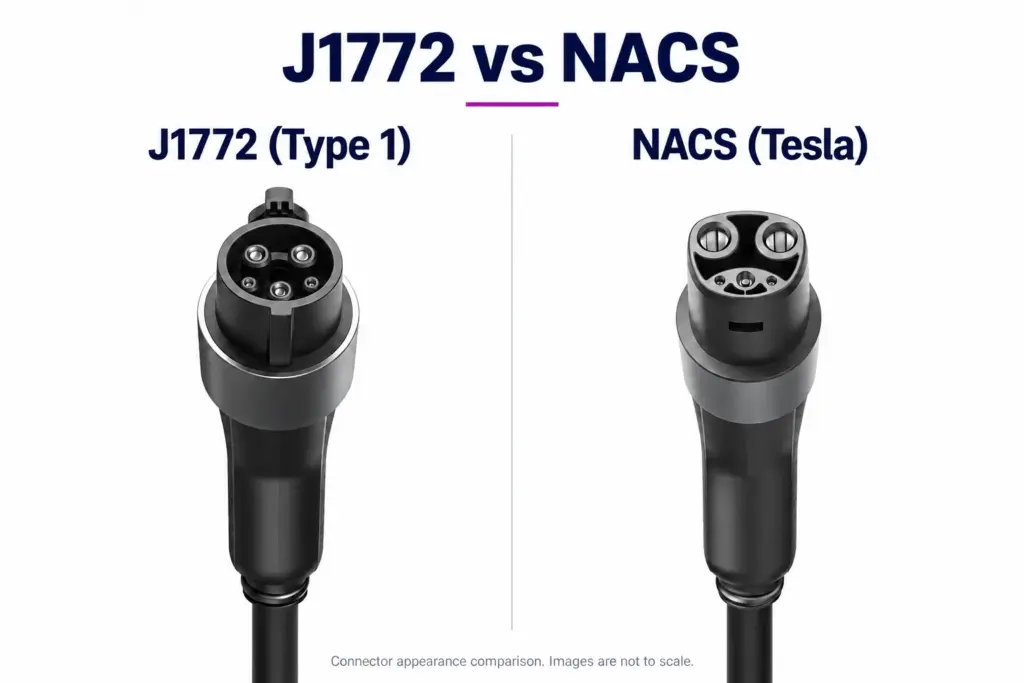
J1772 (Type 1) is a common North American connector for Level 1 and Level 2 AC charging. NACS, originally developed by Tesla, is a smaller connector design that supports both AC charging and DC fast charging. Other automakers now use NACS too.
For home charging, choose the connector your vehicle supports for AC charging. NACS does not make a home charger faster by itself, and a working J1772 charger may still serve your next car with a compatible AC adapter. Fast-charging access requires separate checks for the vehicle, adapter, and station.
J1772 vs NACS at a Glance
The main difference is the charging connector each design supports. Here is how they compare for drivers in the United States and Canada.
| Factor | J1772 | NACS |
| AC charging | Supports Level 1 and Level 2 | Supports Level 1 and Level 2 when the vehicle and equipment allow it |
| DC fast charging | The five-pin J1772 connector does not support DC fast charging | The design supports DC fast charging with suitable vehicles and equipment |
| Connector size | Larger than NACS | More compact than J1772 |
| Connection to CCS1 | Forms the upper AC portion of a CCS1 inlet | Uses a different connector design |
| Home charging speed | Depends on the electrical supply, charging equipment, and vehicle | Depends on the same limits |
| Buying decision | Suits vehicles that use J1772 for AC charging | Suits vehicles that accept NACS AC charging |
What Is J1772?
In everyday use, “J1772” means the five-pin AC charging connector, also called Type 1. Many North American EVs and plug-in hybrids use it, as do home and public AC chargers.
Level 1 charging typically uses a 120-volt supply. Level 2 uses a higher-voltage AC supply, commonly 240 volts at home. The same J1772 vehicle connector can serve either level when the charging equipment supports it.
Do not choose a connector based only on the car’s brand or age. Check the charging section of your owner’s manual.
What Is NACS?
NACS stands for North American Charging Standard. It uses a compact connector with the same two main power contacts serving AC or DC charging, depending on the equipment and vehicle.
You may also see NACS referred to as SAE J3400. SAE standardized the NACS-based charging system under J3400, including a connector that can transfer single-phase AC or DC power. That describes what the design can do. It does not mean every vehicle with a NACS inlet accepts both types of power through that inlet.
How Does CCS1 Relate to J1772?
CCS1 combines the five-pin J1772 AC section with two larger DC contacts below it. A CCS1-equipped vehicle can usually accept a J1772 AC connector in the upper section of its inlet. A CCS1 DC connector uses the larger combined connection.
The Joint Office’s connector guide explains this layout. A car with only a five-pin J1772 inlet does not gain CCS1 fast charging through an ordinary adapter.
Is NACS Better Than J1772?
NACS offers a smaller connector and a design that can handle AC and DC charging. For home use, choose the connector that suits your car and daily routine.
Connector Size and Everyday Handling
A compact connector can be easier to handle, especially when you plug in every day. However, the full cable assembly also affects how easy the charger is to handle. Cable thickness, flexibility, weight, and storage can matter as much as the handle.
If possible, try lifting the cable and reaching the car’s port before buying. Check that you can connect it without pulling the cable tight or placing strain on an adapter.
Is NACS Faster for Home Charging?
No. NACS does not increase AC charging speed just because the plug is different.
During AC charging, the car’s onboard charger converts AC power into DC for the battery. At 240 volts, these output currents give the following power levels, rounded to one decimal place:
- 32 Amps: 7.7 kW.
- 40 Amps: 9.6 kW.
- 48 Amps: 11.5 kW.
These figures show power supplied to the car. They do not promise how fast the battery will gain energy. Some energy is lost as heat or used by the car, so the battery stores less. A 208-volt supply also delivers less power at the same current.
For example, a car limited to 7.2 kW AC charging cannot use a home unit’s full 11.5 kW output. Changing from J1772 to NACS will not raise that limit.
Check the supply, configured charger output, vehicle limit, and any adapter rating together. Charger settings, load management, and the car’s condition can reduce the rate further.
Is NACS Compatible with J1772?
J1772 and NACS do not connect directly, but a suitable AC adapter can bridge many compatible home and public AC setups. The adapter must match the charger-to-vehicle direction and support the intended equipment.
This table applies to AC charging only:
| Charger connector | Vehicle’s AC inlet | Connection needed |
| J1772 | J1772, including the AC section of CCS1 | Direct connection |
| J1772 | NACS inlet that accepts AC | Compatible J1772-to-NACS AC adapter |
| NACS AC connector | J1772, including the AC section of CCS1 | Compatible NACS-to-J1772 AC adapter; check charger access settings |
| NACS AC connector | NACS inlet that accepts AC | Direct connection, subject to equipment compatibility and access settings |
Using a J1772 Charger with a NACS Vehicle
For a compatible Tesla vehicle, a J1772-to-NACS AC adapter lets you use a J1772 home or public AC charger. Check that the adapter supports your vehicle and the charger’s output before use. You may be able to keep your home unit after changing cars or use a J1772 charger at work.
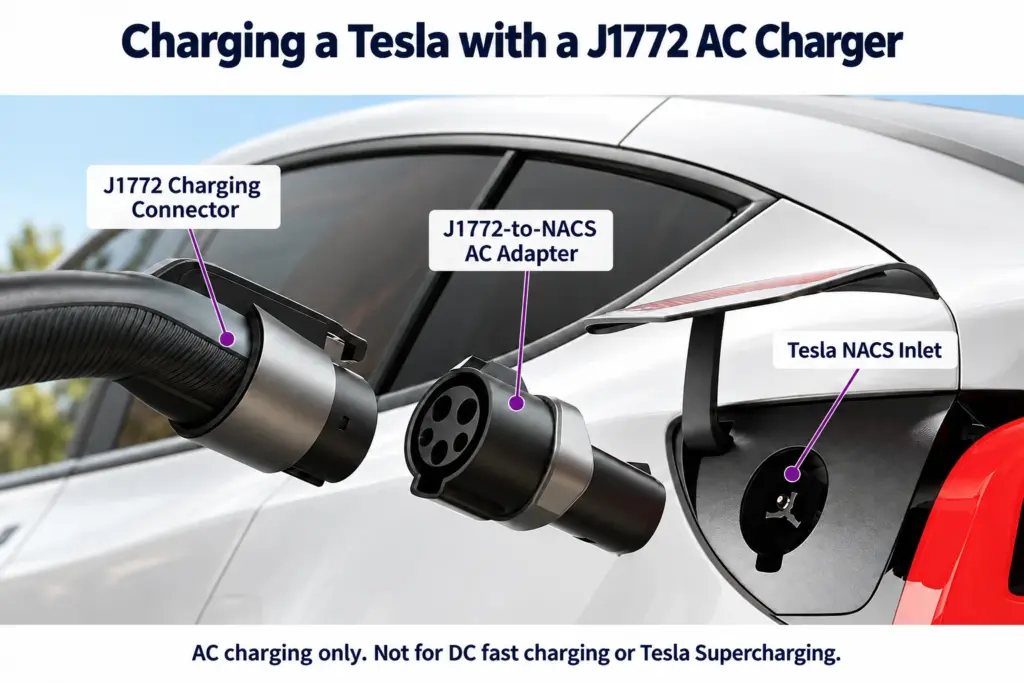
First, check that the car accepts AC through its NACS inlet. Check the adapter’s current and voltage ratings, supported vehicles, and instructions. Follow the connection order stated by the manufacturer.
Using a NACS AC Charger with a J1772 Vehicle
The reverse connection needs a compatible NACS-to-J1772 AC adapter. It allows a J1772 vehicle to use supported NACS home or destination AC chargers. Check the adapter’s vehicle compatibility and electrical ratings before use.
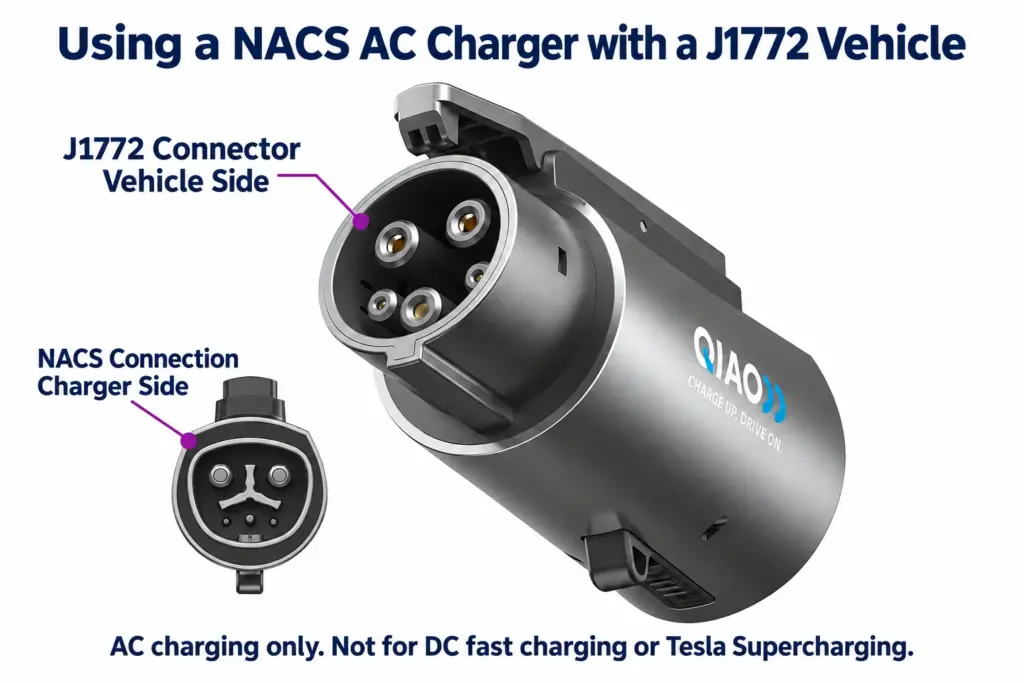
Some AC chargers have access settings that limit which vehicles can charge. A connector that fits will not bypass those settings. Confirm both equipment compatibility and permission to use the charger.
This adapter does not let the vehicle use a Tesla Supercharger. Superchargers supply DC power, which requires a different charging path.
Check AC Support Before Buying an Adapter
The US-market 2026 Nissan LEAF shows why the inlet’s shape is not enough. Nissan specifies a J1772 port for home and public AC charging, plus a separate NACS port for DC fast charging. Its official press kit describes both ports.
For that version of the LEAF, choose a home charger that suits the J1772 AC port. Do not assume a NACS home charger connects directly just because the car has a NACS fast-charging port.
Before ordering any adapter, check four details:
- Vehicle Configuration: Confirm the model year, market, and inlet used for AC charging.
- Charging Type: Confirm that the adapter supports AC or DC as required.
- Connection Direction: Match the charger’s connector to the vehicle’s inlet.
- Supported Equipment: Check vehicle and charger compatibility, electrical ratings, and manufacturer instructions.
An adapter only connects charging systems that are already compatible. It does not add a charging capability that the vehicle does not support.
Can a J1772 Vehicle Use a Tesla Supercharger?
A car cannot use a Tesla Supercharger through its J1772 AC inlet alone. An eligible vehicle with CCS1 DC charging may use compatible Superchargers with a supported DC adapter or a station’s built-in adapter.
The difference between J1772 and CCS1 matters here. A CCS1 vehicle uses its J1772 section at an AC charger, but it needs the full CCS1 connection for DC fast charging.
Tesla’s Supercharging guidance for other EVs explains station access and adapter requirements. For Supercharging, use only an NACS DC adapter provided by Tesla or your vehicle manufacturer. Tesla prohibits third-party adapters at Superchargers. An AC adapter must not be used for Supercharging.
Some Supercharger sites have a built-in CCS1 adapter called Magic Dock. At those sites, a compatible vehicle may use the station’s adapter instead of bringing one.
Before traveling, check the site in the Tesla app or a charging service your automaker supports. Confirm that your vehicle can use that location. A native NACS inlet does not grant access to every Supercharger site.
Also check what kind of Tesla charging equipment you are using. A Wall Connector or destination charger supplies AC; a Supercharger supplies DC. The same connector shape does not make their adapters interchangeable.
Is J1772 Going Away?
J1772 remains useful for vehicles and AC chargers already in service, even as automakers and charging providers add NACS. There is no single replacement date that applies to every car, home charger, and public location.
Adoption differs by model, model year, and market. A brand’s move to NACS does not prove that every car it sells has the same inlet or charging support.
If you already own a charger, ask whether it still meets your car’s needs. A working J1772 charger can remain suitable for a J1772 car. It may also serve a later NACS AC vehicle through a supported adapter.
Do You Need to Replace an Existing J1772 Charger?
Not always. Compare these options before buying a new unit:
| Option | When it may fit | Costs and details to check |
| Keep the charger unchanged | Your vehicle still uses J1772 AC | Equipment condition, cable reach, and charging output |
| Add an AC adapter | The next vehicle accepts NACS AC and supports the connection | Adapter price, ratings, handling, and compatibility |
| Use a manufacturer cable conversion kit | The exact charger model supports an approved conversion | Kit price, installation work, warranty terms, and instructions |
| Replace the charging unit | The existing unit lacks needed features or a suitable supported connection | New equipment, installation, setup, and possible electrical work |
Only some charger models support cable changes. Ask the charger manufacturer about your exact model. A generic replacement cable is not proof that a conversion is supported.
Changing the vehicle connector also does not increase the circuit’s capacity or the charger’s output. If you want more power, have an electrician assess the electrical supply and installation separately.
Which Connector Should You Choose for Home or Portable Charging?
Choose for the vehicle you will charge regularly, then consider other cars and places where you expect to use the equipment.
| Your situation | Practical starting point |
| Your car uses J1772 AC | Choose J1772 for a direct connection |
| Your car accepts NACS AC | Choose NACS for a direct connection |
| Your car has separate AC and DC ports | Choose the connector that matches its AC port |
| Your household has J1772 and NACS AC vehicles | Compare one charger with a supported adapter against separate charging units |
| You already own a suitable J1772 charger | Check adapter or supported conversion options before replacing it |
| Your next vehicle is undecided | Prioritize current use and verify future compatibility when you select the car |
For a mixed household, one charger with an adapter can serve two compatible vehicles in turn. It will not charge both at once. If both cars need overnight charging, consider parking access, schedules, and separate units with suitable load management.
A portable charger adds another question: which electrical outlets will you actually use? The vehicle connector may match your car, yet the input plug may not suit the available outlet.
Match the Electrical Supply as Well as the Car
After choosing J1772 or NACS for the vehicle side, check how the charger will connect to your electrical supply. J1772 and NACS describe the connection to the vehicle, while common North American NEMA 5-15, 6-20, and 14-50 outlets are on the supply side. For example, a “NACS with NEMA 14-50” portable charger uses NACS at the car and a NEMA 14-50 connection at the power source.
Cable reach matters too. Port positions vary between vehicles, so measure the route the cable will actually follow from the charger to the charge port rather than relying on straight-line distance. The same cable length checks apply when choosing an attached J1772 or NACS cable.
Connector type is also separate from the choice between a portable or wall-mounted EV charger. One can travel with you, while the other stays ready at your usual parking space, but either still needs the correct vehicle connector.
Final Thoughts
Start with your vehicle’s AC charging inlet and maximum AC rate. Then check the electrical supply, cable reach, and any supported adapter or conversion option. If you also need Supercharger access, verify the vehicle and station separately. Those checks help you choose useful equipment without replacing a charger that can still meet your needs.
About QIAO Charger
QIAO Charger offers home EV chargers and portable EV chargers for different charging needs. Connector options, input connections, and features vary by model and market. Check that the version you choose suits your car and the place where you will charge.
We also work with distributors, retailers, and partners delivering EV charging projects. If you are building a local EV charging product range or planning a charging project, contact QIAO Charger about a partnership to discuss product selection, documentation, supply, and project requirements.