Table of Contents
Single-Phase vs Three-Phase Power: A Technical Guide for EV Charging Applications
When deploying AC EV charging infrastructure, one of the most critical—and often misunderstood—technical decisions is whether to use single-phase or three-phase electrical supply. This choice directly affects charging performance, infrastructure cost, grid compatibility, and long-term scalability.
For residential, commercial, and fleet applications, understanding the electrical principles behind single-phase and three-phase power is essential to selecting the most efficient and future-proof EV charging solution.
Electrical Fundamentals: How Single-Phase and Three-Phase Power Work
Single-Phase Power: Simplicity and Accessibility
Single-phase power consists of one alternating voltage waveform and is typically delivered through:
- One live conductor
- One neutral conductor
Because the current oscillates through a single waveform, instantaneous power delivery fluctuates, which limits the maximum continuous load that can be efficiently supported.
Typical single-phase characteristics:
- Nominal voltage: 220–240V (EU/Asia), 120–240V split-phase (North America)
- Lower maximum current capacity
- Suitable for light-to-moderate electrical loads
Three-Phase Power: Balanced and High-Capacity Delivery
Three-phase power uses three alternating voltage waveforms, each offset by 120 degrees. This configuration ensures that power delivery is continuous and balanced.
Key advantages:
- Higher total power transfer with the same conductor size
- Reduced current per phase
- Improved thermal efficiency and system stability
Typical three-phase characteristics:
- Nominal voltage: 380–415V (EU/Asia)
- Higher efficiency for sustained loads
- Preferred for commercial and industrial environments
Power Output and Charging Performance in AC EV Charging
The relationship between phase type and EV charging power is direct and quantifiable.
Single-Phase AC Charging
- Typical power levels: 3.6 kW / 7.4 kW
- Current-based limitation on power scaling
- Charging time suitable for overnight or low-usage scenarios
Three-Phase AC Charging
- Typical power levels: 11 kW / 22 kW
- Higher onboard charger utilization
- Faster energy replenishment without DC infrastructure
In practical terms, a vehicle charging on 22 kW three-phase AC can receive up to three times more energy per hour than a single-phase setup, assuming vehicle compatibility.
Impact on Grid Load and Energy Efficiency
Load Distribution
Three-phase systems distribute electrical load evenly across three conductors, reducing peak stress on any single line. This is especially important in multi-charger installations.
Cable Loss and Heat Management
Lower current per phase means:
- Reduced resistive losses (I²R)
- Lower operating temperatures
- Longer equipment lifespan
For sites with multiple EV chargers, three-phase AC charging offers superior electrical efficiency and stability.
Infrastructure Cost and Installation Complexity
Single-Phase Installations
- Minimal electrical upgrades
- Lower installation and hardware cost
- Limited scalability
Three-Phase Installations
- Higher upfront infrastructure planning
- Potential transformer or switchgear upgrades
- Significantly better long-term scalability
For businesses planning to expand charging capacity over time, three-phase infrastructure typically results in lower total cost of ownership (TCO).
Regional Infrastructure Considerations
- Europe: Three-phase power is widely available in residential and commercial buildings, making 11 kW and 22 kW AC charging common.
- North America: Residential single-phase dominates; three-phase is mainly limited to commercial and industrial properties.
- Asia-Pacific: Mixed adoption depending on urbanization and building standards.
Selecting the correct charger requires aligning with local electrical codes and grid availability.
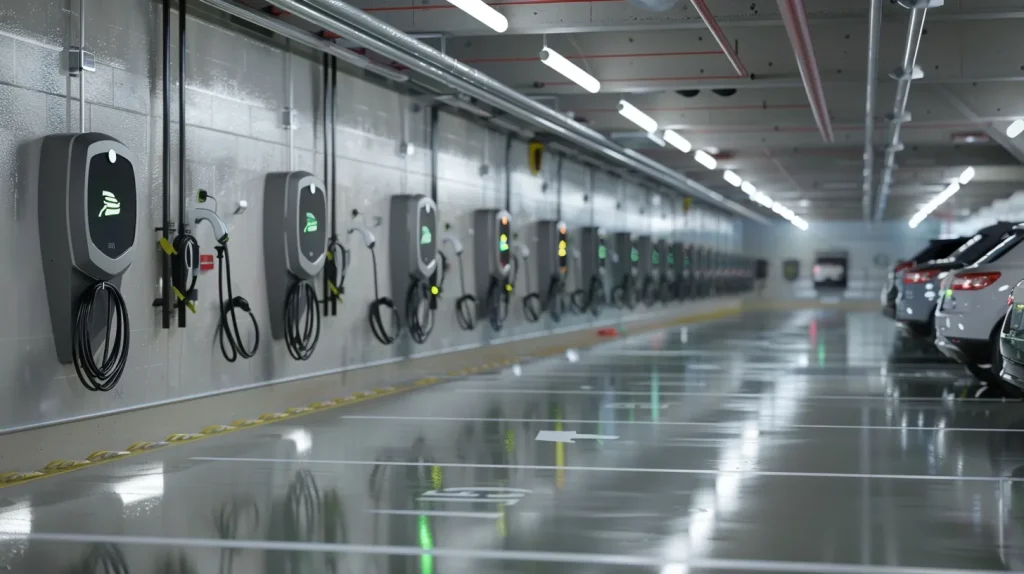
Single-Phase vs Three-Phase: Application-Based Selection
| Application | Recommended Power Type |
| Private homes | Single-phase AC |
| Apartment complexes | Three-phase AC |
| Retail & workplaces | Three-phase AC |
| Fleet depots | Three-phase AC |
| Temporary / portable use | Single-phase AC |
The correct approach is use-case-driven, not power-maximization-driven.
AC Charging as the Backbone of EV Infrastructure
Despite increasing attention on DC fast charging, AC charging remains the backbone of global EV infrastructure because it:
- Matches real-world parking durations
- Minimizes grid impact
- Enables cost-efficient scaling
- Supports overnight and off-peak charging
Understanding phase selection is therefore a core competency in AC EV charger deployment.
How QIAO Supports Both Power Architectures
QIAO designs commercial AC EV chargers that support both single-phase and three-phase electrical systems, covering:
- 7 kW single-phase chargers for residential and portable applications
- 11 kW and 22 kW three-phase chargers for commercial, retail, and fleet environments
Available in wall-mounted and portable form factors, QIAO chargers allow customers to align charging infrastructure with existing electrical capacity while remaining scalable for future demand.
Conclusion
Choosing between single-phase and three-phase power is not merely a technical detail—it determines charging efficiency, infrastructure cost, and operational reliability.
For EV charging projects to succeed at scale, stakeholders must understand electrical fundamentals and select AC charging solutions that match real-world usage patterns and grid constraints.