
Home EV charging in Australia starts with your daily driving, your car’s AC charging limit and your home’s electrical supply. A suitable power point may cover modest daily use, while a dedicated charger can provide faster top-ups.
This guide explains how charging power, rooftop solar, electricity tariffs and installation costs affect your choice.
Quick Checks Before You Buy
Before choosing a home EV charger in Australia, gather these details:
- Vehicle: Your model, year, charging connector and maximum AC charging rate.
- Daily Use: Your usual driving distance and available charging hours.
- Home Supply: Ask an electrician to confirm your supply type and available capacity.
- Energy Setup: Your electricity tariff and any rooftop solar or home battery.
- Installation: Your parking location, cable route and an itemised quote covering equipment, electrical work and required accessories.
Do You Need a Dedicated Home EV Charger?
A compatible portable charger and a suitable power point may meet your daily charging needs. Consider a dedicated charger when you need faster top-ups or more energy within a short charging window.
Start with the energy needed to cover your daily driving, rather than the time required to charge an empty battery.
| Charging Option | Approximate Power | When to Consider It |
| 10 A portable charger | Up to 2.3–2.4 kW | Modest daily driving with long parking periods |
| 15 A portable charger | Up to 3.5–3.6 kW | Portable charging from a suitable 15 A socket |
| Higher-power portable charger | Around 7 kW single-phase; 11 kW or 22 kW three-phase | Faster charging where a suitable higher-current outlet and supply are available |
| Fixed home AC charger | Typically 7–22 kW | A permanent charging location with convenient cable access |
Actual power depends on the equipment, input connection, electrical supply and vehicle.
Parking overnight at home may give a portable charger enough time to cover your daily driving. A short window of cheap or free midday electricity may make faster charging more useful.
Higher-power portable chargers require a suitably rated outlet and circuit. They cannot deliver 7 kW, 11 kW or 22 kW from a standard 10 A household power point. Match the input plug and charging current to the available supply.
Have an electrician check that the socket and circuit suit sustained EV charging. A 15 A plug requires a matching 15 A socket. Connect directly to the socket, follow the equipment instructions, and avoid extension leads or power boards.
Cable storage, everyday handling and charging away from home also influence your choice between portable and wall-mounted EV chargers.
What Charging Power Can Your Home and EV Support?
Choose a power rating that both your home’s electrical supply and your vehicle can support. Check the AC charging specifications for the model year and variant of your Australian-market vehicle.
Match Single-Phase or Three-Phase Power to Your Vehicle
Your car’s onboard charger converts AC electricity into DC for the battery. Its capacity limits how much AC power the vehicle can accept.
Common options include 7 kW, 11 kW and 22 kW home EV chargers, with the following supply requirements:
| Charger Rating | Supply Required for Rated Output | Typical Current per Phase |
| 7–7.4 kW | Single-phase | 32 A |
| 11 kW | Three-phase | 16 A |
| 22 kW | Three-phase | 32 A |
Actual output also depends on the circuit, cable, charger settings and available capacity.
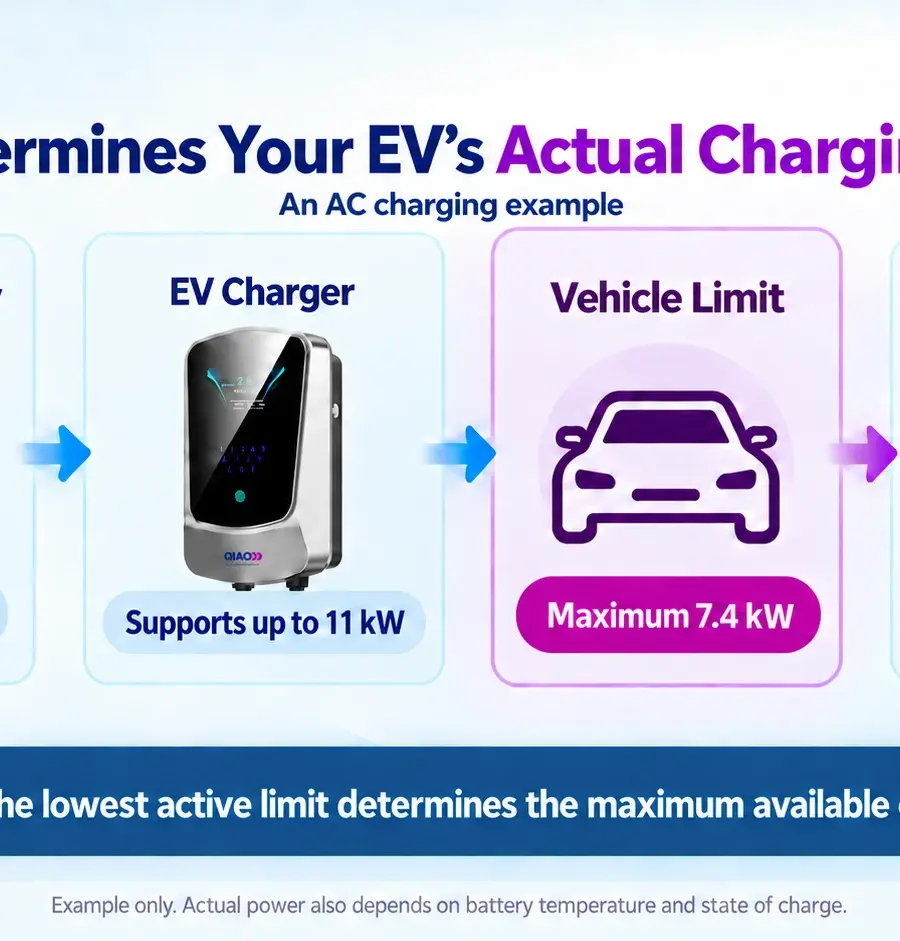
A 22 kW charger cannot make a car exceed its 11 kW AC limit. Likewise, three-phase power at home cannot give a single-phase vehicle three-phase charging capability. Check the vehicle’s supported charging rates for each supply type.
Estimate Your Daily Charging Time
Estimate the energy needed to cover your daily driving. For example, driving 50 km at an assumed consumption of 18 kWh per 100 km uses about 9 kWh from the battery.
Assuming 90% charging efficiency, replacing that energy requires about 10kWh from the power supply:
- At 2 kW average input: Around 5 hours.
- At 7 kW average input: Around 1.4 hours.
These are illustrative estimates. Temperature, charging losses, vehicle behaviour and power limits can change the result.
A higher rating may help with short charging windows or two cars sharing one charger. Compare that benefit with the additional equipment and installation cost.
How Can You Charge Your EV With Rooftop Solar?
You can use rooftop solar to charge your EV without adding a home battery. The amount available depends on solar output, household demand and when your car is plugged in.
Can Your Existing Solar System Charge Your EV?
An ordinary AC charger can use electricity generated by a grid-connected solar system. The available surplus changes as sunlight and household demand change.
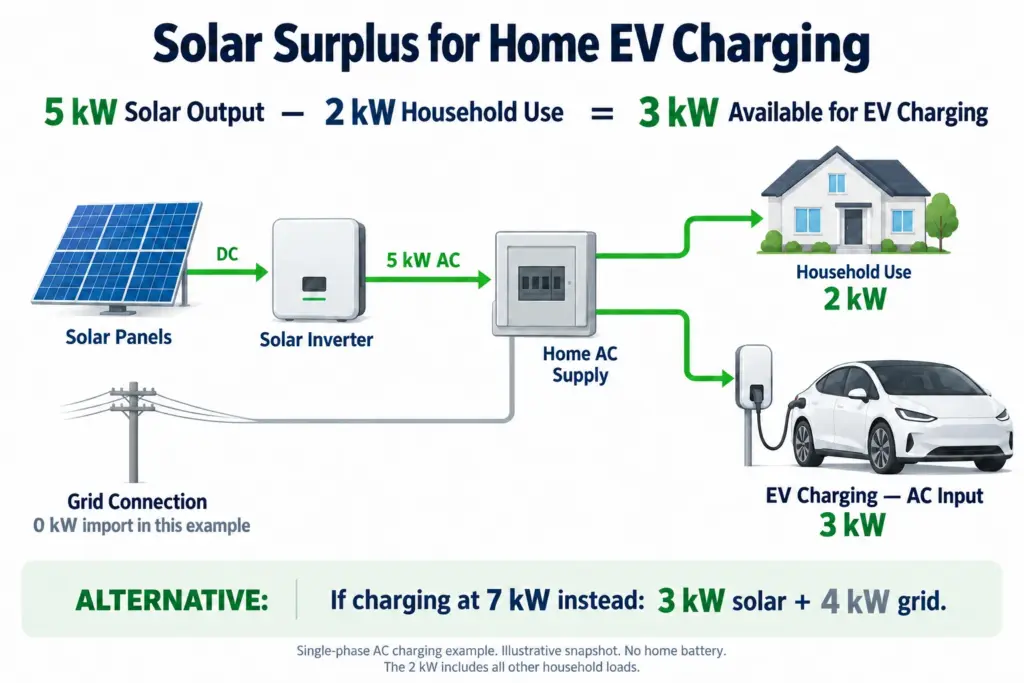
For example, suppose your solar system supplies 5 kW of AC power while household appliances use 2 kW. That leaves about 3 kW before any home battery charging. A charger drawing 7 kW would need additional power from the grid or a battery, depending on your setup.
Check actual generation and consumption data. The panel rating alone does not show how much power will be available for your car.
Scheduled Charging vs. Solar Surplus Control
Charging during daylight hours and automatically following solar surplus provide different levels of control:
| Charging Approach | What It Does | What to Check |
| Daytime charging | Uses solar electricity available while the car charges | Grid or battery power may cover any shortfall |
| Scheduled charging | Starts and stops within selected time windows | A timer alone does not track changing solar output |
| Solar surplus control | Adjusts charging using measurements of available surplus | Minimum charging power, pause behaviour and grid assistance vary by system |
Automatic solar surplus control needs compatible measurement and control equipment. A system may use current transformer (CT) clamps or an energy meter to measure electricity flowing to and from the grid, then adjust EV charging as the available surplus changes.
Ask your installer which monitoring devices and communication links the system needs, and whether the quote includes them.
Minimum charging power also matters. AC charging typically needs at least 6 A per active phase, equivalent to about 1.4 kW for single-phase charging or 4.2 kW when charging on all three phases. With 3 kW of solar surplus, a compatible single-phase setup may continue charging, while a setup using all three phases may need to pause or draw additional grid power.
Some chargers can switch automatically between single-phase and three-phase charging to use smaller solar surpluses. Check whether the charger and vehicle support this function, as well as the vehicle’s minimum charging requirements.
How Will EV Charging Affect Your Home Battery?
Your home battery may supply the car when charging demand exceeds available solar. A “solar charging” label does not explain whether a system prevents this.
Ask your installer to confirm:
- Charging Priority: Whether the home battery or EV receives surplus solar first.
- Battery Discharge: Whether stored energy can supply the EV, including during scheduled overnight charging.
- System Compatibility: How the charger, inverter and battery controls work together.
A compatible home energy management system can coordinate these priorities. A charger app alone does not guarantee that integration.
If your car is usually away during daylight hours, consider weekend solar charging alongside suitable grid charging times.
When Is the Cheapest Time to Charge at Home?
The cheapest charging time depends on your electricity plan, available solar surplus and when your car is at home. Compare these options:
- Solar Surplus: Compare the feed-in income you give up with the cost of grid electricity you avoid buying.
- Off-Peak Rates: Check the exact hours and whether they provide enough time for your daily top-up.
- Midday Offers: Check eligibility, usage limits and whether your car is parked at home during the offer.
Compare the whole household bill before switching plans. Lower EV charging rates can come with higher prices at other times or increased daily supply charges.
For illustration, saving A$0.2/kWh on 10kWh of daily EV charging saves A$2. However, 20kWh of other household use costing A$0.05/kWh more adds A$1. A further A$0.5 in daily supply charges leaves a net saving of A$0.50 per day. These are example rates, not a current electricity offer.
As of October 2026, Tesla Australia lists its Gen 3 Wall Connector at A$890. Its installation guide gives A$750-A$1,500 for a straightforward installation. Together, these suggest A$1,640-A$2,390 for that model before additional site work. This is one supplier’s example; your quote may differ.
Check charges outside the free window and compare the offer with your current plan. Your daily supply charge still applies.
What Should You Check Before Installation?
Before buying a charger, ask a licensed electrician to assess your electrical supply and proposed charging location. Confirm any required upgrades, approvals and installation work before booking.
Electrical Capacity and Load Management
Your electrician should check the switchboard, supply capacity and demand from other appliances. The assessment should cover circuit protection, wiring and whether your home can support the proposed charging power.
Where capacity is limited, dynamic load management can reduce charging power as household demand rises. A suitable system may help avoid some supply upgrades, but the electrician must confirm whether this approach suits your installation.
Ask what equipment is needed, where sensors will be fitted and how they communicate with the charger. Also confirm what happens if that communication fails.
Parking, Cable Routes and Outdoor Conditions
Check the location with your car parked in its usual position:
- Cable Reach: The connector should reach the charging port without stretching the cable or blocking a walkway.
- Installation Route: Identify the route from the switchboard to the charger. Long runs, trenching or difficult access can increase installation costs.
- Outdoor Suitability: Confirm that the charger, mounting position and cable storage suit the expected weather and the manufacturer’s instructions.
- Connectivity: Check signal coverage at the parking space if your chosen functions need Wi-Fi, mobile data or another communication link.
Consider a future second EV when planning the location and cable route. Discussing this early may reduce repeat work later.
Local Requirements and Permissions
A hardwired home charger must be installed by a licensed electrician. The work must meet applicable AS/NZS 3000 Wiring Rules, local electrical requirements and manufacturer instructions. Your installer should also check current electricity distributor connection requirements.
Choose equipment carrying the Regulatory Compliance Mark (RCM), and request Australian compliance information for the exact model. Equipment compliance and correct installation are separate checks.
If you rent, seek your landlord’s approval before arranging fixed installation work. For strata properties, confirm the owners corporation’s approval process and any conditions covering shared wiring, metering and electricity billing. Requirements vary by location and building.
Before handover, ask the installer to demonstrate charging with your car and any purchased scheduling, solar or load management functions. Keep the required electrical certificate, charger settings, warranty details and operating instructions.
How Much Does Home EV Charging Cost in Australia?
The total cost includes the charger, electrical installation and ongoing electricity use. Compare complete installed quotes, as an advertised charger price may exclude the work needed at your home.
Charger and Installation Costs
Check equipment prices and included accessories with the charger seller. Ask your licensed electrician to quote for installation and any additional electrical work. If one company supplies and installs the charger, request an itemised quote covering the following:
| Cost Item | What to Confirm |
| Charger | Exact model, power rating, charging cable and included accessories |
| Installation | Cable run allowance, mounting, circuit protection, testing and electrical certification |
| Additional Work | Switchboard or supply upgrades, trenching, longer cable runs and mounting posts |
| Control Equipment | Any meters, sensors or communication devices needed for solar charging or load management |
As a price reference, Tesla Australia listed its Gen 3 Wall Connector at A$890. Its installation guide gives A$750-A$1,500 for a basic installation. Together, these suggest A$1640-A$2,390 for that model before additional site work. This is one supplier’s example; your quote may differ.
Before accepting a quote, confirm GST, delivery, exclusions and any ongoing software fees. Check who handles charger faults and installation problems, especially if different businesses supply the equipment and complete the work.
Electricity Costs
Calculate grid charging costs using electricity drawn from the wall:
Charging Cost = Grid Electricity Used (kWh) × Electricity Rate (A$/kWh)
For example, assume your EV uses 18 kWh per 100 km and charging is 90% efficient. It would draw about 20 kWh from the wall. At an example rate of A$0.30/kWh, that costs A$6 per 100km.
Actual consumption and charging losses vary. Use your vehicle’s consumption records, charging data and electricity plan for a closer estimate. For solar charging, include the feed-in income you give up when comparing savings.
Which Home Charger Features Are Worth Paying For?
Pay for features that fit your charging routine. Once power, solar control and load management are settled, compare these everyday functions:
- Charging Schedules: Look for settings that match your electricity plan, including different weekday and weekend hours. Check how to override a schedule when you need an immediate top-up. During setup, check the car’s own timer so both schedules allow charging.
- Offline Operation: Ask which functions continue without internet access, including charging, saved schedules and access control. Confirm whether you can start charging without the app. Offline behaviour depends on the product and settings.
- Cable Handling: Your choice between tethered and untethered EV chargers affects daily handling. A tethered cable stays ready beside the charger. A socketed model uses a removable cable; check whether one is included.
- Access Control: RFID cards or app authorisation may be useful where other people can reach the charger. Ask how household members and guests start a session, and what happens if a card or phone is unavailable.
- Charging Records and Support: Session energy records can help you track use. Confirm what the app records and whether you can export it. Also check warranty coverage, replacement parts and who handles a fault.
FAQs
Yes. Confirm your ordered vehicle’s charging connector and maximum AC charging rate first. A licensed electrician can assess your home and install a suitable charger before delivery. Once the car arrives, test charging and any scheduled or solar charging functions with it.
Use one as the main scheduling control where possible. If the charger manages solar or tariff-based charging, make sure the car allows charging during those periods. Conflicting timers can prevent a session from starting. Test your settings before relying on them overnight.
Yes, one compatible single-outlet charger can charge two cars in turn. Check connector compatibility, cable reach and whether the available hours cover both cars’ daily needs. Charging both simultaneously requires two charging points and an electrical installation designed for their combined demand.
Plan Your Home Charging Setup
Start with your car’s AC charging limit, daily driving and available charging time. Compare your electricity tariff with any solar surplus you can use, then ask a licensed electrician to assess your home.
Use that assessment to compare complete equipment and installation quotes. At handover, test charging with your car and check any scheduling, solar or load management functions.
About QIAO Charger
QIAO manufactures home EV chargers and portable AC charging equipment for different markets. Power ratings, input connections and control features vary by model and configuration.
Importers, distributors and retailers exploring the Australian home charging market can discuss a distribution partnership with QIAO. Share your sales channels, preferred product types and required features so we can discuss proposed configurations and available technical documentation.