
AC depot charging suits fleets that return to base and stay parked long enough to replace the energy used each day. The next decision is how many charging ports to install and how to share the available power.
A port for every vehicle can reduce overnight moves. Fewer ports may lower equipment costs but require staff to move vehicles or reconnect cables.
This guide compares AC charging configurations using the same fleet needs and site power limit. You’ll see how vehicle charging limits, parking arrangements and staff availability affect which setup can deliver the energy needed before departure.

What Makes a Fleet Suitable for Overnight AC Charging?
Overnight AC depot charging fits fleets whose vehicles can receive the energy they need within their available connection time. Delivery vans and service vehicles that regularly return to a yard or workshop are potential candidates, provided their charging needs match that window.
A vehicle parked from 7 p.m. to 7 a.m. does not necessarily have 12 charging hours. It may connect later, share a port or wait for a lower-cost electricity period. Check each vehicle’s available time, AC charging limit, and the power it will actually receive. The U.S. Department of Energy’s fleet guidance also identifies vehicle routes, charging opportunities and dwell times as factors in fleet planning.
Include higher-demand days and earlier departures in your assessment. A setup that covers a normal night may fall short after a longer route or late return. Short charging windows or high energy needs may require additional charging opportunities or compatible DC charging.
Your fleet charging infrastructure plan should establish where vehicles will charge. Once overnight AC is a suitable option, compare how different port arrangements would serve those vehicles.
Should Every Vehicle Have Its Own Charging Port?
A charging port for each vehicle can reduce overnight handling when several vehicles need to charge during the same period. Fewer ports may suit a fleet with staggered parking times or staff available to manage changeovers. Base the choice on the vehicles that need charging that night, their connection times and the work involved.
A Port for Each Vehicle
Providing a port at each charging position lets drivers connect on return and leave vehicles parked until departure. This can suit unattended depots, where nobody is available to manage changeovers overnight.
Each port does not need to deliver its full rated output throughout the session. A compatible power-sharing system can distribute a limited charging allocation across connected vehicles. The U.S. Department of Energy explains that coordinated charging can keep total demand within a set power limit. More ports can therefore provide more connection points without requiring all ports to operate at full power at once.
Check how dynamic load management responds to changing building demand if your plan relies on that function. Every vehicle must still receive enough energy within its own charging window.
Fewer Ports With Planned Changeovers
Sharing ports can reduce equipment numbers, but it creates a task that someone must complete. For example, eight vans using four ports need at least two rounds of connections if all eight require charging that night.
Confirm when the first group will receive its required energy, who will connect the next group and how long the changeover takes. Moving a cable may be enough where adjacent parking positions allow it; other layouts require vehicles to be moved.
Compare the equipment savings with staff time and the effect of a missed changeover. Automatic power sharing can adjust output between connected vehicles, but a vehicle waiting without a connection still needs someone to plug it in.
Count Usable Ports, Not Charging Units
A dual-port unit may provide two connections, but check whether both operate simultaneously and how output is divided. Two connectors do not automatically mean two independent full-power outputs.
Count only the ports that vehicles can actually reach and use. An additional connector offers little flexibility if it is blocked by another vehicle or cannot reach the required charging inlet.
How Should You Choose AC Charger Power?
Choose AC charger power around each vehicle’s charging limit, its connection time and the power available at the depot. Higher output is useful when it helps a vehicle receive its required energy sooner or allows another vehicle to use the port before departure.
A vehicle with an 11 kW onboard AC charger cannot charge at 22 kW simply because it connects to a 22 kW unit. Its actual charging power may be lower still when the supply, cable or power-sharing settings impose another limit. For example, Tesla lists separate AC input limits for single-phase and three-phase supplies. Check both specifications for each fleet vehicle.
For European installations, common options include approximately 7 kW single-phase and 11 or 22 kW three-phase charging. The choice depends on your site’s single-phase or three-phase supply and each vehicle’s supported AC input.
Use three checks when comparing charger ratings:
| Check | What It Means for Your Configuration |
| Vehicle AC Limit | Extra charger capacity provides no immediate speed benefit above the vehicle’s supported input. |
| Available Port Power | A higher-rated unit may receive less power while other vehicles are charging. |
| Connection Time | Faster charging helps reduce port numbers only when vehicles can finish and change over within the available window. |
For shared ports, check whether higher output creates enough time for another vehicle to connect. Include the changeover itself, rather than dividing the night into charging sessions with no gaps.
For ports assigned to individual vehicles, lower output may cover the overnight requirement without a changeover. Higher-rated equipment can provide flexibility for future vehicles, but the supporting supply and controls must also accommodate it.
Compare configurations using the power vehicles can actually receive. The equipment rating alone does not show how many vehicles the depot can serve.
How Does the Charging Configuration Affect Depot Layout?
Arrange AC charging positions around the vehicles using them and any planned changeovers. The layout should let drivers connect, disconnect and move vehicles without blocking other charging spaces or daily depot work.
With a port at each parking position, drivers can usually leave vehicles in place overnight. Check cable reach against the actual charging inlet location on every vehicle model. A position that suits a van with a front inlet may be awkward for one with a rear-side inlet. Agree on parking direction before fixing charger locations, and allow cables to reach without stretching or crossing pedestrian routes.
Shared ports need space for both charging and waiting vehicles. The first vehicle must be able to leave its charging position when the next one is due. Avoid arrangements where staff must move several parked vans to reach a vehicle or connector. Where one cable serves adjacent spaces in turn, check that it can reach both vehicles and be stored safely between uses.
A dual-port unit serving two bays should be positioned so both connections remain usable when the bays are occupied. Check door opening, loading access and the space staff need to handle connectors. Include cable storage and protection against vehicle impacts in the layout.
Mark these arrangements on a parking plan before the installation site survey. Show the intended vehicle models, charging positions and changeover routes. Reserve suitable locations for future ports so additional equipment can follow the same parking arrangement.
Worked Example: Compare Three Overnight AC Configurations
The following example compares three AC depot configurations using the same vehicles, energy requirements and charging window. The differences are the number of ports, their output ratings and the need for staff to change connections.
Use the Same Planning Assumptions
Assume a hypothetical depot has these requirements:
| Planning Input | Assumption |
| Fleet | Eight electric vans |
| Energy Required | 24 kWh per van from the AC supply, including charging losses |
| Charging Window | 10 p.m. to 6 a.m. for every van |
| Vehicle AC Limit | Each van can accept at least 4 kW on a single-phase connection and up to 11 kW on a three-phase connection. |
| Available Charging Power | 32 kW after other site loads |
| Group Changeover | 15 minutes where vehicles share ports |
The fleet needs 8 × 24 kWh = 192 kWh overnight. Across eight hours, that requires an average of 24 kW.
Assume the vehicles can maintain the AC inputs shown below until they receive the required energy. The 32 kW charging allocation remains available throughout the eight-hour window. In Configuration A, the electrical design supports the planned distribution of single-phase loads across all three phases, with each phase and circuit kept within its rated limit. Charging losses are already included in the energy requirement.
Configuration A: Eight 7 kW Ports With Power Sharing
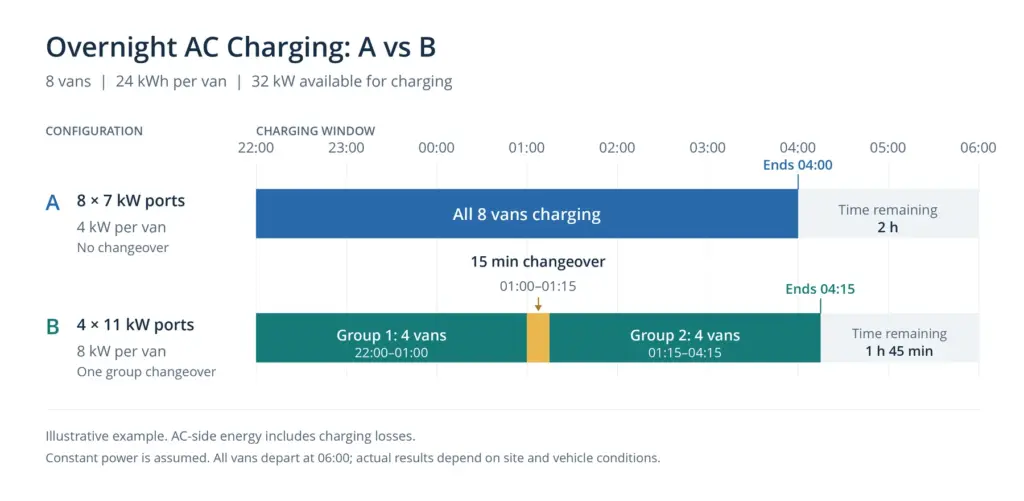
All eight vans connect at 10 p.m. Compatible controls divide the 32 kW allocation equally, giving each van 4 kW.
Each van needs:
24 kWh ÷ 4 kW = 6 hours
Under these assumptions, charging finishes at 4 a.m., leaving two hours before departure. No overnight changeover is required.
The eight ports have a combined rating of 56 kW, but the controls limit their combined output to 32 kW. This arrangement provides a connection for every van while keeping charging within the agreed allocation.
Configuration B: Four 11 kW Ports With One Changeover
Four vans connect first. Each receives 8 kW within the same 32 kW allocation and needs three hours to receive 24 kWh.
The first group charges from 10 p.m. to 1 a.m. Staff takes the assumed 15 minutes to disconnect those vans and connect the remaining four. The second group charges from 1:15 a.m. to 4:15 a.m.
All eight vans finish before departure under the stated assumptions. However, the plan depends on staff completing the changeover. If nobody connects the second group, those vans receive no energy, even though sufficient power and time were available.
Configuration C: Two 22 kW Ports With Repeated Changeovers
Each van can accept only 11 kW, so two connected vans draw a combined maximum of 22 kW. The higher port rating cannot overcome the vehicle limit.
Even with continuous charging and no time lost between vehicles, the maximum energy supplied in eight hours is:
2 × 11 kW × 8 hours = 176 kWh
That is 16 kWh below the fleet’s requirement. Actual changeover time reduces the energy available further. This configuration cannot meet the stated overnight demand.
Compare the Operational Requirements
| Configuration | Calculated Outcome | Main Requirement |
| Eight 7 kW Ports | All vans finish at 4 a.m. | Compatible power-sharing controls and eight usable connections |
| Four 11 kW Ports | All vans finish at 4:15 a.m. | Staff complete the planned changeover |
| Two 22 kW Ports | Insufficient energy within eight hours | The vehicle limit prevents the ports from using their full rating |
Configurations A and B both meet the modeled demand, but they create different operating responsibilities. Compare their equipment, installation and operating costs, including the work needed for changeovers.
Before selecting either option, repeat the calculation with actual vehicle records and test higher energy demand, reduced charging power or an unavailable port. The time remaining in this example is not a fixed allowance for every disruption.
Choose a Configuration Your Team Can Operate
Choose an AC depot configuration that supplies the required energy within each vehicle’s charging window and fits your staffing arrangements. More connection points may suit an unattended depot. Shared ports need a changeover plan that staff can carry out consistently.
Shortlist suitable options using your vehicle records, parking layout and available charging power. Ask your electrical contractor and equipment provider to confirm the assumptions behind each option, including vehicle compatibility, power sharing and cable reach.
Test the proposed arrangement with representative vehicles before expanding it. Record energy delivered, completion times and staff involvement, then adjust the configuration where the trial reveals gaps.
About QIAO Charger
QIAO Charger develops and manufactures home EV chargers and commercial AC EV chargers, with in-house R&D and factory production. Selected QIAO AC charger configurations support OCPP 1.6J for communication with compatible charging management platforms.
For an overnight depot project, share your vehicle models, required connector types, charging windows and proposed parking layout. We can discuss available power ratings, cable lengths and communication options, and provide specifications for your installer and charging management provider to review. Confirm the equipment configuration and platform compatibility against your project requirements before ordering.