
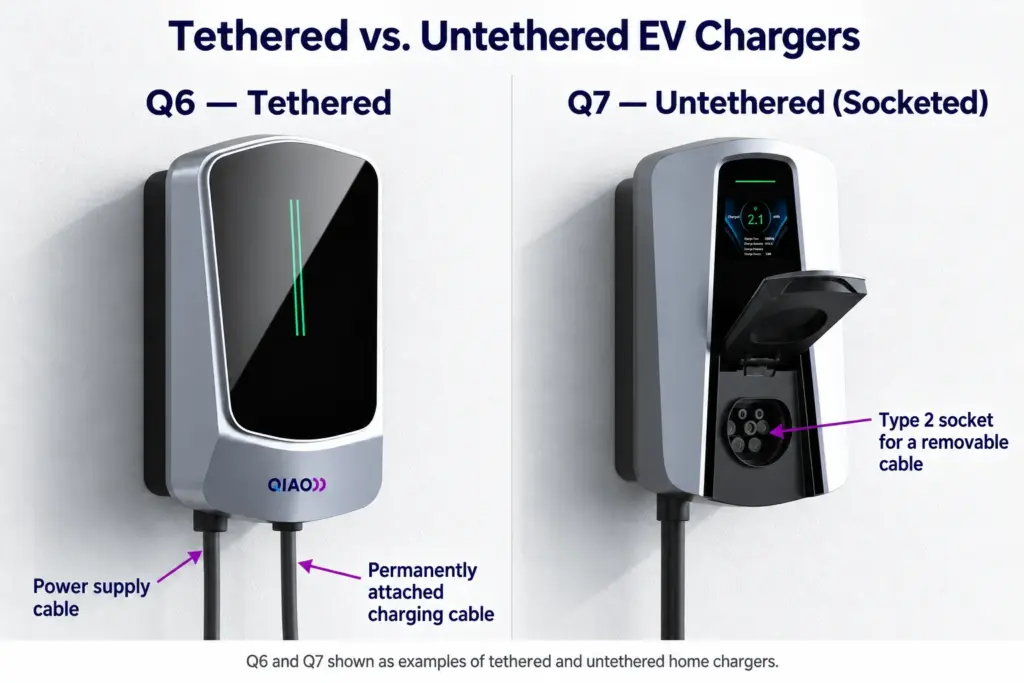
A tethered EV charger has a permanently attached charging cable. An untethered EV charger has a socket for a separate, removable cable. Choose tethered for a cable that is always ready at home. Choose untethered when you want to remove the cable, select a different length, or use suitable cables for different vehicle connectors.
Your parking layout, storage space and charging routine will help you decide. This guide focuses on UK and European home AC charging, where Type 2 connections are common.
What Is the Difference Between Tethered and Untethered EV Chargers?
The difference is how the charging cable connects to the charger. Both types need a cable between the unit and your car during charging.
What Is a Tethered EV Charger?
A tethered EV charger comes with its vehicle charging cable fixed to the unit. You take the connector from its holder and plug it into your car.
The supplied cable sets your normal reach and vehicle connection. You cannot unplug it from the charger to swap lengths during everyday use. Check those details before buying, including any longer cable options the manufacturer offers.
What Is an Untethered EV Charger?
An untethered EV charger, also called a socketed charger, needs a separate cable that plugs into both the unit and your car. You can remove that cable for storage or use it at another compatible AC charging point.
A Type 2 socketed wallbox commonly uses a Type 2-to-Type 2 cable for a car with a Type 2 AC inlet. Some older EVs need a Type 2-to-Type 1 cable instead. Check the vehicle manual and charger instructions before choosing either.
The charger socket is a dedicated EV connection. It is different from an ordinary household electrical socket. Also, “untethered” does not mean the wallbox is portable. These terms describe the vehicle-side cable, rather than how the unit connects to your home’s electricity supply.
Tethered vs. Untethered Home Chargers at a Glance
Tethered chargers reduce cable handling, while untethered chargers give you a removable cable. Compare the details below before choosing a model.
| Buying Consideration | Tethered EV Charger | Untethered EV Charger |
| Daily Connection | Unwind the attached cable and connect it to the car. | Retrieve the cable and connect both ends, unless you leave it attached as permitted. |
| Cable Choice | Choose from the manufacturer’s fixed cable options. | Select a compatible removable cable with suitable length and ratings. |
| Appearance | The cable stays beside the charger and needs tidy storage. | The wall looks less cluttered when you remove and store the cable. |
| Reach | Depends on the supplied cable and charger position. | Can change with a suitable replacement cable. |
| Cable Damage | Ask about approved service, parts and labour. | Replace a damaged removable cable if the charger socket remains sound. |
| Purchase Cost | Includes the attached cable; travel needs may require another. | Check whether a suitable separate cable is included or already owned. |
| Cable Security | The cable cannot be unplugged from the unit in normal use. | Cable locking depends on the model and settings. |
| Charging Speed | Depends on the car, charger, cable, supply and active limits. | Depends on the same factors. |
Neither cable format is inherently faster. A tethered charger can make plugging in quicker, but attachment alone does not increase charging power. A suitable 7 kW, 11 kW or 22 kW home charger must also match your car’s AC charging capabilities and your home’s electrical supply. In typical UK and European installations, 11 kW and 22 kW AC charging require a suitable three-phase supply and a vehicle that supports the intended charging rate.
Check scheduling, solar charging and load balancing separately. Those features, along with electrical protection, depend on the exact product and installation.
Which Is Easier to Use Day to Day?
A tethered charger is usually easier when you want to plug in with fewer handling steps. An untethered charger suits a routine where removing or sharing the cable is useful.
Charging Frequency, Weather and Cable Handling
Frequent home charging makes a ready-to-use cable more appealing. You can arrive home, uncoil the lead and connect the car without opening the boot to find it.
With a removable cable stored in the car, you retrieve it, connect both ends, then pack it away afterwards. That extra handling can be awkward on a rainy evening, especially when the cable is wet or dirty.
Also consider how the cable feels in use. A heavy lead or an awkward holder can make either arrangement difficult to manage.
Appearance and Storage When You Are Not Charging
An untethered charger leaves the wall looking less cluttered when you remove and store the cable. Simply disconnecting the car leaves the cable visible if its other end stays in the charger.
Plan storage before choosing on appearance alone. A cupboard, garage hook or cable bag needs enough room for the lead. For a tethered unit, check the cable wrap and connector holder rather than relying on a product photo with no cable shown.
Both types need orderly storage. Keep the lead away from tyres and walking routes, and avoid sharp bends around a holder.
Using a Cable at Home and at Public AC Chargers
A separate cable may still be needed away from home, even when your home charger is tethered. Socketed public AC points require you to bring a suitable lead.
One removable cable can serve home and travel when its connectors, length and electrical ratings suit both locations. You must remember to take it with you. Keeping a second cable in the car avoids moving the home cable, but adds to the purchase cost.
Check the station listing before travelling to see whether you need your own cable.
Will the Cable Reach Your Car?
The cable must reach your car’s charging port in your normal parking positions without pulling tight. Measure the route before deciding on either format.
Check Your Parking Positions Before Installation
Park as you normally would and trace the cable route from the proposed charger position to the vehicle inlet. Include bends around the car and enough slack at the connectors.
For example, a wallbox near the front of the driveway may reach a front charging port easily. A rear port on another car may need a longer route. Reversing into the space can change the reach again.
Check each parking position your household uses. Discuss the mounting position with your installer before paying for extra cable length.
Choose a Suitable Cable Length and Rating
Choose a cable with compatible connectors, enough length to reach your car comfortably, and a suitable current rating. Also check whether it supports the single-phase or three-phase charging your setup requires. Length alone does not make it the right choice.
An untethered charger gives you more freedom to select a removable lead. Tethered models can also offer different factory cable lengths, so check the available options before ruling one out.
Extra length means more cable to lift and store. When choosing an EV charging cable, balance the reach you need with its weight and your available storage space.
Use one correctly specified cable that reaches comfortably. Avoid improvised extensions or joining charging leads together. Ask the manufacturer about approved options if a fixed cable is too short.
What Is the Full Cost, Including Cable Replacement?
The full cost includes the charger, installation, required cables and any storage accessories. Compare complete setups with similar power and features.
Compare the Charger, Installation and Required Cables
An untethered charger is not automatically the cheaper option. Its price may exclude the lead you need, while a suitable cable already supplied with your car could reduce your spending.
These three home charging setups show what to include in a quote:
| Home Charging Setup | What to Include | What Could Change the Cost |
| Tethered Charger | Charger with attached lead, installation and suitable cable storage. | Add a separate travel cable if you need one and do not already own it. |
| Untethered Charger With an Existing Cable | Socketed charger, installation and cable storage. | Replace the existing lead if its connectors, rating or reach do not suit the setup. |
| Untethered Charger With New Cables | Socketed charger, installation and the required removable lead. | Add a second cable if you want one to stay at home and another in the car. |
Ask for an itemised quote. Check the supplied cable length, installation work, required accessories and taxes. A lower equipment price may lose its advantage once those items are included.
Check How a Damaged Cable Would Be Replaced
A damaged removable lead can normally be replaced without opening the charger. First confirm that the charger socket is also undamaged.
Replacing a tethered cable depends on the model’s approved service options. Some units have replacement cable assemblies; others require a different service route. Damage to the lead does not automatically mean the entire wallbox must be replaced.
Ask who carries out the work, what parts are available and how the warranty applies. Include labour in repair costs. Stop using damaged equipment and contact the supplier.
A socketed charger can also develop faults in its socket or locking mechanism. An easily replaced cable does not make the whole unit maintenance-free.
Can You Leave an Untethered Cable Plugged In?
You can leave an untethered cable connected between sessions if the manufacturer’s instructions allow it. However, a cable that stays plugged in is not necessarily locked to the charger.
Check When the Cable Can Be Removed
Cable locking varies by model. Some untethered chargers can retain the cable between sessions, while others release it after charging. Check the settings and instructions for the model you plan to buy.
The QIAO Q7 home EV charger locks the charging cable in place during charging. It does not offer a setting to keep the cable locked between sessions.
Follow the charger’s instructions when ending a session and releasing the cable. Do not pull on a connector while it is locked.
Plan Cable Storage After Charging
Choose a suitable storage location for the removable cable when it is not in use. Removing and storing it also gives an untethered charger a cleaner wall appearance.
Follow the charger and cable manufacturer’s instructions for outdoor use. Use the supplied connector holder or protective cover where provided, and keep connectors out of standing water.
Store the cable away from tyres, sharp edges and heavy objects. Avoid tight bends, and check for damage before using it again.
Which Charger Type Fits Your Home?
Choose tethered for a cable that stays ready beside your parking space. Choose untethered when removable cable choice and storage better suit your routine. Then compare the power, controls and energy features your home needs.
Consider Tethered for Ready-to-Use Charging
A tethered charger suits regular charging in a predictable parking space. You can connect your car without retrieving and plugging in a separate lead.
In QIAO’ s home EV charger range, the Q5, Q6 and Q8 have attached charging cables. Check the vehicle connector and available cable lengths for your chosen configuration. The cable should reach your usual parking position without pulling tight.
Consider Untethered for Removable Cable Choice
An untethered charger suits drivers who want to remove the cable after charging or choose a suitable lead for their parking layout.
The QIAO Q7 home EV charger uses a Type 2 socket for a separate charging cable. You can disconnect and store the lead after use, leaving the wall area clearer. Plan where you will keep it and check whether a cable you already own has suitable connectors, ratings and reach.
Check Energy Features Separately
Selected QIAO Q6 home EV charger configurations offer dynamic load balancing and solar charging. These features help manage EV charging alongside other household electricity use and available solar power.
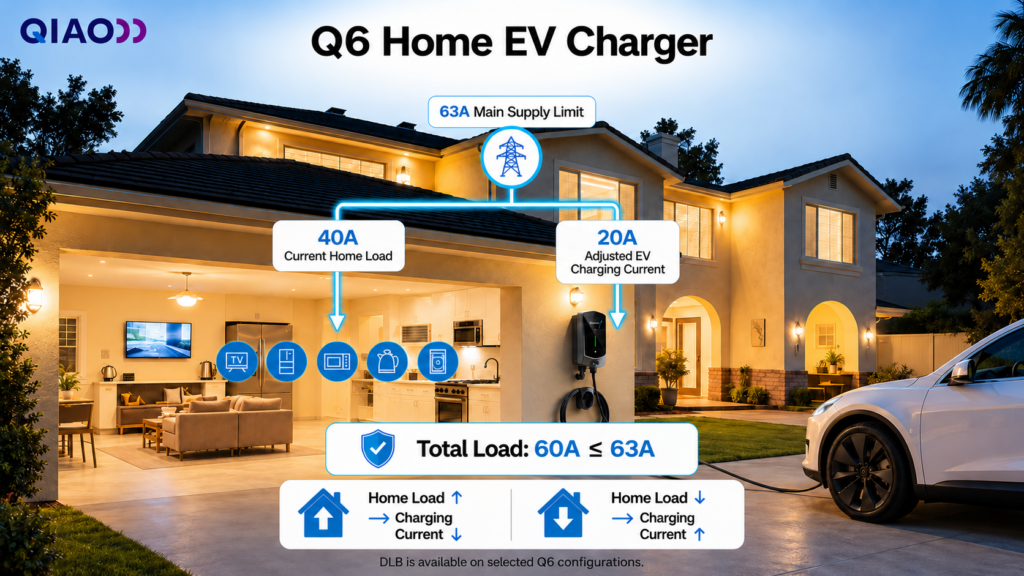
Dynamic load balancing adjusts charging power as other household electricity use changes. With compatible monitoring equipment correctly installed, it helps prevent the home’s electrical supply from being overloaded.
If you choose a Q6 configuration with solar charging, confirm how it manages charging when solar output changes, whether it also uses grid electricity, and what monitoring equipment it requires.
These features are optional. Confirm that your chosen Q6 configuration includes the functions you need before ordering.
Already Have a Socketed Home Charger?
You may only need a suitable cable if your existing socketed charger already meets your charging needs.
A QIAO Type 2-to-Type 2 charging cable connects a compatible Type 2 socketed charger to a vehicle with a Type 2 AC inlet. It can serve the Q7 or another compatible home wallbox.
Choose the cable by its current rating, phase support and measured reach. Check any existing lead before buying another, and confirm that the selected version suits both your charger and car.
What Changes If Your Household Has Two EVs?
Two EVs can share either charger type when the connection and cable reach suit both cars. Different vehicle brands do not necessarily require different cables.
A tethered Q5, Q6 or Q8 remains an option when its connector fits both vehicles and its cable reaches both parking positions. A socketed Q7 offers removable cable choice, but each vehicle and cable must still meet the charger’s compatibility requirements.
Also check your charging schedules. One charging outlet serves one car at a time, so households that need simultaneous charging require enough outlets and a suitable electrical installation.
What Should You Confirm Before Ordering?
Confirm the exact charger configuration, cable needs and installation plan before ordering.
Use this home EV charger checklist with the supplier and installer:
- Confirm the Cable Format: Check that the quoted model has the fixed cable or socket you intend to buy.
- Match the Vehicle Connection: Check each car’s AC inlet and the required cable ends.
- Verify the Electrical Ratings: Confirm charger output, cable current and phase support with the car and home supply.
- Measure the Reach: Test the route to every regular parking position, leaving slack at the connectors.
- Check the Package Contents: Ask whether the price includes a removable cable, holder and any required accessories.
- Confirm the Lock Settings: Check cable retention, release controls and charging access separately.
- Review Replacement Support: Ask about approved cable replacement, service contacts and warranty terms.
- Arrange the Installation Assessment: Have a qualified local installer check the supply, mounting position and applicable requirements.
Use the checklist above to compare itemised quotes for your shortlisted chargers. Before ordering, confirm with your supplier and installer that the selected charger and cable suit your vehicle, parking space and electrical supply.
About QIAO Charger
QIAO Charger offers home EV chargers and EV charging cables and accessories. Cable formats, connector types and functions vary by model and configuration. Share your vehicle connection and measured cable route when discussing a suitable product.
We also work with distributors and retailers supplying AC charging equipment to their markets. Businesses planning a local product range can explore QIAO’s partnership opportunities.