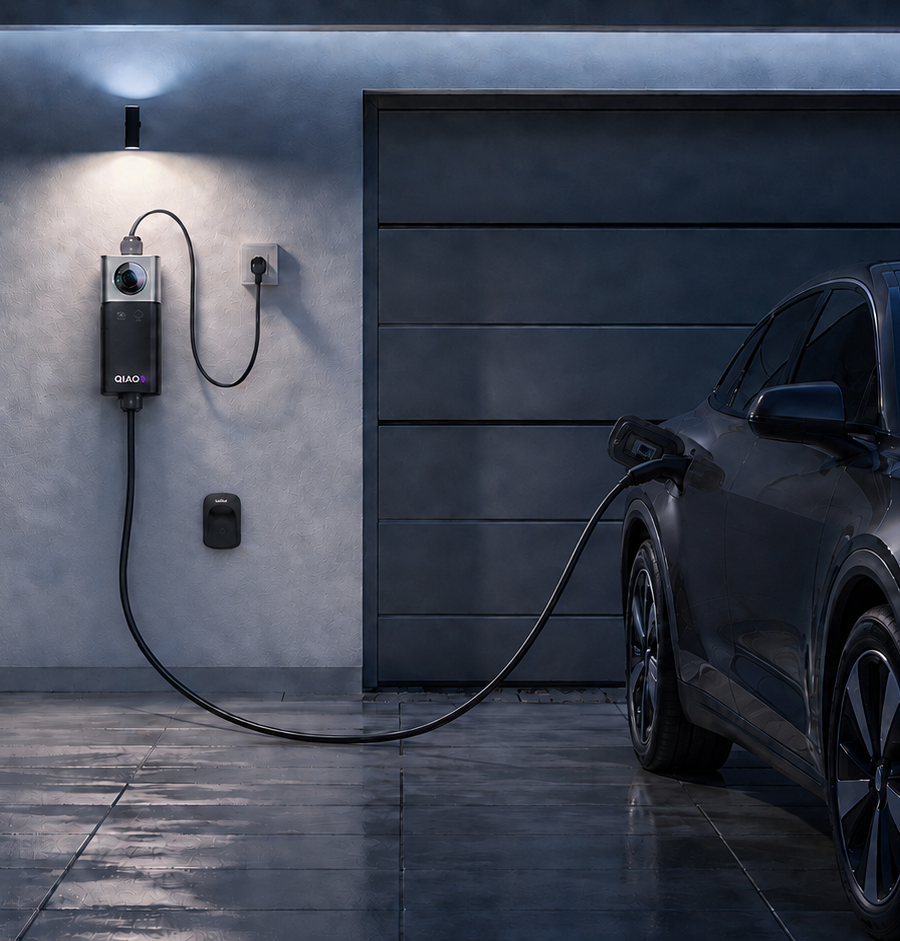

For most drivers with private parking in Germany, a wallbox is a better choice for regular home charging than a standard Schuko-based setup. Installed on a suitable dedicated circuit, it supports sustained charging and usually delivers more power.
Start by checking your right to use or alter the parking space. Then ask an electrical contractor to assess the building supply, cable route, and distribution board. Your vehicle’s AC charging limit and the local grid process also affect the final choice. Once you know those facts, you can compare 11 kW and 22 kW wallboxes, control options, installation quotes, and product documents with fewer surprises.
This guide explains what to check first and what to decide after that. It focuses on the decisions that change from one German home to another.
Start With Your Housing Situation
Your housing situation determines who must approve the work and how much of the electrical system needs joint planning. Use the table below as a starting point before asking for product prices.
| Your Situation | Check First | Decide After That |
| You own a detached or semi-detached home with private parking | Available capacity, three-phase supply, cable route, and distribution board space | Charging power, cable length, load balancing, and solar charging |
| You rent a home with a fixed parking space | Landlord permission, responsibility for the work, ownership of the wallbox, and removal terms | Fixed wallbox or a suitable portable setup on an approved circuit |
| You own an apartment with an assigned space | Owners’ association process, common-property work, metering, and the building’s charging plan | An individual charger or a device that joins the shared system |
| You park in a shared garage | Shared connection capacity, billing method, access control, and energy management | Charger features that match the building-wide design |
| You are considering 22 kW | Vehicle AC limit, supply capacity, grid operator approval, and added installation cost | Whether the shorter charging time will be useful in daily life |
If You Own a House
House owners often have the shortest approval path, but the site still needs an electrical survey. The contractor should check the service capacity, distribution board, protective devices, cable route, mounting point, and large household loads. Heat pumps, battery storage, and electric heating can change the power available for charging.
If You Rent Your Home
Ask your landlord for written permission before starting any electrical or structural work. Section 554 of the German Civil Code gives tenants the right to request permission for changes that support EV charging. The landlord may refuse if the change would be unreasonable after considering both sides’ interests.
Agree on site access, costs, equipment ownership, electricity billing, maintenance, and removal before requesting a final quote. A portable charger avoids permanent mounting, but it still needs a suitable outlet and circuit. Understanding the practical differences between portable and wall-mounted EV chargers can help you choose an option that fits both the property and your charging needs.
If You Own an Apartment or Use a Shared Garage
Apartment owners can request reasonable changes for EV charging under Section 20 of the Condominium Act. The owners’ association still decides how the work is carried out where common property is involved.
Do not treat the project as one wallbox on one parking space until the building plan is clear. A shared garage may need a common cable route, meter design, access rules, and power allocation method. In July 2026, VDE FNN described shared energy management as a way to use the connection efficiently and add more charging points later. A standalone wallbox may not be compatible with the building’s chosen charging system.
What Should You Confirm Before Buying a Wallbox?
Confirm parking rights, vehicle limits, site capacity, grid rules, and the exact product version before placing an order.
1. Confirm the Parking Space and Cable Route
Check where the vehicle stops, where its charging port sits, and how the cable will reach it. Measure the route from the distribution board. Include wall openings, fire compartments, outdoor sections, and shared garage areas.
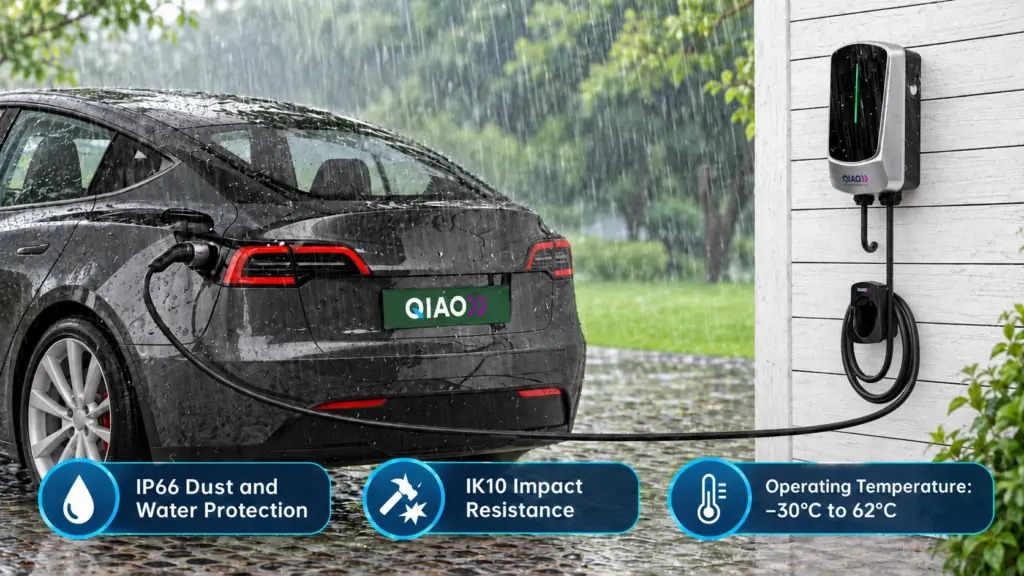
The mounting point must support the unit and allow the cable to hang without sharp bends. For outdoor installation, check the enclosure’s dust and water protection, impact resistance, operating temperature range, and placement requirements. QIAO home EV chargers are rated IP66 for dust and water protection and IK10 for impact resistance. They are designed to operate from –30°C to 62°C. The installer should still confirm that the chosen model and location meet the product’s installation requirements.
2. Check the Vehicle’s AC Charging Limit
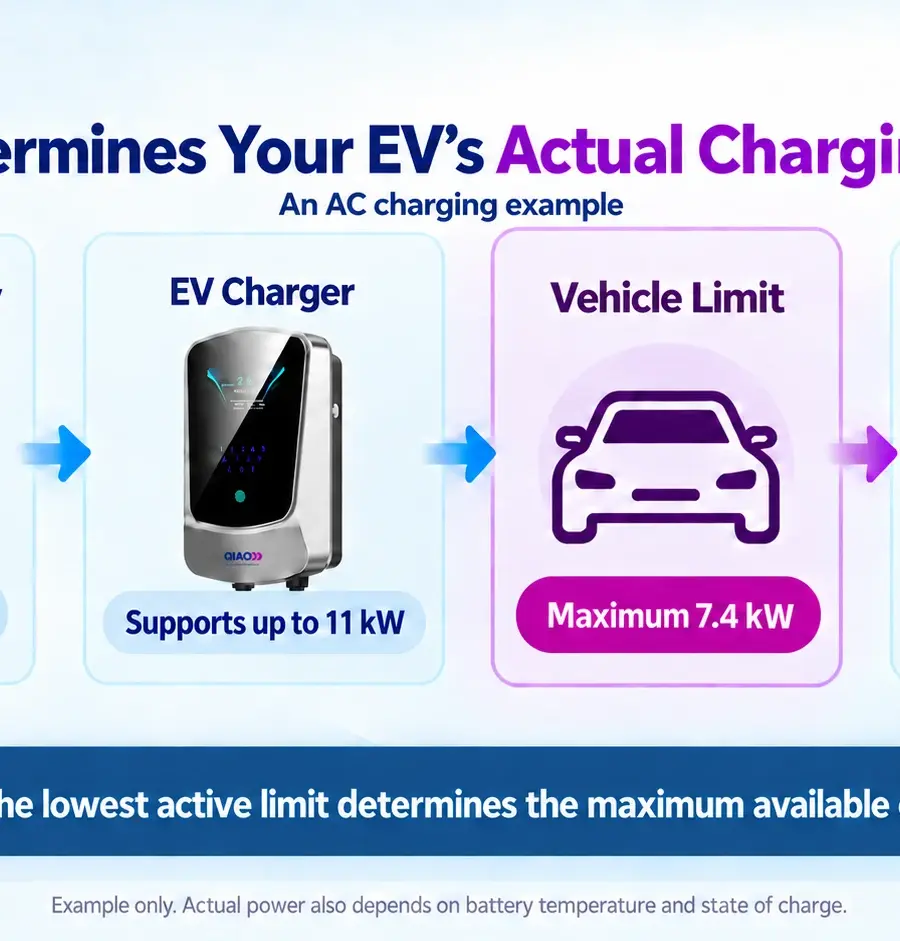
The wallbox rating does not determine charging speed by itself. The vehicle’s onboard charger converts AC power and sets its own maximum. A car limited to 11 kW AC will not charge at 22 kW when connected to a 22 kW wallbox.
Check the vehicle manual or manufacturer specifications for its maximum AC charging rate and the number of phases it supports. Understanding how onboard charger limits affect AC charging speed can help you avoid paying for wallbox capacity your vehicle cannot use.
3. Ask a Qualified Electrical Contractor to Survey the Site
Use a qualified contractor listed in the grid operator’s installer directory. The survey should cover the service connection, phases, spare capacity, distribution board, protective devices, earthing, cable size, and route. Mention a planned heat pump, solar system, battery, or second EV because it could change the design.
4. Confirm the Grid Process
Ask who will notify the grid operator and request approval when needed. The quote should name the responsible party and explain the planned §14a control method.
5. Make Sure Every Document Covers the Selected Variant
Before ordering, make sure the quote, product documents, and installation plan all refer to the same wallbox configuration. Check the exact power rating, connector, input, control method, and optional features.
Should You Choose an 11 kW or 22 kW Wallbox in Germany?
In Germany, 11 kW is usually the more straightforward home-charging option because it uses three-phase power. Some 7 or 7.4 kW chargers use single-phase charging, but German phase-imbalance requirements can limit how much single-phase power may be used at a residential connection. Ask the installer to confirm the permitted configuration before choosing this power level.
| Question | 11 kW Wallbox | 22 kW Wallbox |
| Typical three-phase current | 16 A per phase | 32 A per phase |
| Vehicle requirement | Vehicle can use up to 11 kW AC | Vehicle must support more than 11 kW AC to gain speed |
| Grid step | Notify the grid operator before commissioning | Prior grid operator approval is normally required because 22 kW exceeds 12 kVA |
| Home use | Often enough for overnight charging | Useful for high daily energy demand or short parking windows when all limits allow it |
| Installation effect | Often lower capacity demand | May require a supply or distribution board upgrade |
Daily energy use gives a better answer than battery size alone. Compare daily distance, vehicle consumption, parking time, and lower-cost charging hours. You may gain little from 22 kW when an 11 kW unit can replace the day’s energy overnight.
When choosing between 7 kW, 11 kW, and 22 kW EV chargers, consider the vehicle’s AC limit, available electrical capacity, phase supply, and typical charging time. For an installation in Germany, the site assessment and applicable grid operator requirements should determine the final power rating.
What Rules Apply Before Installation in Germany?
German home charging projects involve separate rules for notification, approval, and grid control. Meeting one rule does not meet the others.
Notify the Grid Operator Before Commissioning
Section 19 of the Low Voltage Connection Ordinance requires EV charging facilities to be reported to the grid operator before they enter service. The same section requires prior consent when the combined rated apparent power of the charging facilities on one electrical installation exceeds 12 kVA.
The legal threshold applies to combined rated capacity, so two or more charging points can change the result.
Plan for §14a EnWG Control
New private wallboxes put into service on low voltage after January 1, 2024, fall under the §14a rules when their grid connection capacity is more than 4.2 kW. The wallbox must be registered with the grid operator. The owner must also arrange the control method and needed metering equipment with the installer and grid operator.
The Federal Network Agency’s §14a guidance says control can reach a device directly or through a home energy management system. If the local grid is at risk of overload, the grid operator may temporarily reduce the amount of power the device draws from the public grid. A directly controlled wallbox must generally retain at least 4.2 kW, so charging does not stop completely. The user receives reduced grid fees under the applicable model.
Do Not Confuse DLB With §14a Control
Dynamic load balancing and §14a control solve different problems. DLB measures household demand and adjusts EV charging to keep the home within an available power limit. Section 14a allows the grid operator’s limit to reach the charger or home energy management system during a local grid event.
A wallbox may need both functions, but one does not prove the other. Ask the installer and seller three questions:
- Scope: Does the planned wallbox fall within the new-installation and power conditions for §14a?
- Control Path: Will the grid signal reach the wallbox directly or pass through a home energy management system?
- Technical Evidence: Can the seller provide documents for the exact model and the chosen control path?
Do not accept “has load balancing” as the full answer to §14a compatibility.
What Should a Wallbox Installation Quote Include?
A useful quote separates equipment, electrical work, grid-related items, and optional upgrades. This lets you compare the same scope across contractors.
ADAC’s 2026 cost guide places wallbox hardware at about EUR 300 to EUR 2,000 before installation. ADAC lists typical professional installation at about EUR 500 to EUR 3,000. Older buildings, shared garages, and connection upgrades can cost more. These figures are market references, not a price promise.
| Quote Item | What the Quote Should State |
| Wallbox | Exact model, power, connector, cable length, mounting type, and included controls |
| Survey and design | Site visit, load check, cable route, calculations, and drawings if required |
| Cable and containment | Cable type, length, conduit, trays, trenching, wall openings, and fire sealing |
| Distribution work | New circuit, breaker, residual-current protection, surge protection, and cabinet changes |
| Metering and control | Intelligent metering system, control box, communications, EMS connection, and §14a setup |
| Grid process | Notification, approval request when required, documents, and any grid operator fee |
| Building work | Pedestal, mounting base, weather protection, parking-area work, and restoration |
| Testing and handover | Inspection, test results, commissioning record, user setup, and operating instructions |
| Future additions | Spare capacity, conduit, cabinet space, and limits for a second charging point |
| Warranty and service | Installer workmanship cover, product warranty, response route, and excluded work |
Ask contractors to mark allowances and exclusions. A low headline price may omit trenching, distribution board work, §14a controls, or grid paperwork. It may also assume that untested cables or protective devices can be reused.
Which Product Documents Should You Check?
Check the documents for the exact variant before you approve the purchase. A CE mark or a general certificate page is not enough to identify every configuration in a product series.
Your product file should include the following items:
- Product Identity: Confirm the manufacturer, model, SKU, rated voltage, current, power, connector, and wiring method.
- EU Declaration of Conformity: Confirm that the declaration names the same product. It should list the EU laws and standards used by the manufacturer.
- Installation Instructions: Check the supply requirements, protective measures, conductor sizing guidance, mounting limits, and qualified-person requirements.
- Control Information: Obtain the interface and connection details needed for the planned §14a route, load balancing, solar charging, or home energy management system.
- Environmental Ratings: Match the enclosure, impact, temperature, and mounting limits to the actual indoor or outdoor location.
- Warranty and Support: Confirm the warranty period, proof needed for a claim, service contact, software support, and replacement process.
Ask for revised documents when the quoted SKU changes. A different input, power level, or control package can affect the installation plan.
Which Wallbox Features Fit a German Home?
Choose features after the property and grid requirements are clear.
- Type 2 Connection: Match the connector to the vehicle’s AC inlet. Type 2 is the common AC vehicle connector for European-market EVs.
- Cable Length: Measure the parking position and charging-port location. Leave enough reach without creating a trip route or dragging the connector.
- Access Control: RFID or app access can help in shared or open parking areas. A private locked garage may need only plug-and-charge operation.
- Scheduling: Timed charging can align sessions with a home electricity plan, but the car and wallbox schedules should not conflict.
- Dynamic Load Balancing: Consider DLB when household demand changes or spare capacity is limited. The design needs compatible measuring equipment.
- Solar Charging: Confirm inverter, meter, communications, and minimum charging-current behavior before relying on solar surplus control.
- Local Control Integration: Confirm how the exact model will receive and apply the §14a limit selected for the site.
Selected QIAO home series include Type 2 options at 11 kW and 22 kW. Some QIAO Q6 Home EV charger configurations include DLB or solar charging. These options vary and do not prove §14a compatibility. Ask QIAO and the installer to match one version to the vehicle, site plan, control method, and product file.
Your Pre-Purchase Checklist
Take these eight questions to the property owner, installer, grid operator, and seller:
- Do I have written permission for work at this parking space?
- What power and phase arrangement can the property support?
- What is my vehicle’s maximum AC charging rate?
- Is 11 kW enough for my daily driving and parking time?
- Who will handle grid notification, approval, and §14a arrangements?
- How will the grid control signal reach the charger or home energy management system?
- Does the quote include all cable, protection, metering, building, testing, and paperwork costs?
- Do the quote and compliance documents refer to the same exact SKU?
Do not place the order until the answers fit together. A good product can still be the wrong choice when its power, control interface, or documentation does not match the site.
FAQs
A Schuko socket can charge an EV with suitable equipment. However, it should not be treated as the default option for regular home charging. Household wiring may not be designed for a high electrical load over many hours. Ask an electrician to inspect the socket, circuit, and connections before use. Always follow the charger manufacturer’s instructions and current limits.
Possibly, but the plug type alone does not confirm that the installation is suitable. An electrician should check the outlet, cable, circuit protection, earthing, phase supply, and available capacity. The wallbox plug, voltage, current, and phase arrangement must also match the outlet. Using a plug-in wallbox does not remove any applicable German grid registration or control requirements.
Not always. A basic wallbox can charge without Wi-Fi or an app. Connectivity may be useful for scheduling, usage records, remote settings, or solar integration. However, app control, dynamic load balancing, and §14a grid control are separate functions. Check which interfaces the selected model supports and what the installation plan requires.
Conclusion
Follow this order: confirm the parking rights, survey the electrical supply, check the vehicle, and complete the grid process. Then choose the wallbox. This reduces the risk of buying a charger that the property cannot fully support.
For many German homes, a Type 2, three-phase 11 kW wallbox is the first option worth comparing. Choose 22 kW, dynamic load balancing, solar charging, or app controls when they solve a specific need in your home charging setup.
About QIAO Charger
QIAO Charger develops and supplies AC EV charging products for home and portable use. Our range includes Type 2 home wallboxes and portable EV chargers for European markets. Available configurations include different power ratings, connection methods, access controls, and smart charging features. Buyers should always confirm the exact model against their vehicle, electrical supply, and installation plan.
We also work with distributors, retailers, and partners delivering EV charging projects. If you are building a local EV charging product range or planning a charging project, contact QIAO Charger about a partnership to discuss product selection, documentation, supply, and project requirements.