
Schuko, Blue CEE, and Red CEE are plugs that connect a compatible EV charger to an electrical socket. A separate connector plugs into the car. Which plug you need depends first on the socket available where you charge.
Choose Schuko for occasional, low-power charging from a suitable household socket in much of mainland Europe. Blue CEE may suit regular charging from a properly installed single-phase industrial socket. Red CEE connects to a compatible three-phase socket, but your car will only charge as fast as its onboard AC charger allows.
This guide compares the sockets, typical power levels, and checks to make before choosing a plug.
Schuko vs Blue CEE vs Red CEE at a Glance
The main difference is the supply type each plug can use. Schuko connects to a household socket, Blue CEE usually connects to a single-phase industrial socket, and Red CEE usually connects to a three-phase industrial socket.
| Supply-side plug | Typical European supply | Example charging current | Approximate power at the socket | Best fit |
| Schuko household plug | 230 V, single-phase | 8–10 A for cautious EV charging | 1.8–2.3 kW | Occasional top-ups at a checked socket |
| Blue CEE 16 A | 230 V, single-phase | Up to 16 A | 3.7 kW | Regular charging where a suitable 16 A circuit is installed |
| Blue CEE 32 A | 230 V, single-phase | Up to 32 A | 7.4 kW | Faster single-phase charging where the installation and car allow it |
| Red CEE 16 A | 400 V, three-phase | Up to 16 A per phase | About 11 kW | Charging from a suitable three-phase supply with compatible equipment |
| Red CEE 32 A | 400 V, three-phase | Up to 32 A per phase | About 22 kW | Higher-power charging where the supply, charger, and car allow it |
The 7.4 kW shown for Blue CEE 32 A is a theoretical maximum at 230 V. Local limits on single-phase EV charging may be lower.
These figures are supply-side examples, not promised speeds. A Schuko outlet marked 16 A is not automatically suitable for EV charging at 16 A for hours. The ADAC guide to charging at home advises limiting a standard household socket to 10 A or less to reduce heat risk.
The socket, wiring, protection, charger settings, and vehicle must all suit the current you plan to use. A 32 A plug cannot turn a 16 A circuit into a 32 A supply.
What Are These Plugs, and Where Do They Connect?
Schuko and CEE plugs connect your charging equipment to the power supply. They are different from the Type 2 connector that plugs into many EVs in Europe and the UK.
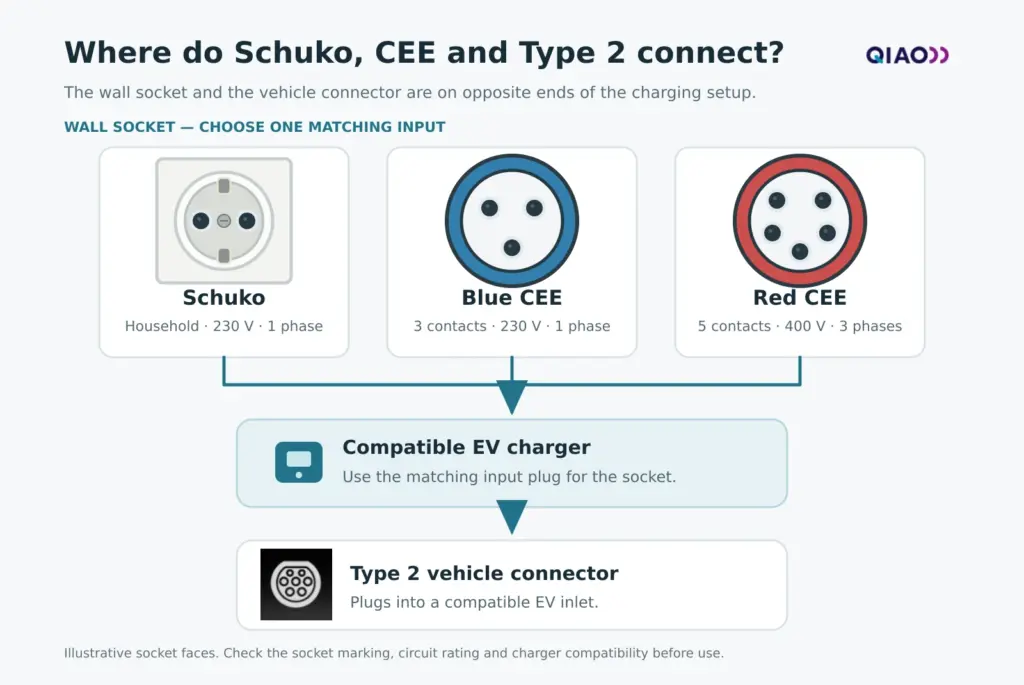
A Schuko, Blue CEE, or Red CEE plug goes into the wall socket. The portable charging unit controls the session and communicates with the car. In the setup shown here, a Type 2 vehicle connector plugs into a compatible car.
Schuko is the round household plug used in many mainland European countries. Blue and Red CEE belong to the IEC 60309 family of industrial connectors, also called Commando plugs. Blue CEE commonly uses 230 V single-phase power; Red CEE commonly uses 400 V three-phase power. Both come in different current ratings.
A note for UK readers: A standard UK three-pin household socket uses a BS 1363 plug. It is not a Schuko socket. Some UK locations also have Blue or Red CEE sockets. Match your charger to the socket that is actually installed; do not assume a Schuko plug fits a UK household outlet.
How Can You Identify the Socket You Have?
Read the markings on the socket before choosing a plug. Look for its voltage, current rating, and pin arrangement, then check the circuit with a qualified electrician if you do not know how it was installed.
A Schuko household outlet has two round contact openings and side earth contacts. A typical Blue CEE single-phase socket has three contacts: live, neutral, and earth. A typical Red CEE socket for European three-phase EV charging has five: three phases, neutral, and earth. Other industrial CEE designs exist, so count the pins and read the label rather than relying on colour alone.
The markings also tell you whether you have a 16 A or 32 A version. A Blue CEE 16 A plug is not the same as a Blue CEE 32 A plug. Likewise, Red CEE 16 A and Red CEE 32 A are different connections. Do not force a plug into a socket or use an unapproved converter to make it fit.
An outdoor cover does not prove that the circuit is suitable for EV charging. Ask an electrician to check its supply, earthing, protection, and condition before regular use.
How Much Charging Power Will You Actually Get?
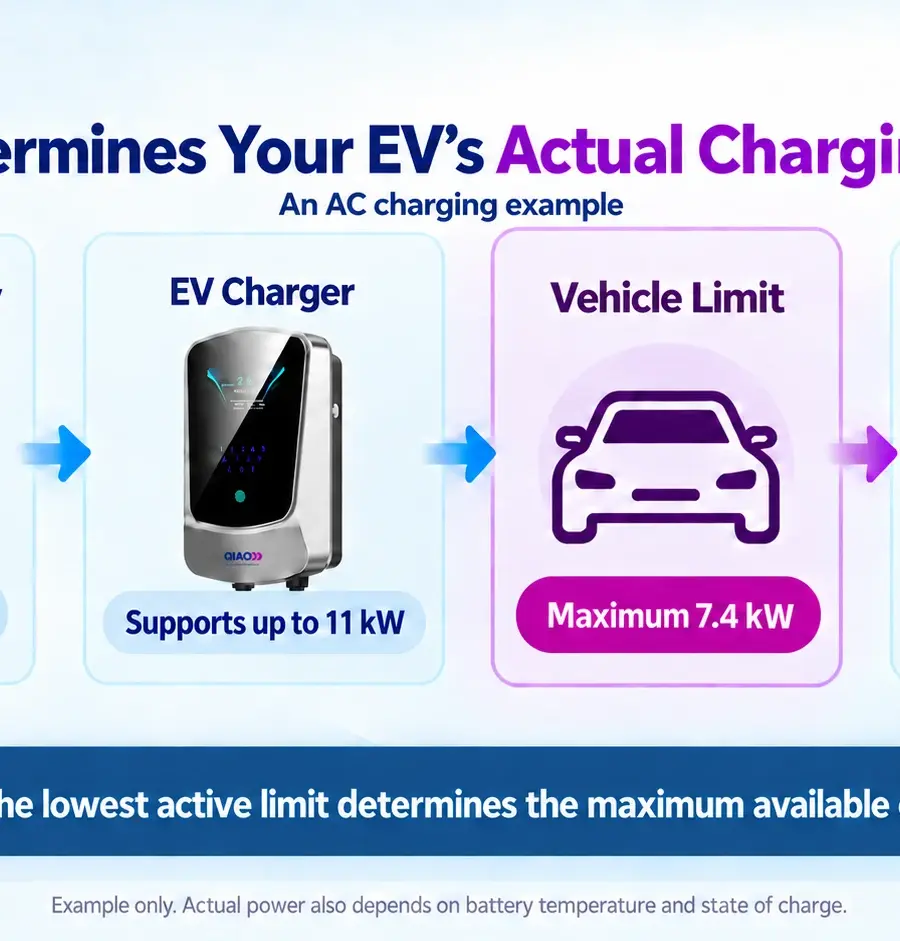
Your real AC charging power is limited by the lowest-rated part of the setup: the supply, circuit, socket, plug, charging unit, cable, or car’s onboard AC charger. The figures on a product label describe what the unit can deliver under suitable conditions.
Single-phase power is roughly voltage multiplied by current. At 230 V and 16 A, that is about 3.7 kW. At 32 A, it is about 7.4 kW. For balanced three-phase charging, 400 V and 16 A gives about 11 kW; 32 A gives about 22 kW.
Consider an 11 kW EV charger connected to a Blue CEE 16 A socket. The socket can supply about 3.7 kW on one phase, so the charger will not deliver 11 kW from this connection. This setup only works if the charger supports single-phase input and uses a compatible plug or manufacturer-approved adapter.
Now consider a 22 kW EV charger connected to a Red CEE 16 A socket. That three-phase supply can provide about 11 kW, so the charger must limit its current to suit the circuit. Moving the same charger to a suitable Red CEE 32 A socket could raise the available power, but a car with an 11 kW onboard AC charger would still charge at no more than about 11 kW.
Finally, a car that accepts only single-phase AC charging cannot use all three phases simply because you have a Red CEE socket. Its actual rate depends on the vehicle, charger settings, and permitted single-phase current. The same vehicle and supply limits determine whether a 7 kW, 11 kW, or 22 kW charger makes sense for your setup.
Charging losses and the car’s controls can also reduce the energy that reaches the battery. Check your vehicle’s specifications for a realistic estimate.
Is Schuko Safe for Regular EV Charging?
A standard Schuko socket is best treated as an occasional charging option unless an electrician has assessed the full installation for the intended load. EV charging can draw steady current for many hours. Loose contacts, worn sockets, and poor wiring connections can heat up during that time.
The 16 A marking does not approve every household circuit for overnight charging at 16 A. ADAC recommends 10 A or less from a standard socket at 230 V, which provides roughly 2.3 kW before charging losses.
Use a compatible EV charger at the approved current. Stop charging if you notice heat, discolouration, a burning smell, or a loose connection. Avoid extension leads, multi-plug strips, and improvised adapters.
For frequent home charging, ask an electrician to assess your electrical supply and circuit capacity. A properly installed Blue CEE socket may suit a compatible EV charger, while a fixed wall charger may be more convenient at a permanent parking space. Your car’s AC charging limit, charging routine, and need for portability also matter when comparing portable and wall-mounted chargers. An electrician can confirm which setups your home can support.
In the UK, take similar care when charging from a BS 1363 household socket. Have the socket and circuit checked before relying on them for EV charging, and follow UK installation guidance. The IET’s EV charging installation guidance explains that sockets marked for EV charging face extra test requirements compared with ordinary 13 A outlets.
Can You Replace a Schuko Socket With Blue CEE?
You can ask an electrician to assess an upgrade to Blue CEE, but replacing the socket face alone does not increase the circuit’s capacity. The wiring, breaker, protective devices, earthing, and available supply must suit the new load.
Blue CEE 16 A can support about 3.7 kW at 230 V when the installation is designed for it. A 32 A setup can reach about 7.4 kW, but may need a different cable run. An electrician can assess the required work.
Ask a qualified electrician what continuous charging current the circuit can safely support. Then choose a socket and charger that match the approved current. If the circuit needs upgrading, compare the total installed cost of a Blue CEE setup with that of a fixed wall charger.
If you charge at more than one location, you may also need to use different types of sockets. That raises another question: can the same charger work with different plugs?
Can One Portable Charger Work With Schuko, Blue CEE, and Red CEE?
It depends on the charger model. Some portable EV chargers accept manufacturer-approved interchangeable input plugs, but that does not mean every model works with all three socket types. Check the exact charger version and approved plug options before buying.
At each location, make sure the socket and circuit are suitable, then set the charger to the permitted current. Changing the input plug does not increase the circuit’s capacity or your car’s AC charging limit. Use the manufacturer’s specified parts; a generic adapter does not establish that an unsupported combination is safe.
QIAO offers interchangeable input plugs for selected configurations of the Q9, Q20, and Q21 portable chargers. The illustration below compares the three series.
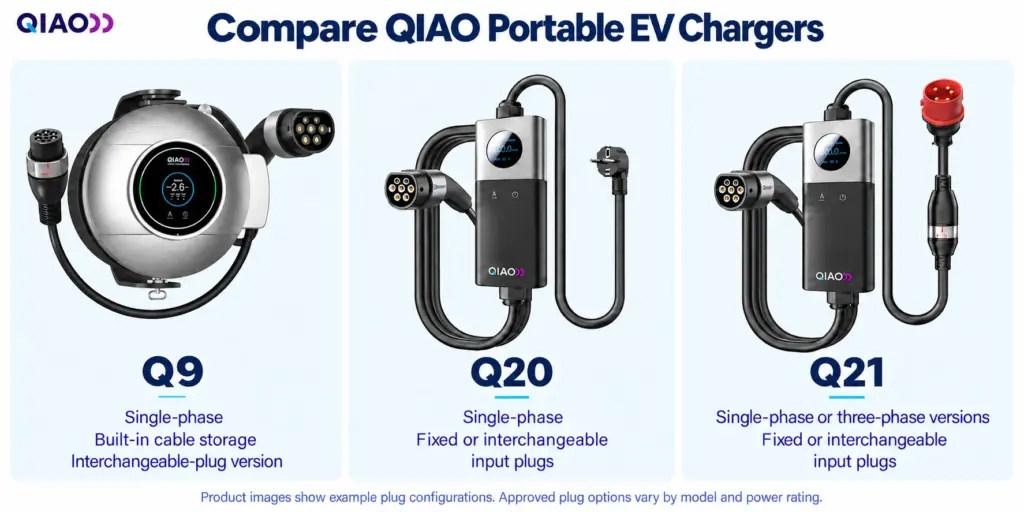
For QIAO’s European interchangeable-plug versions, input options vary by model and power rating. Q9 lists Schuko, with Blue CEE options on its 7 kW version. Q20’s 7 kW version lists Schuko and Blue CEE. Q21’s 11 kW and 22 kW versions list Schuko and Blue CEE alongside compatible Red CEE options. Check the approved plug list for the exact charger configuration before ordering; the illustration compares product series, not one charger that works with every socket.
Which Plug Should You Choose for Your Situation?
Start with the socket available where you park, then consider how often you charge and whether you need to take the charger elsewhere. Have an electrician confirm the circuit and permitted charging current before relying on any socket for EV charging.
You need an occasional top-up: A Schuko plug may be useful in much of mainland Europe if you’ve checked the household socket and circuit and set the charger to an appropriate current. Expect slow charging. In the UK, choose equipment made for a suitable BS 1363 socket instead; a Schuko plug will not fit a standard UK household socket.
You charge regularly from one parking space: If you have single-phase power, ask an electrician whether a dedicated Blue CEE socket or a fixed wall charger suits the space better. The higher-rated Blue CEE plug will only help if the circuit, local rules, charger, and car allow the higher current.
If you have access to three-phase power, a Red CEE plug may suit a compatible EV charger. Match the charger and plug to the socket’s rating. If your car charges on only one phase, it may still charge from this setup, but it will not draw power from all three phases. Check the charger’s supported inputs and your car’s AC charging limit.
You charge at several locations: A portable charger with manufacturer-approved plug options can help you use different suitable sockets. Check the socket and permitted current at each location, then use the matching plug and charger setting. Workplaces, campsites, and shared properties may also set their own charging limits.
Conclusion
Start with the socket available where you charge. Schuko may suit occasional charging from a checked household socket, while Blue CEE may suit regular charging from a properly installed single-phase socket. Red CEE requires a compatible three-phase socket and charging setup. A single-phase car may still charge through suitable equipment, but it will not draw power from all three phases.
Before choosing a plug, have the circuit checked and confirm that your charger supports the exact input plug and permitted current. A higher-rated plug alone will not make your car charge faster.
About QIAO Charger
QIAO Charger develops and manufactures AC EV chargers for home and portable use. Our portable EV chargers offer plug options for different electrical supplies, while our home EV chargers serve fixed parking spaces. The right choice starts with your socket, electrical supply, and vehicle. Check the exact model and plug combination before ordering.
We also work with distributors, retailers, and partners planning EV charging projects. If you are building a local product range or selecting chargers for a project, contact QIAO Charger about a partnership to discuss product options, documentation, supply, and project requirements.